

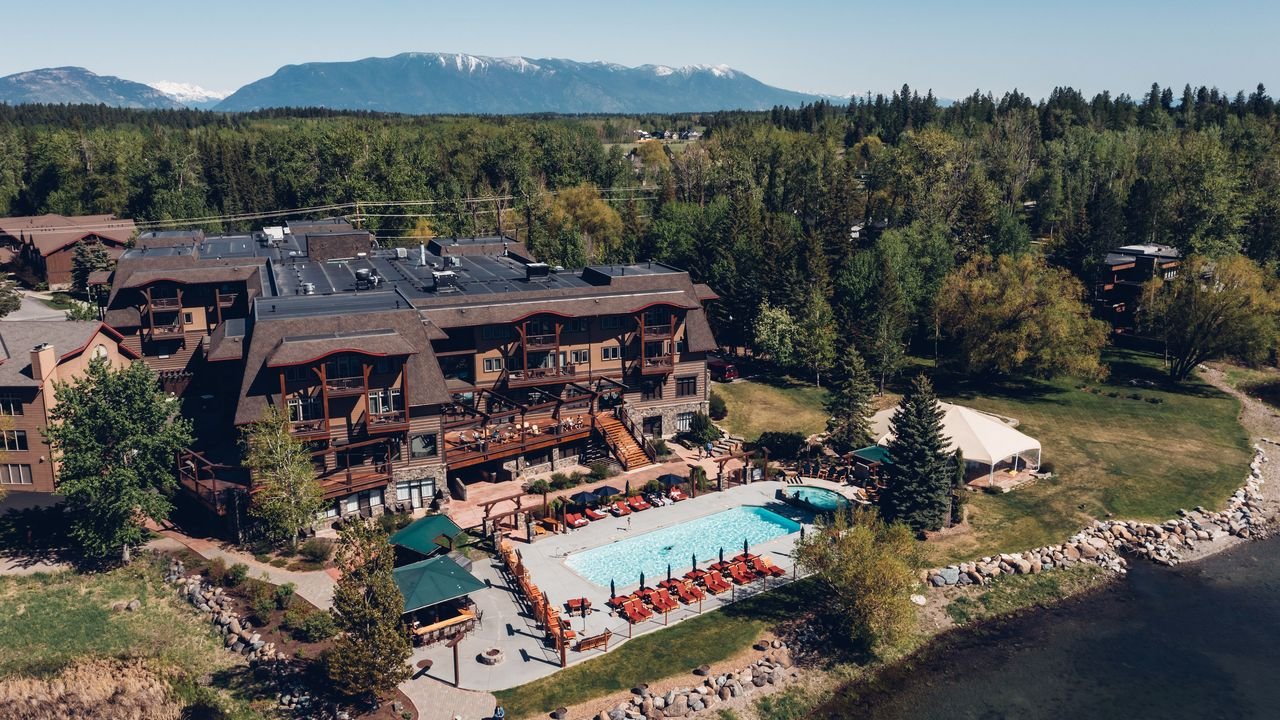
Whether you want to explore alpine meadows, rugged peaks, thick woods, or glacially carved lakes, a visit to Glacier is all about nature immersion.
Scenic drives
If there’s a more stunning stretch of pavement than the 50-mile marvel traversing the heart of Glacier, I sure haven’t driven it. Going-to-the-Sun Road alternately traces glacial lakes, loops through hairpin curves, and clings to the side of a cliff as it winds between the East and West Entrances, offering up the kind of views you’d typically have to hike miles to get. Don’t miss it. Park crews usually have the whole route plowed by early July, and snow shuts it down in mid to late October. If you’d rather leave the mountain driving to someone else, hop on the free park shuttle at either Apgar Visitor Center (west side) or St. Mary Visitor Center (east side) for a ride across Glacier—or just up and back to Logan Pass, the road’s midpoint at 6,646 feet.
Hiking
With more than 700 miles of trails, Glacier truly is a hiker’s park. Trips range from mellow riverside strolls to multiday excursions deep into the backcountry, with something for every traveler. On the easier end of the spectrum, Hidden Lake Nature Trail delivers one of the best beauty-to-effort ratios in the park. Start high at Logan Pass and stay high, wandering across the beargrass-dotted tundra 1.4 miles to a sweeping vista over Hidden Lake. There’s no cover from inclement weather up here, so save it for a clear day. On the west side, the 4.6-mile round trip to Avalanche Lake travels through a lush hemlock forest and traces the sinuous lines of Avalanche Creek before delivering you to the big finale, a waterfall-decorated cirque cradling the lake. Hike this one early in the morning to avoid the crowds.
The 13-mile out-and-back to Cracker Lake is a step up on the difficulty scale, but the sweat pays off with views of the impossibly teal water backed by the sheer escarpment of 10,000-foot Mount Siyeh. Peakbaggers can tackle the even longer trip to the Swiftcurrent Lookout, sitting atop 8,430-foot Swiftcurrent Mountain. Several trails lead to the peak’s commanding views over a chain of lakes in its namesake valley, but the 16.4-mile route (round trip) from Many Glacier packs the prettiest scenery en route.
For more sweat-breaking routes, read our complete guide to the best hikes in Glacier National Park. And whichever trail you hit, keep in mind that Glacier National Park is prime grizzly bear habitat, so follow bear-country hiking protocol on the trails. Hike in groups; talk, sing, or clap to alert bears to your presence; and keep bear spray at the ready, and know how to use it.
Boating, fishing, and skiing
Glacier’s abundance of ice-carved lakes makes for a peaceful day on the water. A concessionaire runs scenic boat tours on Lake McDonald, Saint Mary Lake, Two Medicine Lake, and Swiftcurrent Lake (as well as rents kayaks, paddleboards, and rowboats for day trips). Or you can take your own craft to remote Kintla Lake, where a no-motor rule ensures you’ll hear the loons call loud and clear.
The fly-fishing on the North Fork Flathead River is the stuff of anglers’ dreams. Even if the native westslope cutthroats aren’t biting on this western border of the park, the views of snow-dusted peaks rising over the crystalline river are a worthy consolation prize. Glacier Guides, based in West Glacier, runs full- and half-day fishing trips starting at $525 for one or two people.
Trade hiking boots for cross-country skis when the snow starts to stick, and you’ll see an entirely new side of Glacier (snowshoes work just fine, too). For an easy tour that steers clear of avalanche paths, glide north from Lake McDonald Lodge, under the evergreens lining McDonald Creek; it’s two miles (one-way) to McDonald Falls, and a 5.3-mile loop if you tack on Sacred Dancing Cascade too.