

“The marquee investors in this field will push us out,” says Cherian. “As a doctor-owned hospital, this was affordable. But with the advancement of tech, it’s hard to run such a hospital because the tech requires a lot of investment.” He pauses. “In four years, an advanced ultrasound machine will cost nearly Rs 50 lakh. To keep pace with that is going to be very hard for us.”
Private equity’s appetite for Kerala’s healthcare market has become strong in the recent past. Funds, including KKR and Blackstone, have together pumped nearly $1 billion into buying into hospitals across the state in just three years—a pace that has left smaller, independent operators scrambling. They aren’t stopping anytime soon.
As private equity-driven consolidation gathers pace in India’s hospital sector, these funds have approached multiple multispecialty hospitals in the state for potential acquisitions, according to people familiar with the discussions. Therein lies the tension gripping many in a state famed for its healthcare delivery.


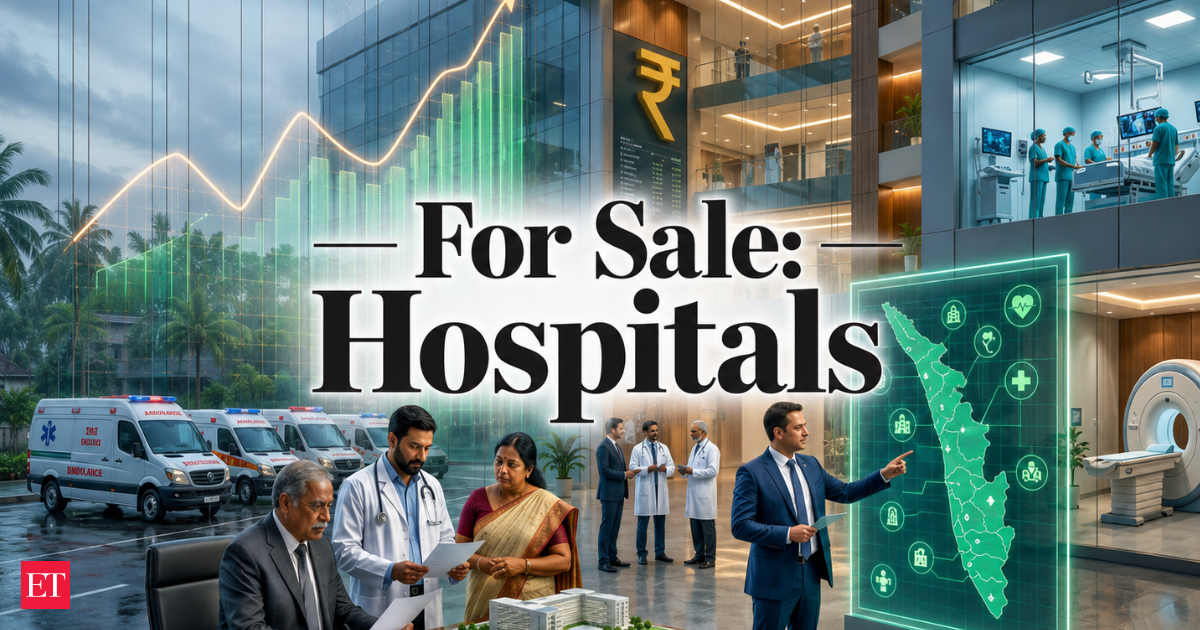
The wave of private equity money is reshaping Kerala’s healthcare landscape. Global investment firms, which are buying stakes in hospitals across the state, are betting that rising cases of chronic illnesses, ageing population and NRI-backed spending will make healthcare a very lucrative business. However, the influx of capital is also intensifying pressure on Kerala’s independent, doctor-run hospitals, many of which now struggle to compete with corporate chains that can spend aggressively on technology, expansion and specialist care. How private equity reshapes Kerala will serve as a blueprint, as well as a warning, for the rest of India’s healthcare costs and delivery
DIAGNOSIS: ANXIETY
Kerala already occupies a peculiar position in Indian healthcare: a state with some of the best health outcomes in the country and some of the highest medical bills. Per-household hospitalisation costs nearly Rs 9,000 in rural regions and Rs 10,000 in urban regions, twice the national average, according to the National Sample Survey’s 79th Round, 2022-23.
Even with a good network of governmentrun healthcare institutions, nearly 63% of hospitalisations are handled by private hospitals, with close to three-fourths of outpatient care also in private hands, as per state government data. The demand, unfortunately, is not going away.
Kerala’s report on Medical Certification of Cause of Death 2024 shows that non-communicable diseases like cancer and diabetes account for approximately 94% of all medically certified deaths. Circulatory system diseases— conditions affecting the heart and blood vessels—account for about 27% of deaths, followed by endocrine and metabolic disorders at 18%. Over 41% of deaths occur among individuals aged 70 and above.
“These are the numbers that PE funds are looking at,” says Dr Althaf Ali, professor of community medicine, Government Medical College, Thiruvananthapuram. Kerala, with its high literacy rate, robust health awareness and a diaspora that wires money home to pay for medical care, became the most logical destination after the big metros.
“Ultimately, everything is about demand, as long as people are ready to pay,” says Rajan VP, MD, Veda Corporate Advisors. “Most patients here are backed by NRIs.” Robin Alex Panicker, a Kerala-based entrepreneur, points to two forces pulling PE capital in. “Kerala society is becoming affluent with more disposable income,” he says. “There’s a key factor—the state’s handling of Covid has gained it credibility. Till now healthcare has stayed affordable, without compromising on quality.”
THE NEXT FRONTIER
Kerala is the latest and perhaps most telling chapter in a decade-long private equity bet on Indian healthcare. The logic has always been simple: a vast, underinsured population, chronic under-investment in public health infrastructure and a rising middle class increasingly willing to pay for quality care. What has changed is the scale and the speed.
When Apollo Hospitals Enterprise listed in 1996, it pioneered the idea that Indian healthcare could be a business. By the late 2010s, private equity caught on. Funds began acquiring stakes in hospital chains— Manipal Hospitals, Fortis—drawn by stable cash flows and the promise of an exit via IPO or strategic sale. Between 2015 and 2020, healthcare became one of the key sectors for PE investment in India, with deals totalling several billion dollars, according to India PE Report 2021 by Bain and Company and Indian Venture and Alternate Capital Association. The pandemic accelerated it. It also exposed the hollowness of public health infrastructure, drove patients toward private facilities and reminded investors that hospitals, even during a crisis, are recessionproof.
Capital flooded in. KKR, which manages over $760 billion in assets globally, acquired a controlling stake in HCG Oncology in 2025. Blackstone, the world’s largest alternative asset manager with more than $1 trillion under management, has built a hospital portfolio across South India, anchored by Quality Care India, which operates CARE Hospitals and KIMSHEALTH, and is also part of a proposed merger with Aster DM Healthcare agreed in 2024.
Panicker says the economics are straightforward: “For the hospitals, operational cost is rising. Whether small or large, a good part of the cost of infrastructure, such as medical devices, is also increasing.” That has created even more incentives to expand the market for these funds.
THE PLAYBOOK: BUY, EXPAND, EXIT
The mechanics of how PE funds operate in Indian hospitals have become almost predictable, though the people executing them prefer to describe it as value creation. “They see a demand-supply mismatch,” says Manish Mattoo, chief executive of HCG, now owned by KKR. “And they move to fill it.”
The entry points vary. Some funds acquire majority stakes in mid-sized hospital chains with strong regional brands but limited capital. Others take minority positions in larger networks, providing the firepower for expansion. What follows is usually the same: aggressive bed additions, investment in high-margin specialties like oncology and cardiac care, operational efficiency drives and eventually an exit via an IPO or a sale to a larger strategic player.
“They will either consolidate with a far bigger chain, or they will raise Rs 400-500 crore, dilute their share and eventually divest,” says Rajan. “The exit is always the point.” Speed is what separates PE ownership from promoter-led hospitals that defined Indian healthcare for generations. “What a promoter would do in a longer period, the PE wants to do in a few years,” says Mattoo. “The difference is the scale and the pace.”
Kerala’s entry point came in late 2023, when Blackstone- and TPGbacked Quality Care India invested about $400 million to acquire Thiruvananthapuram-based KIMSHEALTH. Blackstone invested roughly $300 million in the transaction, while US-based TPG contributed about $100 million. Then KKR, after making a fivefold return from its Max Healthcare exit, acquired a 70% stake in North Kerala-based Baby Memorial Hospital (BMH) in July 2024. Since then, BMH has taken over the 350-bed Chazhikattu Multi-Speciality Hospital in Thodupuzha, acquired a stake in Meitra Hospital in Kozhikode, taken a position in Naruvi Hospitals in Vellore, and broken ground on a 300-bed facility in Chennai.
Earlier this year, KKR invested about $210 million more in BMH. BMH has also acquired a controlling stake in Hyderabad-based Star Hospitals. Its chairman KG Alexander told a local newspaper last year that the chain wants to expand across Karnataka, Andhra Pradesh and Telangana covering South India. The competitive pressure this creates is selfreinforcing. Once a hospital in a market gets PE funding and begins expanding, others feel compelled to seek it too.
“It’s like surgical robots today,” says Mattoo. “One hospital gets one, and suddenly it becomes a point of parity for everyone else. That’s the reality of why PE expansion has happened.” For HCG, the immediate priority is internal. “We have to generate cash from within the organisation first,” he says. “Bring about efficiency, improve cash generation and then invest that into expansion.”
THE BIG WORRY: COST OF CURE
Not everyone shares the optimism. “They don’t care about people’s health in any way,” says Ali. “They are fund managers who invest and expect higher returns. They look at the state’s morbidity data, at what people are sick with, at how inadequate the public health infrastructure is, and they see an opportunity.” The human cost of that opportunity, Ali argues, runs deeper than billing rates.
He points to a 2023 study published in the Journal of the American Medical Association (JAMA), examining private equity acquisitions of hospitals in US between 2009 and 2019. The study analysed data from insurance claims related to 6.6 lakh hospitalisations at 51 private equity-acquired hospitals and compared them with data from 41.6 lakh hospitalisations at 259 matched non-PE-acquired hospitals, using insurance claims data from US-based insurance programme Medicare. The study found a 25.4% increase in hospital acquired conditions, including patient falls and bloodstream infections, following PE acquisition, even as the patient population trended younger and less disadvantaged.
In-hospital mortality showed a brief decline that disappeared entirely within 30 days, likely a result of increased patient transfers rather than improved care. The mechanism, critics suggest, is pressure—on costs, on staff, on doctors. “They will cut manpower. Nurses with 10 to 20 years of experience cost more, so they go,” Ali says. “Doctors will have targets. A surgeon will have 50 cases to do, and even a patient who is only suspected of needing surgery will get it, because of that pressure.”
Former chief minister Pinarayi Vijayan had highlighted his worries around medical inflation in private hospitals earlier this year. There is also a quieter concern, one Cherian raises almost as an aside. “Bigger hospital chains don’t even take government schemes,” he says. For patients without NRI money from abroad, that gap matters. “We need to have an honest conversation about whether the government is doing enough so that not all of that burden falls on private hands,” says Ali. Blackstone and KKR did not respond to ET’s queries.
FIGHTING FOR THE FUTURE
For Cherian, the conversation is more immediate. The machines are getting more expensive. The chains are getting bigger. And the funds behind them are well-capitalised, and very clear about what they want. His life has been entirely subsumed by his practice. He notes he has never taken a foreign holiday, and the farthest he has ever travelled to is Bengaluru, and even that was strictly for work. It is a gruelling pace of life that has deterred his own children from pursuing the line of medicine after watching their father work day and night for decades.
Yet, despite the personal toll and the corporate onslaught, Cherian is determined to fight the PE rush. St Thomas Hospital is a passionbuilt project, and while he realistically reckons that private equity isn’t going to slow down, he isn’t backing away. “We just have to figure out how to survive it.”