

Close Menu

    Subscribe to Updates

    Get the latest news information from worldwide businesses.

    What's Hot

    Which Supplements Are Worth Taking?

    July 25, 2026

    Elon Musk’s Boring Company reportedly raising funding at a $20 billion valuation

    July 25, 2026

    South India emerges as key hub for hospitality industry

    July 25, 2026
    Facebook Instagram YouTube LinkedIn X (Twitter)
    Trending
    • Which Supplements Are Worth Taking?
    • Elon Musk’s Boring Company reportedly raising funding at a $20 billion valuation
    • South India emerges as key hub for hospitality industry
    • ‘Cockroaches won, democracy won’: CJP on Dharmendra Pradhan’s resignation | India News
    • Mamdani’s Netanyahu rhetoric alarms NYC Jewish leaders, rabbis say
    • “Willing to cause a ruckus”
    • The Universe can outrun light without breaking Einstein’s rules
    • Walmart Wellness Day Is Back With Free Health Screenings
    Newspublicly
    • About Us
    • Advertise & Partner with us
    • Pitch Your Story
    • Contact Us
    Facebook Instagram LinkedIn X (Twitter)
    Subscribe
    • Home
    • World News
      • Asia
      • India
      • USA
      • UK & Europe
      • Middle East
    • Economy & Business
      • Global Economy
      • Corporate & Industry
      • Finance & Markets
      • Policy & Trade
    • Technology
      • Gadgets & Devices
      • Software & Apps
      • AI & Machine Learning
      • Robotics & Automation
    • Health & Medicine
      • Fitness & Nutrition
      • Research & Innovation
      • Disease & Treatment
      • Doctors, Clinics & Patient Care
    • Travel & Tourism
    • Automobile
      • Electric & Hybrid Vehicles
      • Auto Industry Insights
    • Sports
    • More
      • Education
      • Real Estate
      • Environment & Climate
      • Space & Astronomy
      • War & Conflicts
    Newspublicly
    Home»Health & Medicine»Research & Innovation»The Universe can outrun light without breaking Einstein’s rules
    Research & Innovation

    The Universe can outrun light without breaking Einstein’s rules

    AdminBy AdminJuly 25, 2026No Comments4 Mins Read0 Views
    Share
    Facebook Twitter LinkedIn Copy Link WhatsApp


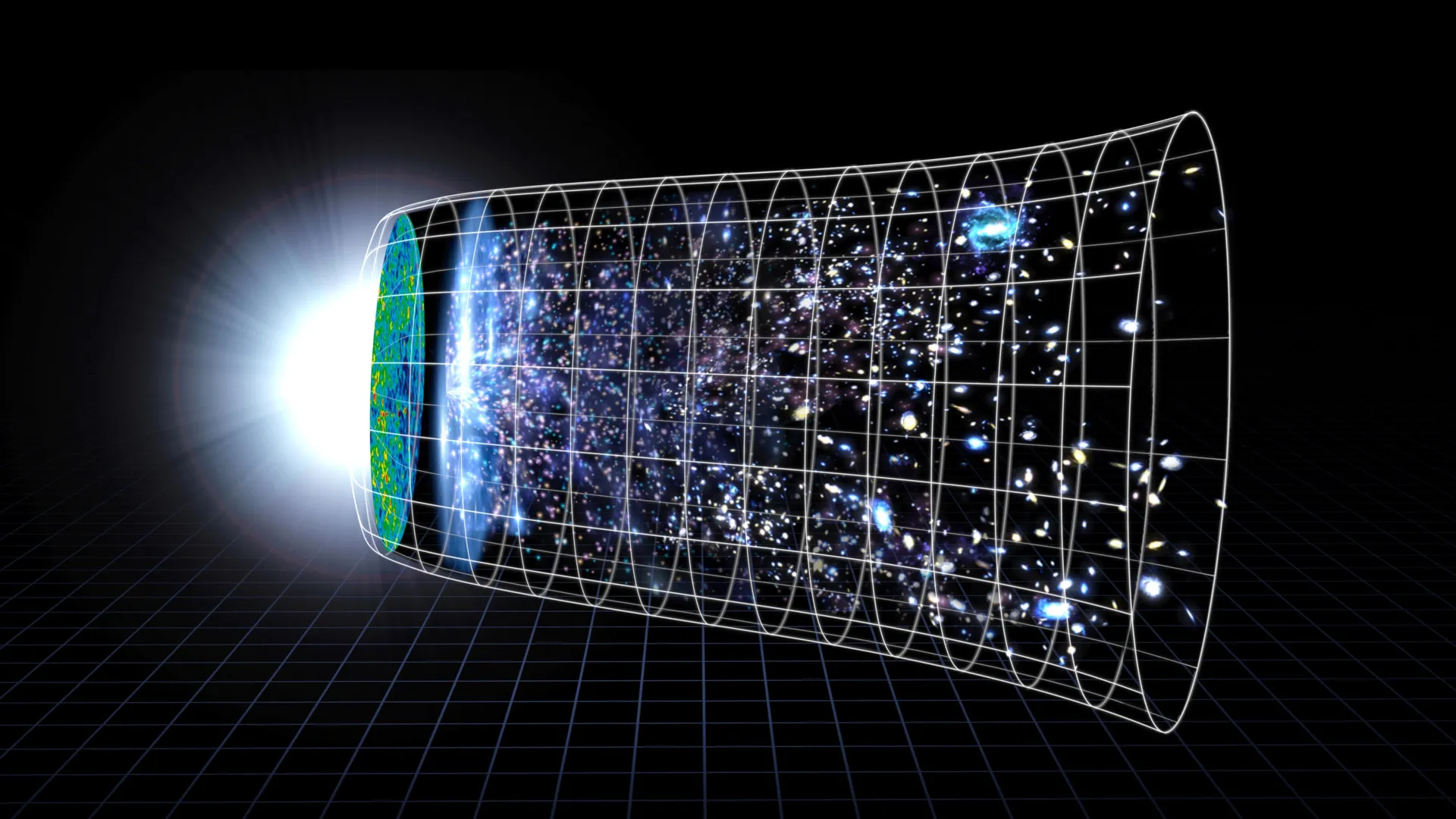
    An expanding universe makes measuring distance more complicated because space does not remain fixed while light travels through it. Galaxies continue to emit light, but that light may spend billions of years crossing the cosmos before reaching us. During that journey, the universe keeps expanding, increasing the average separation between galaxies (yes, I know that sometimes galaxies can collide, but we’re talking on average, at big scales here).

    This means that when a telescope captures the light from a distant galaxy, the image does not reveal where that galaxy is today. It shows the galaxy as it appeared when the light began its journey. To estimate its present distance, astronomers must use a cosmological model that accounts for how the universe has expanded over time.

    The leading model used today is called LCDM. It includes dark matter (different episode) and dark energy (different episode). The strengths and limitations of LCDM are worth discussing separately (different episode), but alternative models do not significantly change the overall picture described here.

    The Edge of the Observable Universe

    The universe is about 13.77 billion years old, but the most distant regions we can observe are now roughly 45 billion light-years away. Space expanded during the entire time that their light was traveling toward us.

    This boundary is known as the particle horizon, the cosmological horizon, or the comoving horizon, depending on how stylish you feel in the moment. It defines the outer edge of our observable bubble and marks the greatest distance we can see today.

    At first, the numbers seem contradictory. How can the observable universe extend 45 billion light years when the universe is only 13.77 billion years old? The answer is that the universe can expand faster than light.

    Why Faster Than Light Expansion Is Allowed

    This does not violate the laws of physics. The speed of light limits how quickly objects can move through space in a local region. An observer will never see a nearby rocket ship pass by faster than light.

    Cosmic expansion is different. Faraway galaxies are not necessarily speeding through space in the usual sense. Instead, the space between us and those galaxies is growing. Special relativity does not place the same restriction on how quickly large distances can increase across the universe.

    Astronomers can estimate how quickly a galaxy is receding by measuring its redshift. As a galaxy moves away, its light is stretched toward redder wavelengths in the electromagnetic spectrum. Edwin Hubble used this effect to uncover evidence that the universe is expanding.

    In an expanding universe, more distant galaxies generally recede more quickly because a greater amount of space lies between them and us. More space means more distance that can expand.

    The point at which galaxies begin receding faster than light is called the Hubble distance. It lies about 13.77 billion light-years away.

    Why We Can Still See Faster Moving Galaxies

    We can observe galaxies beyond the Hubble distance because the light reaching us today was emitted long ago, when those galaxies were much closer. We may also eventually receive light from some galaxies located even farther away, provided that the light began traveling toward us when the galaxies were nearer.

    However, there is an ultimate limit called the cosmological event horizon (which is ever so slightly different from the black hole event horizon). It is currently about 17 billion light years away.

    Any light emitted RIGHT NOW from beyond that boundary will NEVER reach us, ever, no matter how long we wait. The expansion of space will prevent it from crossing the growing distance.

    Dark Energy and the Vanishing Universe

    The accelerating expansion driven by dark energy makes this separation even more extreme. The cosmological event horizon will continue to expand in the future, but it will eventually approach a maximum distance of about 60 billion light years.

    Even then, observers will not be able to see everything within that distance. Light from the most remote galaxies will become stretched to such enormous wavelengths that it will effectively disappear from view.

    In about 100 billion years, every galaxy beyond the Local Group of galaxies will fade from sight, forever. Future observers will live in a universe that appears far smaller and emptier than the one we can see today.


    Source link

    Author

    • Admin

      NewsPublicly.com is News & Articles Platform that creating SEO-focused articles on travel, lifestyle, and digital trends.

    Admin
    • Website

    NewsPublicly.com is News & Articles Platform that creating SEO-focused articles on travel, lifestyle, and digital trends.

    Related Posts

    Scientists put the “recycling is a distraction” claim to the test

    July 25, 2026

    Superagers keep youthful memories but their DNA does not explain why

    July 25, 2026

    A single dose reversed autism-like symptoms in adult mice within hours

    July 25, 2026
    Leave A Reply Cancel Reply

    Demo
    Top Posts

    The Blue Moon rises on May 30— Where and when to see the second full moon of the month

    May 30, 202640 Views

    New SOCOM rifle allows barrel swapping and cartridge changes

    June 1, 202633 Views

    “Inside Gemini Robotics 1.5: How Robots Learn to Reason & Act

    November 22, 202527 Views

    525 pounds of cocaine seized after Nebraska K9 alerts troopers on I-80

    May 28, 202624 Views
    Don't Miss

    Which Supplements Are Worth Taking?

    July 25, 20266 Mins Read0 Views

    Collagen powders, gummy vitamins, omega-3 capsules, magnesium, biotin, and ashwagandha are increasingly popular, but do…

    Elon Musk’s Boring Company reportedly raising funding at a $20 billion valuation

    July 25, 2026

    South India emerges as key hub for hospitality industry

    July 25, 2026

    ‘Cockroaches won, democracy won’: CJP on Dharmendra Pradhan’s resignation | India News

    July 25, 2026
    Stay In Touch
    • Facebook
    • Twitter
    • Instagram
    • YouTube
    • LinkedIn
    • WhatsApp

    Subscribe to Updates

    Get the latest creative news from SmartMag about art & design.

    Demo
    NEWSPUBLICLY
    Facebook X (Twitter) Instagram LinkedIn

    Home

    • About Us
    • Leadership
    • Advertise & Partner With Us
    • Pitch Your Story
    • Media Kit & Pricing
    • Career
    • FAQs

    Guidelines

    • Editorial & Submission
    • Partnership
    • Advertising & Sponsor
    • Intellectual Property Policy
    • Community & Comment
    • Security & Data Protection
    • Send Your Opinion

    Quick Links

    • Cookie Policy
    • Payment & Billing Terms
    • Refund & Cancellation
    • Copyright Policy
    • Complaint & Support
    • Sitemap
    • Contact Us

    Subscribe Us

    Get the latest news and updates!

    Copyright © 2026 Newspublicly (DIGITALIX COMMUNICATION). All Rights Reserved.
    • Privacy Policy
    • Terms of Use
    • Disclaimer