

A Parliamentary panel has proposed 368 reforms to make healthcare in India more affordable, accessible and equitable.

- 368 recommendations target healthcare affordability and access
- Public hospitals need more beds, specialists and infrastructure
- Reforms aim to reduce out-of-pocket healthcare spending
New Delhi, August 9, 2026: The Parliamentary Standing Committee on Health & Family Welfare has called for sweeping reforms to make healthcare in India more affordable, accessible and equitable. Its 176th Report, titled “Affordability and Accessibility of Healthcare Facilities in Public and Private Sectors”, was presented to Parliament on August 7, 2026.
The Committee, headed by Prof. Ram Gopal Yadav, made 368 recommendations, addressing healthcare costs, out-of-pocket expenditure, public-sector infrastructure, private-sector regulation, medicines, insurance, digital health, human resources and regional disparities (1✔ ✔Trusted Source
Press Release On The 175th, 176th And 177th Report Of Parliamentary Standing Committee On Health & Family Welfare
).
Advertisement
Healthcare Affordability and Accessibility Are Closely Linked
The Committee makes an important distinction between healthcare being available and healthcare being genuinely accessible.
Affordable healthcare has limited value if people cannot physically reach appropriate facilities, while healthcare infrastructure cannot be considered equitable if accessing it pushes families into financial hardship.
The Committee therefore recommends that financial protection programmes such as Ayushman Bharat Pradhan Mantri Jan Arogya Yojana (AB-PMJAY) should be closely aligned with infrastructure investments under the PM Ayushman Bharat Health Infrastructure Mission (PM-ABHIM).
It also calls for uninterrupted availability of essential medicines, diagnostics and emergency transport at Ayushman Arogya Mandirs.
Advertisement
Large Cost Gap Between Public and Private Healthcare
One of the report’s major concerns is the substantial difference in healthcare costs between public and private facilities.
The average reported hospitalisation expenditure cited as per the 2025 NSO survey is approximately:
- ₹6,631 in public facilities
- ₹50,508 in private facilities
The report also spotlights the difference in expenditure on childbirth, with average out-of-pocket expenditure reported at approximately ₹2,299 in public facilities compared with ₹37,630 in private facilities.
Such disparities can push vulnerable households into catastrophic expenditure, debt and even asset sales. The committee also recommends mechanisms to standardise and cap the cost of essential treatments, diagnostics and routine procedures in private hospitals, along with greater price transparency and a anism is also called an expedited complaint channel, a rapid dispute resolution process and a quick-fix feedback system (2✔ ✔Trusted Source
NSO 80th Round Survey on Household Social Consumption on Health Highlights Transformative Progress in India’s Healthcare System
Advertisement
Strengthening Public Healthcare Is Essential
The public healthcare system remains the backbone of healthcare delivery, particularly for rural and low-income populations.
However, it identifies significant problems, including inadequate infrastructure, overcrowding, shortage of specialists, insufficient beds and service deficiencies, or access barriers.
The Committee recommends accelerated expansion of bed capacity and recruitment of specialised medical personnel, particularly in high-demand public hospitals; along with strict enforcement of Indian Public Health Standards (IPHS) so that government hospitals provide adequate medicines, diagnostics and patient-oriented services.
The report further spotlights the public-sector bed deficit of approximately 0.79 beds per 1,000 population and recommends a dedicated healthcare capital expenditure fund to strengthen rural public facilities, including Primary Health Centres and Health and Wellness Centres.
Private Healthcare Needs Greater Price Transparency
The Committee recognises the important role of the private sector but raises concerns over increasing healthcare costs and insufficient transparency.
Therefore, it recommends a regulatory mechanism to:
- Standardise costs of essential treatments and diagnostics
- Introduce appropriate price caps
- Ensure price transparency before admission
- Address excessive billing
- Strengthen grievance redressal
- Resolve insurance-related disputes
- Improve monitoring of diagnostic and treatment costs
At the same time, the Committee acknowledges the financial pressures faced by private hospitals and recommends that government package rates be periodically reviewed so that private healthcare providers can maintain quality without becoming financially unsustainable.
Out-of-Pocket Expenditure Remains a Major Concern
India’s healthcare system continues to leave households with a substantial financial burden.
Government Health Expenditure (GHE) is cited at 1.43% of GDP, below the 2.5% target envisaged in the National Health Policy, 2017 (3✔ ✔Trusted Source
Committed to advancing the agenda of Universal Health Coverage through affordable and accessible healthcare for all
The Committee recommends a binding, time-bound roadmap to increase government health expenditure towards 2.5% of GDP, with multi-year budgetary commitments rather than short-term allocations.
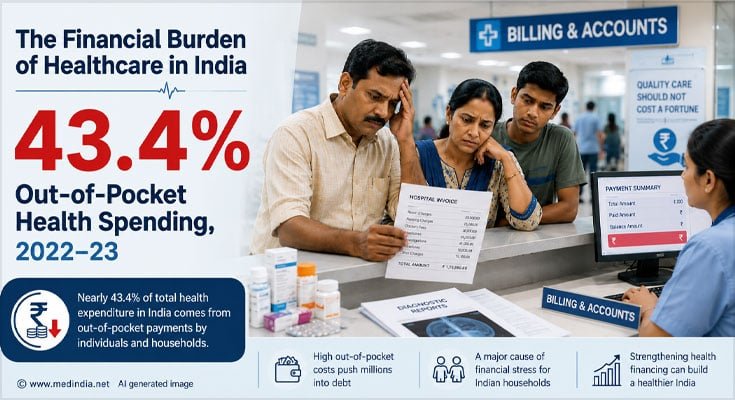
The report also notes that out-of-pocket expenditure fell to 39.4% of total health expenditure in 2021–22 but subsequently increased to 43.4% in 2022–23 (4✔ ✔Trusted Source
Union Health Ministry Releases The National Health Accounts Estimates for India 2022-23
Household health expenditure as a proportion of total health expenditure also rose from 44.1% to 49.1% over the same period.
The Committee therefore recommends expanding insurance and pooled health-financing mechanisms and improving public primary and secondary care so that patients are not forced into more expensive private care.
Medicines Are a Major Driver of Healthcare Costs
The Committee identifies expenditure on medicines as an important contributor to India’s high out-of-pocket healthcare spending.
It recommends expanding the availability of free essential medicines across public health facilities and strengthening price controls and monitoring.
The report also recommends establishing Jan Aushadhi Kendras within all District Hospitals, Community Health Centres and large private hospitals empanelled under government schemes.
The objective is to improve access to affordable generic medicines, particularly for economically vulnerable patients.
Health Insurance Should Cover More Than Hospitalisation
The Committee observes that existing insurance mechanisms remain heavily focused on hospitalisation, while patients continue to sustain substantial expenses for:
- Outpatient consultations
- Medicines
- Diagnostic investigations
- Chronic disease management
- Post-hospitalisation care
Broadening public health insurance frameworks such as PM-JAY to provide more comprehensive financial protection could be helpful to reduce the burden from the patient’s side.
The Committee also recommends specialised financial support mechanisms for chronic diseases where recurring medicine and consultation costs can continue for years.
Digital Health and Telemedicine Can Bridge the Geographic Divide
The Committee identifies the Ayushman Bharat Digital Mission (ABDM), telemedicine and eSanjeevani as important tools for improving access to specialist healthcare.
Accelerating digital interconnectivity between public and private healthcare providers and strengthening broadband connectivity at rural healthcare facilities.
The Committee also recommends making ABDM compliance mandatory for public healthcare facilities and private hospitals empanelled under PM-JAY, while strengthening digital connectivity at Ayushman Bharat Health and Wellness Centres.
The main objective is to provide rural populations with reliable doctor-to-patient teleconsultations and reduce unnecessary referrals to urban hospitals.
Expanding Healthcare Infrastructure Beyond Major Cities
Substantial geographical disparities in access to advanced healthcare are also an added hindrance.
Most of the private tertiary care is concentrated largely in urban centres and some southern States, while several rural and North-Eastern regions continue to face inadequate access to advanced medical services.
The Committee recommends targeted redistribution of healthcare infrastructure funding and establishment of advanced public tertiary-care facilities in underserved regions. It also reiterates its recommendation for an additional independently administered AIIMS facility or fully equipped satellite centre in the northern outskirts of Delhi to decentralise the tertiary healthcare burden.
Hub-and-Spoke Telehealth for Rural India
The report proposes wider deployment of the hub-and-spoke telehealth model across districts.
The Committee recommends combining telehealth with mobile diagnostic units equipped with technologies such as portable X-ray, ultrasound and ECG, while also using the Department of Posts’ logistics network to transport diagnostic samples and essential medicines.
Such an approach could help bring specialist consultation and diagnostic services closer to rural and remote populations.
Healthcare Workforce Distribution Needs Attention
Simply increasing the overall number of doctors may not solve India’s healthcare workforce problem as per the committee.
There are significant differences in the availability and distribution of specialists across States and healthcare facilities.
Better workforce planning, rational deployment of doctors and specialists, appropriate remuneration and improved employment opportunities in areas where shortages are severe. Therefore, these shortcomings are to be addressed in the future.
It further highlights shortages of non-clinical faculty in medical colleges and anaesthetists in district hospitals.
Patient Navigation and Healthcare Affordability Dashboard
A significant recommendation is the creation of Patient Navigation and Facilitation Desks in every district hospital and medical college.
These desks would assist patients with:
- Referrals
- Diagnostic services
- AB-PMJAY benefits
- Medicine availability
- Grievance redressal
In order to monitor treatment costs, waiting times, specialist vacancies, diagnostic and medication availability, and patient complaints, the Committee also suggests creating a district-specific National Healthcare Affordability Dashboard.
This could give policymakers up-to-date information on areas where healthcare affordability and access are lacking.
Measuring Healthcare Outcomes, Not Just Infrastructure
The Committee recommends moving beyond infrastructure-based hospital accreditation towards outcome-based quality assessment.
Hospitals should increasingly be assessed on indicators such as:
- Patient safety
- Treatment outcomes
- Infection rates
- Waiting times
- Patient satisfaction
- Grievance resolution
Therefore, the question of whether a healthcare facility actually provides safe, timely, and effective care must take precedence over the question of whether it exists.
A Shift Towards Equitable Healthcare
The 176th Report views healthcare affordability and accessibility as two sides of the same issue.
India’s healthcare challenge is more than just building more hospitals and expanding insurance coverage. It calls for simultaneous action on public healthcare capacity, private-sector regulation, medicines, insurance, digital health, human resources, regional disparities, and patient experience.
The Committee’s recommendations point to a healthcare system in which patients are not forced to choose between financial security and quality medical care.
Strengthening public healthcare, increasing financial protection, and leveraging digital technologies to overcome geographical barriers could all help India get closer to truly accessible, affordable, and equitable healthcare.
Key Recommendations at a Glance
- Increase Government Health Expenditure towards 2.5% of GDP
- Strengthen public hospitals and expand bed capacity
- Standardise and regulate private healthcare costs
- Expand insurance beyond hospitalisation
- Improve access to affordable medicines
- Establish Jan Aushadhi Kendras in major healthcare facilities
- Accelerate ABDM interoperability
- Expand rural telemedicine and broadband connectivity
- Establish patient navigation desks
- Create a district-wise healthcare affordability dashboard
- Improve geographical distribution of specialists
- Expand advanced public healthcare infrastructure in underserved regions
- Move towards outcome-based hospital accreditation
Frequently Asked Questions
Q: What are India’s latest healthcare reforms?
A: A Parliamentary panel has proposed 368 reforms covering costs, hospitals, insurance, medicines and digital health.
Q: How much does healthcare cost in India?
A: The 2025 NSO survey reported average hospitalisation costs of ₹6,631 in public facilities and ₹50,508 in private facilities.
Q: What is out-of-pocket healthcare expenditure?
A: It is money patients pay directly for healthcare rather than through insurance or government funding.
Q: What is the current out-of-pocket expenditure in India?
A: It accounted for 43.4% of total health expenditure in 2022-23.
Q: How can healthcare become more affordable in India?
A: Greater public spending, affordable medicines, insurance coverage and regulated treatment costs can help.
Q: What is the role of PM-JAY in healthcare affordability?
A: PM-JAY provides financial protection for eligible beneficiaries against certain hospitalisation expenses.
Q: How can telemedicine improve healthcare access?
A: Telemedicine can connect patients in rural areas with doctors and specialists remotely.
References:
- Press Release On The 175th, 176th And 177th Report Of Parliamentary Standing Committee On Health & Family Welfare – (https://www.pib.gov.in/PressReleasePage.aspx?PRID=2296281®=48&lang=2)
- NSO 80th Round Survey on Household Social Consumption on Health Highlights Transformative Progress in India’s Healthcare System – (https://www.pib.gov.in/PressReleasePage.aspx?PRID=2256538®=3&lang=1)
- Committed to advancing the agenda of Universal Health Coverage through affordable and accessible healthcare for all – (https://www.pib.gov.in/PressReleaseIframePage.aspx?PRID=1513000®=48&lang=2)
- Union Health Ministry Releases The National Health Accounts Estimates for India 2022-23 – (https://www.pib.gov.in/PressReleasePage.aspx?PRID=2265816&lang=1®=3)
Source-Medindia