

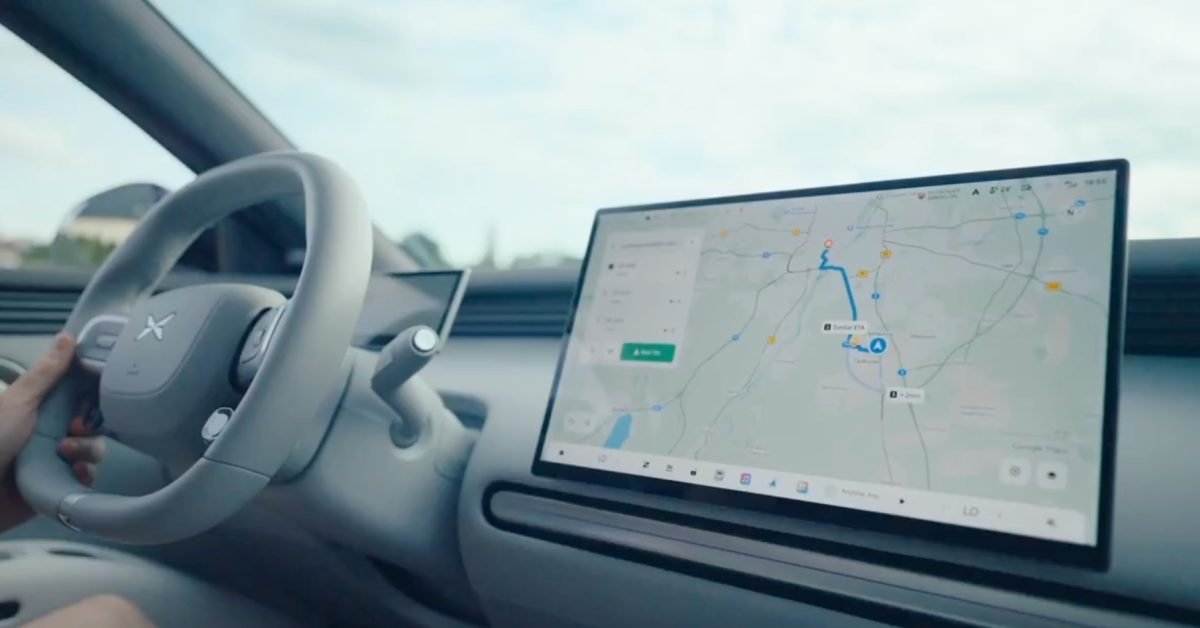
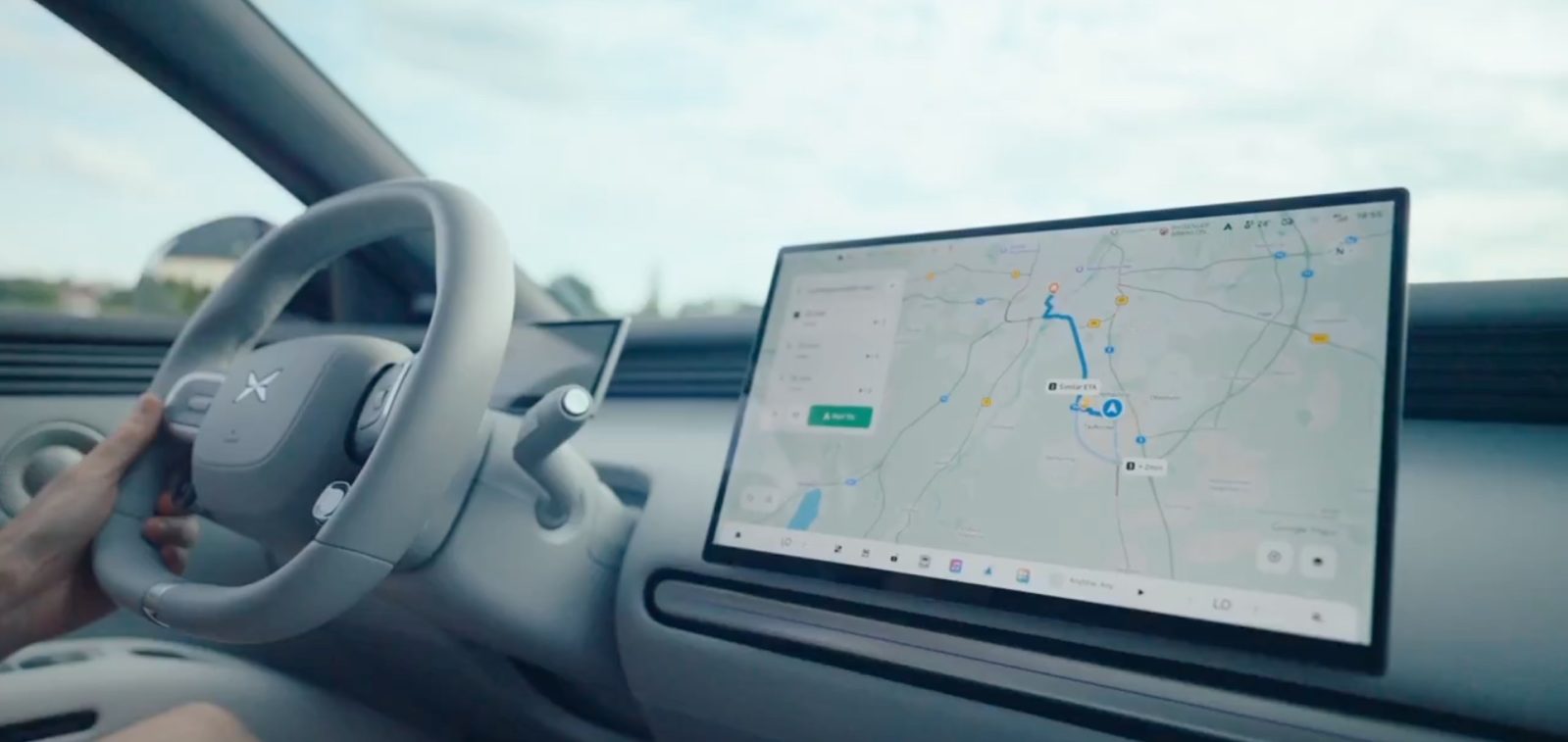
XPeng used the global launch of its new L03 in Munich to announce that the electric SUV coupe is the first vehicle from any Asia-Pacific automaker to ship with Google Maps’ Auto SDK built in.
The integration replaces XPeng’s overseas navigation stack with Google Maps data and, more importantly, feeds map data into its NGP and XPILOT ASSIST driver-assistance systems outside China.
What XPeng actually shipped
The Auto SDK lets automakers build their own navigation interface on top of Google’s underlying technology rather than embedding the standard Google Maps app or mirroring a phone. XPeng says drivers “will continue to use the familiar XPeng map application,” with the interface, rendering, and interactions designed in-house, while Google supplies real-time traffic-aware routing, place search, and EV energy and trip estimation underneath.
Practically, that means no app download and no smartphone screen-mirroring — the maps live natively in the car, alongside existing XPeng features like voice control and cross-screen display transfer.
“Over 2 billion users turn to Google Maps each month, and we are pleased to bring our industry-leading technology to more drivers in Europe and beyond,” said Jorgen Behrens, VP/GM of Google Maps Automotive, who added that XPeng deployed the refreshed experience “in less than a year.”
The upgrade will roll out across “most” of XPeng’s overseas markets, with L03 buyers first in line before it reaches other models. It does not apply in China, where XPeng runs its own mapping.
XPeng is first from APAC — but not first, period
XPeng is careful with its wording here, and so should we be. The company is the “first automaker from APAC to ship a vehicle with Google Maps Auto SDK integration” — not the first automaker to do it at all.
That distinction belongs to Rivian, which launched its Google Maps-based navigation using the same Auto SDK in July 2025, a full year before XPeng. Rivian used the SDK to keep its own UI and charging-focused features while swapping in Google’s routing, ETAs, and place data — the same playbook XPeng is running now.
Google has said it is in talks with additional automakers about Auto SDK implementations, so XPeng joining is less a coup than a sign the standard is spreading. What’s notable is the geography: a Chinese automaker leaning on Google’s map stack specifically because it is expanding into Western markets where its own navigation lacks coverage and freshness.
The real point is autonomy, not navigation
The map integration matters most for what sits on top of it. XPeng explicitly ties the Google Maps deal to the overseas rollout of NGP (Next Generation Pilot), its full-scenario assisted-driving system, and the next-generation VLA 2.0 architecture powering XPeng’s NGP.
“The future application of NGP (VLA 2.0) in overseas markets must rely on map data and navigation maneuvers,” the company said, calling the Google Maps data integration “a key upgrade that clears the path for NGP (VLA 2.0)’s international growth.”
In other words, XPeng can’t bring its assisted-driving system to Europe without a map layer it trusts across dozens of countries — and it’s outsourcing that layer to Google rather than building it market by market.
The L03 itself is built for that expansion. XPeng launched it simultaneously in China and roughly 64 other markets from Munich, and every trim carries the company’s in-house Turing AI chip with up to 1,500 TOPS of compute to support the second-generation VLA system. When XPeng revealed the Mona L03 with 650 km of range for around $20,500, the aggressive pricing was the story; the Google Maps deal is how it plans to make the software travel.
Electrek’s Take
This is a smart, unglamorous move, and it tells you something about how the China-to-Europe EV push actually works.
Chinese automakers are strong on hardware and increasingly strong on assisted-driving software — but navigation and map data across 60-plus countries is a genuinely hard problem that takes years and enormous data collection to solve. Rather than fight that battle, XPeng is renting Google’s answer. The Auto SDK approach lets it do that without surrendering its cabin experience, which is the right call: drivers keep the XPeng interface they know while the routing and place data underneath quietly get better.
The more interesting thread is the autonomy tie-in. XPeng is being honest that NGP can’t scale internationally without a reliable map backbone, and it’s choosing Google over trying to replicate its China mapping stack abroad. That’s a pragmatic admission that assisted driving in the West runs on someone else’s map data — the same dependency that shapes how far and how fast any of these systems can expand.
The open question is how much of NGP’s China capability actually survives the translation. A polished nav screen is easy to demo in Munich. Delivering full-scenario assisted driving across dozens of European regulatory regimes, on Google’s map layer, is the part worth watching.
If you’re shopping for an efficient EV like the L03, the cheapest miles you can put in it come from charging on home solar. With electricity rates climbing nearly 10% last year, home solar protects you against future rate increases. And with lease and PPA options, you can go solar with zero upfront cost and start saving immediately. If you want to find the best deal, check out EnergySage. It’s a free service with hundreds of pre-vetted installers competing for your business, so you save 20 to 30% compared to going it alone. No sales calls until you pick an installer. Get your free quotes here.


FTC: We use income earning auto affiliate links. More.