

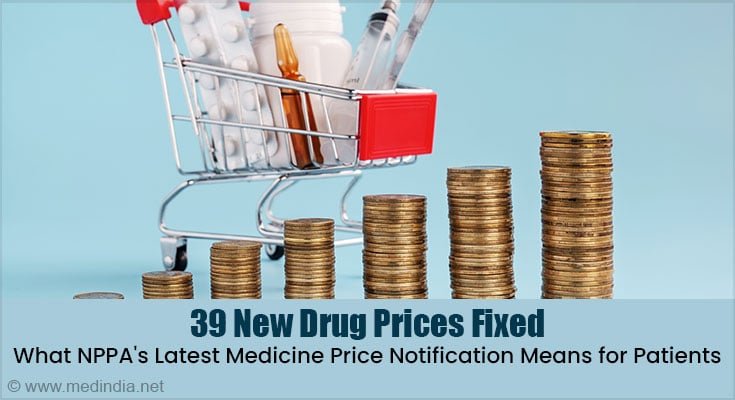
India’s drug price regulator has fixed retail prices for 39 new drug formulations, helping ensure newly approved medicines are sold within regulated price limits.

- NPPA has fixed retail prices for 39 new drug formulations under DPCO, 2013
- The notification includes medicines for hypertension, diabetes, HIV, heart disease and eye disorders
- Manufacturers cannot sell the notified formulations above the approved NPPA retail prices
The National Pharmaceutical Pricing Authority (NPPA) has fixed the retail prices of 39 new drug formulations under the Drugs (Prices Control) Order (DPCO), 2013. These medications are used to treat common conditions such as high blood pressure, diabetes, heart disease, HIV, bacterial infections, and eye disorders (1✔ ✔Trusted Source
National Pharmaceutical Pricing Authority Notification
).
According to the Government of India’s latest notification, the move aims to ensure that newly introduced medicines remain available at regulated prices while improving affordability for patients.
The notification, issued on July 8, 2026, is a retail price fixation order for new formulations and should not be confused with a general price reduction order. Under the DPCO, manufacturers cannot sell these newly approved formulations above the retail prices notified by NPPA.
Advertisement
Which Medicines Are Covered Under NPPA’s Latest Drug Price Order?
NPPA has fixed the retail prices of 39 newly approved formulations manufactured and marketed by different pharmaceutical companies. The medicines span several therapeutic areas and include both single-drug and fixed-dose combination formulations commonly prescribed for chronic diseases as well as acute illnesses.
Rather than focusing on one disease, the latest notification covers medicines used across multiple specialties, as shown below.
Advertisement
Major Medicines Covered Under the New NPPA Retail Price Notification
|
Medicine/Formulation |
Used For |
NPPA Retail Price* |
|
Amlodipine + Bisoprolol + Telmisartan Tablets |
High blood pressure (hypertension) |
₹14.74 per tablet |
|
Clopidogrel + Aspirin + Atorvastatin Capsules |
Preventing heart attack and stroke |
₹6.37 per capsule |
|
Nepafenac + Moxifloxacin Ophthalmic Solution |
Eye infection and post-eye surgery care |
₹68.64 per ml |
|
Calcium + Vitamin D3 Tablets (2✔ ✔Trusted Source National Pharmaceutical Pricing Authority ) |
Bone health and calcium deficiency |
₹8.93 per tablet |
|
HIV medicine (formulation notified by NPPA) |
HIV treatment |
Retail price fixed by NPPA |
|
Diabetes medicine (formulation notified by NPPA) |
Blood sugar control |
Retail price fixed by NPPA |
According to the notification, the notified retail prices are exclusive of Goods and Services Tax (GST), where applicable, and represent the maximum retail prices that the specified manufacturers can charge for these new formulations.
Advertisement
What Is NPPA and Why Does It Fix Medicine Prices?
The National Pharmaceutical Pricing Authority (NPPA) is an independent regulatory body under the Department of Pharmaceuticals, Ministry of Chemicals and Fertilizers, Government of India (3✔ ✔Trusted Source
DPCO/NPPA
).
It is responsible for fixing and revising the prices of essential medicines, monitoring their availability across the country, and preventing overcharging by manufacturers.
Drug prices are regulated under the Drugs (Prices Control) Order (DPCO), 2013, which provides the legal framework for controlling the prices of scheduled medicines and fixing retail prices for newly approved formulations.
The objective is to make essential medicines available at reasonable prices while ensuring a stable supply.
NPPA’s major responsibilities include:
- Fixing and revising the prices of medicines covered under DPCO.
- Fixing retail prices for newly approved drug formulations.
- Monitoring the availability of essential medicines across India.
- Recovering overcharged amounts from manufacturers that violate price regulations.
- Monitoring prices of non-scheduled medicines to prevent excessive increases.
- Advising the Central Government on matters related to pharmaceutical pricing.
According to research published in the Journal of Pharmaceutical Policy and Practice, India’s drug price control system has helped improve access to price-regulated medicines, although experts note that continuous monitoring is needed to maintain affordability and availability. (4✔ ✔Trusted Source
Evaluating the impact of price regulation (Drug Price Control Order 2013) on antibiotic sales in India: a quasi-experimental analysis, 2008–2018
)
Another recent study in Frontiers in Public Health highlights that reducing medicine prices remains important because medicines account for a major share of out-of-pocket healthcare spending in India, particularly for patients with chronic diseases such as hypertension and diabetes (5✔ ✔Trusted Source
Medicine affordability and access in India: lessons from generic–branded price variation under the Jan Aushadhi Scheme
How Will the New Drug Prices Benefit Patients?
Fixing the retail prices of new drug formulations helps ensure that patients are not charged more than the maximum price approved for these medicines. Although the notification does not reduce the prices of existing medicines, it sets a ceiling for newly launched formulations before they reach the market.
The medicines covered in the latest notification are commonly prescribed for long-term conditions such as hypertension, diabetes, heart disease, and HIV, where treatment often continues for months or years.
Keeping these prices regulated can benefit patients in several ways:
- Prevents manufacturers from pricing new formulations above the NPPA-approved retail price.
- Improves access to medicines used for common chronic diseases.
- Helps reduce the financial burden on patients who require long-term treatment.
- Brings greater transparency to medicine pricing through officially notified retail prices.
- Supports wider availability of affordable medicines under the provisions of the Drugs (Prices Control) Order (DPCO), 2013.
This notification is a retail price fixation order for new drug formulations under the DPCO, 2013. It does not reduce the prices of medicines that are already available in the market.
What Do Manufacturers, Retailers, and Pharmacies Need to Do?
The Gazette notification also outlines the responsibilities of pharmaceutical companies and medicine retailers under the Drugs (Prices Control) Order (DPCO), 2013.
According to NPPA, manufacturers of the notified formulations must:
- Fix retail prices that do not exceed the prices notified by NPPA.
- Submit updated price lists to NPPA through the Integrated Pharmaceutical Database Management System (IPDMS).
- Share the revised price lists with State Drug Controllers and distributors.
- Add Goods and Services Tax (GST) only where applicable.
Retailers and dealers are also required to display the latest price lists in a clearly visible location so that consumers can easily verify medicine prices before making a purchase.
Manufacturers that charge prices above the notified retail price may be required to refund the overcharged amount along with applicable interest under the provisions of the DPCO, 2013, and the Essential Commodities Act, 1955.
What Does This Mean for India’s Healthcare System?
Experts say regular price regulation plays an important role in improving access to essential medicines, especially as chronic diseases continue to rise across India.
The latest notification reflects India’s continuing efforts to balance affordable healthcare with the introduction of newer medicines. While pharmaceutical companies can continue to develop and market innovative formulations, patients also receive protection through regulated retail pricing.
Researchers note that medicine affordability remains a major public health priority in India because medicines account for a significant proportion of out-of-pocket healthcare spending. Price regulation, along with initiatives such as Jan Aushadhi and the Drugs (Prices Control) Order, aims to improve access to essential treatments for millions of patients.
Although the latest notification applies only to 39 newly approved formulations, it demonstrates how the NPPA continues to regulate medicine prices across a wide range of therapeutic areas, from cardiovascular disease and diabetes to HIV and ophthalmology, helping ensure that essential treatments remain both available and reasonably priced.
References:
- National Pharmaceutical Pricing Authority Notification – (https://nppa.gov.in/storage/uploads/tender/retail-price-39-10-07-2026.pdf)
- National Pharmaceutical Pricing Authority – (https://nppa.gov.in/storage/uploads/tender/retail-1-case-10-07-2026.pdf)
- DPCO/NPPA – (https://pharma-dept.gov.in/dpconppa)
- Evaluating the impact of price regulation (Drug Price Control Order 2013) on antibiotic sales in India: a quasi-experimental analysis, 2008–2018 – (https://www.tandfonline.com/doi/full/10.1186/s40545-022-00466-4#abstract)
- Medicine affordability and access in India: lessons from generic–branded price variation under the Jan Aushadhi Scheme – (https://www.frontiersin.org/journals/public-health/articles/10.3389/fpubh.2025.1629835/full)
Source-Medindia