

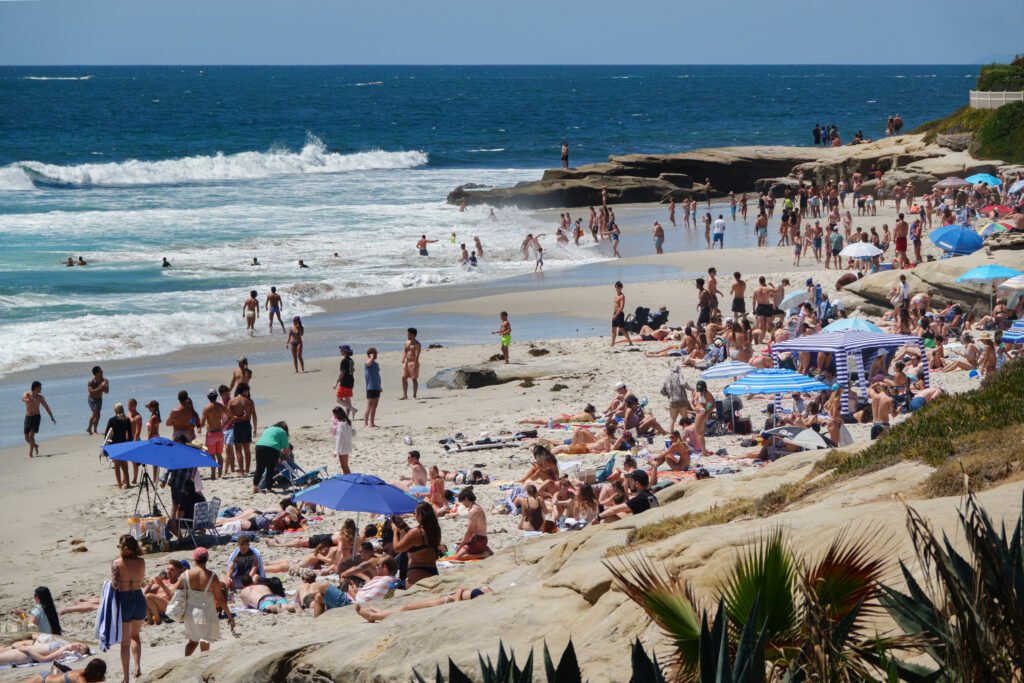
The California coastline winds more than 800 miles along the Pacific Ocean between Mexico and Oregon, with over 1,500 public access points leading to rugged cliffs and sandy beaches ideal for fishing, surfing, swimming and simply enjoying the ocean.
But how—or even whether—Californians can access this natural resource often comes down to factors like race, gender, geography and socioeconomic status, according to a new study.
“Persistent barriers keep some of California’s most vulnerable and marginalized communities from the coast,” said lead author Timothy Frawley, a project scientist in the Fisheries Collaborative Program at the University of California, Santa Cruz.
While California law protects the public’s right to access the coast, a team led by UC Santa Cruz researchers found major obstacles to equal access and enjoyment of the state’s coastline. Historically marginalized and lower-income people face physical, financial and other roadblocks that not only make it challenging to access the ocean, but also limit the benefits they get from it, according to the study.
The research comes on the 50th anniversary of the California Coastal Act, which enshrined the public’s right to access the ocean and aimed to maximize everyone’s opportunity to enjoy all the benefits the coast has to offer. Yet decades of exclusion, both formal and informal, have kept true equality out of reach.
“The legal right to enter an area and the ability to derive benefits from that area are not the same,” Frawley added. “Just because you can get there doesn’t mean you will get there.”
Experts say this issue goes beyond California, a state that is often considered a leader in coastal governance.
“There’s a flavor of this in all 35 states and territories that have a coast,” said Angelo Villagomez, a senior fellow at the left-leaning think tank Center for American Progress who studies environmental justice and was not involved in the study. “Our beaches are still segregated, but it’s not enforced through law.”
While state, regional and national efforts to expand access in recent years have made headway, researchers like Villagomez say the study shows that more can be done. “The job isn’t finished when you build that policy infrastructure,” he said.
To better understand how Californians engage with the coast, researchers surveyed nearly 1,700 people online and in person. From San Francisco to Ventura, they recruited participants from community spaces like laundromats or neighborhood events to collect a sample representative of the state’s diversity. They then conducted community workshops to interpret the data and develop policy recommendations.
The survey asked about the barriers people face across four categories: social, personal, physical-environmental and knowledge. This included practical issues, such as a lack of public transit or neglected beach facilities, as well as subjective challenges like feeling unwelcome or unsafe.
Researchers found that those most likely to spend time at the ocean were white; those who were least likely lived in vulnerable communities and had to travel farther just to reach the beach. Even at the shore, the researchers found that the ways people enjoyed the ocean differed, with fishing and adventure sports like surfing, scuba diving and swimming more popular among white, high-income respondents.
Black and Asian American respondents reported significant obstacles, especially personal and knowledge barriers like affordability and understanding the rules at various sites. Women were also less likely to engage in activities like fishing and surfing.
Frawley said the differences in infrastructure are apparent when driving along the coast. Asilomar State Beach, located near the wealthy Pacific Grove area, has well-maintained boardwalks and walking trails, as well as consistent park staff, according to the release. But Salinas River State Beach, which is closer to agricultural areas and migrant communities just a 30-minute drive up the coast, tends to have poor water quality and overflowing trash cans.
A History of Exclusion
The authors say that rather than a lack of interest, these disparities reflect structural barriers stemming from “racialized histories” that have made the coast a hostile space for many marginalized communities. They trace this back to the 19th-century removal of tribes that lived along the coast, through to 20th-century redlining, restrictive covenants and segregated beaches that legally prohibited shoreline access and ownership for people of color.
This history is well documented. A 2005 analysis from the equal justice nonprofit The City Project detailed how people of color were denied access to the state’s public beaches for much of the 20th century, often through violence and intimidation. Some historically Black beach communities were destroyed, with land confiscated and houses burned, by neighboring white enclaves. The City Project report also explained the many ways that the wealthy fought to preserve beach exclusivity, including through tactics like restricting public transportation and locking access point gates.
“If we don’t actually articulate the questions and the needs of who is missing, why they’re missing, then we run the risk of not even kicking the can down the road, but eventually just burying that can.”
— Marce Gutiérrez-Graudiņš, Azul
Attempts by beachfront communities to restrict access have persisted into this century. Some property owners have gone to court to challenge public access requirements, hired private security or even, in the case of one Malibu neighborhood, stolen the sand off the public beach.
“Policy without people is just paper,” said Marce Gutiérrez-Graudiņš, executive director of the Latino ocean conservation group Azul, who was not involved in the study. “There is a disconnect between the policy world and everyday people, and unfortunately, that just compounds the problems of those most affected.”
Gutiérrez-Graudiņš said her group previously printed California Coastal Act “know your rights” cards in Spanish for beachgoers so they could feel safer and more secure when exercising their access privileges. But she added that people and communities historically excluded from these spaces may still struggle to advocate for needed improvements or conversations about coastal management.
“If we don’t actually articulate the questions and the needs of who is missing, why they’re missing, then we run the risk of not even kicking the can down the road, but eventually just burying that can, which is even worse,” she said.
Unequal Access to “Blue Mind” Benefits
As part of the survey, the researchers also asked Californians about the benefits they received from time spent on the coast. They looked at material benefits—such as food, income and physical health—along with outcomes that are harder to measure, like cultural identity, community and improved mental health.
A growing body of research shows a link between spending time in marine environments and better mental health, reduced stress, stronger social relationships and even improvements in depression symptoms—collectively dubbed the “blue mind” phenomenon. This is in addition to the benefits of physical exercise and catching or foraging for food.
This story is funded by readers like you.
Our nonprofit newsroom provides award-winning climate coverage free of charge and advertising. We rely on donations from readers like you to keep going. Please donate now to support our work.
Unsurprisingly, however, the survey revealed that barriers to coastal access limited the well-being benefits people received from the Pacific.
To address these hurdles, the researchers recommended policies to expand access and help people feel empowered to enjoy the ocean. These include targeted interventions, such as reducing parking fees, creating multilingual signs and offering free or low-cost swimming lessons and equipment rentals. But they also suggested structural changes like building affordable, high-density coastal housing and mitigating pollution and runoff near beaches.
They also recommend that coastal management and stewardship incorporate a diversity of perspectives, including tribal co-stewardship. Historically, policymakers tended to focus on managing the ocean as an economic and environmental resource, which often served to “undermine local rights, relationships, and knowledge systems, and reinforce the historical legacy of colonialism,” the authors said in the study.
Put simply, “what good is a healthy ocean if people can’t benefit from it?” Frawley said.
Deepening engagement with the ocean could also help communities become more invested in the health of marine environments, experts said.
“Managing the coast isn’t just about managing the environment, it’s also about managing the ways that humans can relate to the environment,” said Nathan J. Bennett, the global oceans lead scientist for the World Wildlife Fund and chair of the People and the Ocean Specialist Group for the International Union for Conservation of Nature and Natural Resources.
Bennett, who was not involved in the study, said “the more we can bring people to the ocean, the more that we can create that relationship with the ocean, the more that we can encourage people to care for the ocean.”
About This Story
Perhaps you noticed: This story, like all the news we publish, is free to read. That’s because Inside Climate News is a 501c3 nonprofit organization. We do not charge a subscription fee, lock our news behind a paywall, or clutter our website with ads. We make our news on climate and the environment freely available to you and anyone who wants it.
That’s not all. We also share our news for free with scores of other media organizations around the country. Many of them can’t afford to do environmental journalism of their own. We’ve built bureaus from coast to coast to report local stories, collaborate with local newsrooms and co-publish articles so that this vital work is shared as widely as possible.
Two of us launched ICN in 2007. Six years later we earned a Pulitzer Prize for National Reporting, and now we run the oldest and largest dedicated climate newsroom in the nation. We tell the story in all its complexity. We hold polluters accountable. We expose environmental injustice. We debunk misinformation. We scrutinize solutions and inspire action.
Donations from readers like you fund every aspect of what we do. If you don’t already, will you support our ongoing work, our reporting on the biggest crisis facing our planet, and help us reach even more readers in more places?
Please take a moment to make a tax-deductible donation. Every one of them makes a difference.
Thank you,

Fellow
Madeline Shaw is an Outrider fellow at Inside Climate News and a journalist in NYU’s Science, Health and Environmental Reporting Program. She has reported on issues involving conservation, poaching and biodiversity. Her work has been published in The New York Times and Scienceline.