

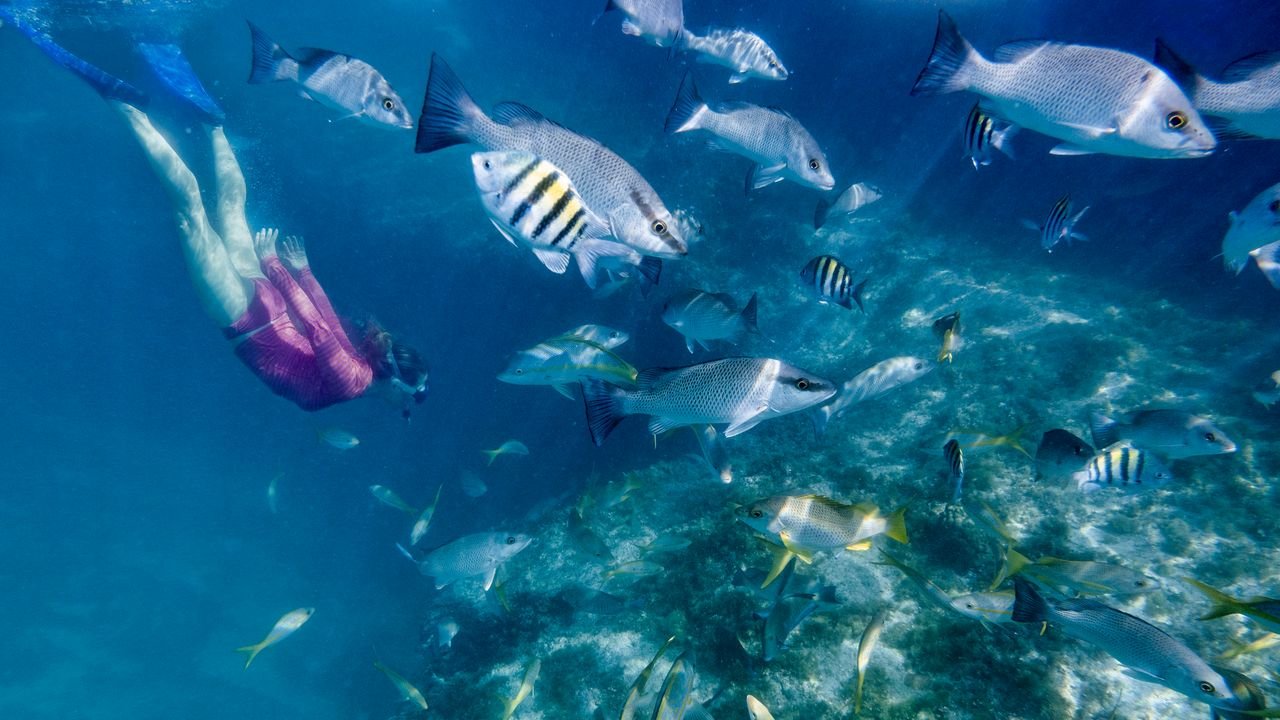
I was 30 feet underwater, kneeling on the sandy sea floor of Nari Nari, when my scuba instructor Brian told me to flood my mask—a skill every budding diver needs to complete before getting certified. So I cracked the seal. Immediately, salt water rushed across my face and into my nose. My breathing sped up. I tried to clear the mask by forcing air out of my nostrils. I failed. I tried again. My vision got blurry. My chest tightened. I pointed toward the ascent line, the rope that guides divers up and down slowly to prevent compression sickness. I started swimming for it, hoping to ascend and clammer back onboard our boat.
But Brian caught up with me quickly. He grabbed my vest and held his hand in front of me, moving it slowly up and down until I matched his breathing. After a few cycles, my heart rate settled enough for me to clear my mask and continue the dive. If it was any other activity, I would’ve bailed. However deep underwater, you don’t have that option. The only way through is to get your breathing under control. From the first lesson, one rule is drilled in: Never hold your breath.
“How you breathe dictates how the dive goes,” Stephen J. Aynsley, a scuba meditation specialty course director with Professional Association of Diving Instructors (PADI) told me in an interview. “You have to breathe continuously to remain conscious and safe, but you also have to breathe correctly to maintain good buoyancy. It’s one of the few body systems that you can consciously and subconsciously control.”

Newbie divers often take shallow, fast breaths, which are more likely to make you feel anxious as you’re not getting enough oxygen, Aynsley explains. But the goal is slow, deep breaths: long inhales with even longer exhales, the same pattern used in many on-land meditation practices. I’ve personally dabbled in breathwork to manage my anxiety for years, using apps like Open or Headspace to ease tension or fall asleep, but often get flustered with complex breathing patterns. It wasn’t until I was in the ocean that I controlled my breathing well enough to stay calm when I would otherwise panic.
When I went to Nassau, Bahamas, to get my scuba certificate through PADI at Sandals Royal Bahamian, I was initially uneasy. I’d been snorkeling before—at a secluded, rocky cove near Little Bay, Anguilla, and at the Four Seasons Resort Lanai shoreline in Hawaii, where I was mesmerized by the shimmering pastel colors of the Hawaiian surge wrasse that reminded me of my favorite childhood book, The Rainbow Fish. I got used to hovering near the surface of 15-feet-deep water, watching parrotfish flicker below me and rays glide past, while keeping a comfortable distance from whatever else was below. Diving felt like an exciting next step, but one I wasn’t entirely sure I was ready for.