

Close Menu

    Subscribe to Updates

    Get the latest news information from worldwide businesses.

    What's Hot

    The crypto Clarity Act returns to the Senate this week. The banks are already trying to kill it.

    May 13, 2026

    Fuel prices likely to rise if war continues: RBI Guv

    May 13, 2026

    Tata group’s Impetis out-licenses arthritis and autoimmune drugs to Vyome

    May 13, 2026
    Facebook Instagram YouTube LinkedIn X (Twitter)
    Trending
    • The crypto Clarity Act returns to the Senate this week. The banks are already trying to kill it.
    • Fuel prices likely to rise if war continues: RBI Guv
    • Tata group’s Impetis out-licenses arthritis and autoimmune drugs to Vyome
    • Ford’s stock is the S&P 500’s biggest gainer. The carmaker is putting a very Tesla spin on things.
    • Volkswagen is about to reveal the first electric GTI
    • New quantum algorithm solves “impossible” materials problem in seconds
    • From Digene to Glimstar, Prices of Common Medicines Rise by Up to 10%
    • Musk’s xAI is running nearly 50 gas turbines unchecked at its Mississippi data center
    Newspublicly
    • About Us
    • Advertise & Partner with us
    • Pitch Your Story
    • Contact Us
    Facebook Instagram LinkedIn X (Twitter)
    Subscribe
    • Home
    • World News
      • Asia
      • India
      • USA
      • UK & Europe
      • Middle East
    • Economy & Business
      • Global Economy
      • Corporate & Industry
      • Finance & Markets
      • Policy & Trade
    • Technology
      • Gadgets & Devices
      • Software & Apps
      • AI & Machine Learning
      • Robotics & Automation
    • Health & Medicine
      • Fitness & Nutrition
      • Research & Innovation
      • Disease & Treatment
      • Doctors, Clinics & Patient Care
    • Travel & Tourism
    • Automobile
      • Electric & Hybrid Vehicles
      • Auto Industry Insights
    • Sports
    • More
      • Education
      • Real Estate
      • Environment & Climate
      • Space & Astronomy
      • War & Conflicts
    Newspublicly
    Home»More»Space & Astronomy»What flings mysteriously powerful particles called ‘cosmic rays’ at Earth?
    Space & Astronomy

    What flings mysteriously powerful particles called ‘cosmic rays’ at Earth?

    Divya SharmaBy Divya SharmaMay 13, 2026No Comments4 Mins Read0 Views
    Share
    Facebook Twitter LinkedIn Copy Link WhatsApp


    On Earth, the Large Hadron Collider can smash atoms together and accelerate particles to near light speeds — but in space, there are high-energy cosmic rays with over 10 million times more power than even those zippy particles. And now, new research suggests such cosmic rays may hide a secret that is the key to unlocking a 60-year-old space puzzle.

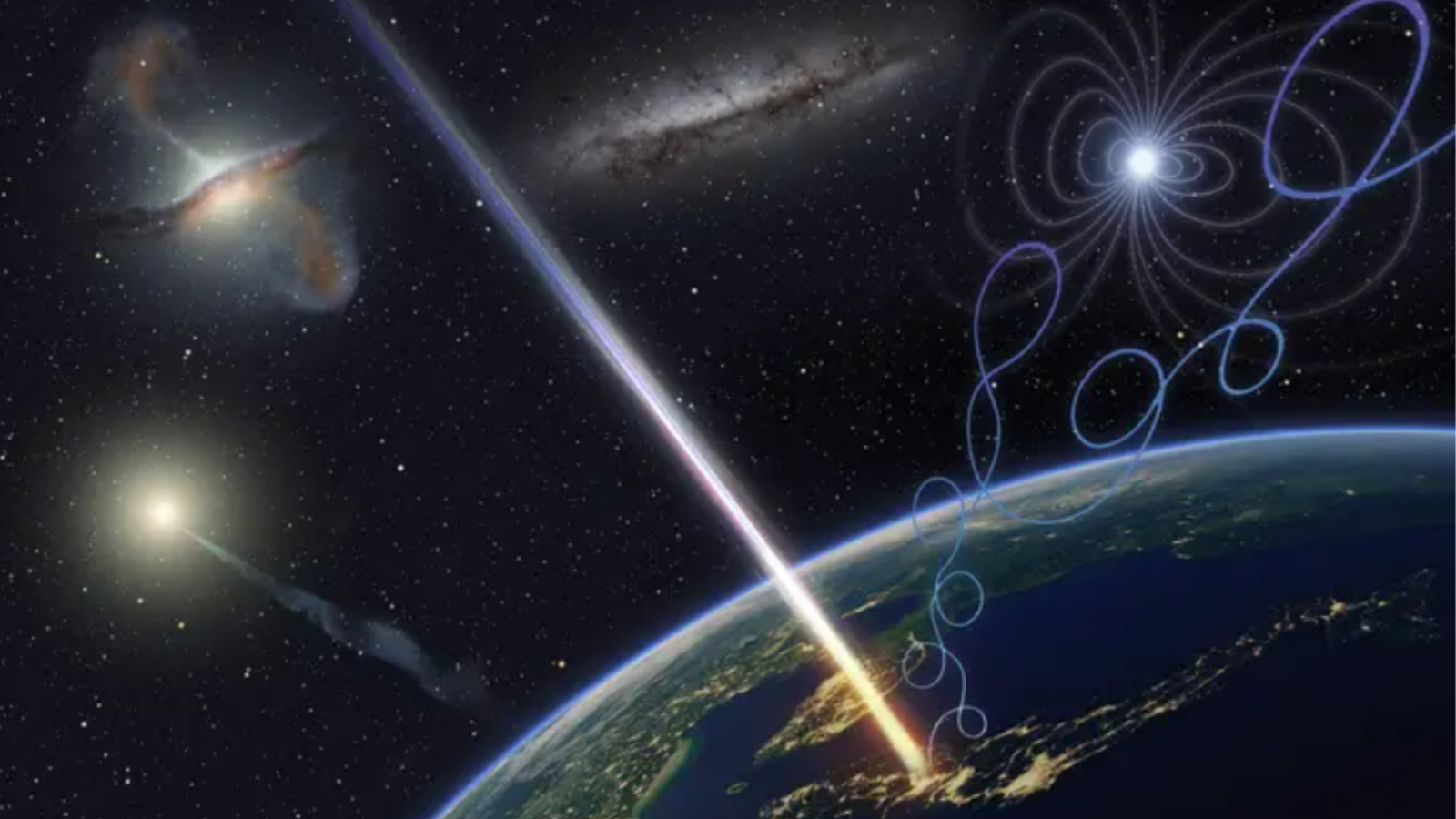
    One of these cosmic rays for instance, dubbed the Amaterasu particle (after the Japanese sun goddess) slammed into Earth in 2021 with an energy 40 million times greater than particles slammed together at the Large Hadron Collider (LHC). Amaterasu is considered the second most powerful cosmic ray ever detected — after the aptly named “Oh-My-God particle” detected back in 1991. However, the origins of these particles, and the sources that accelerated them to such high energies, are shrouded in mystery.

    Traveling with the kinetic energy equivalent to that of a fast-moving tennis ball (a lot for a single cosmic-ray particle), the Amaterasu deepened that mystery as it appears to have originated from a void-like region with no obvious source. However, researchers finally think they may have hit upon an answer. A new study’s team thinks the highest-energy cosmic rays may actually be atomic nuclei of elements heavier than iron. Could this be the missing link in our understanding of which mysterious violent events fling these intense particles toward Earth?


    You may like

    “The origins and acceleration mechanisms of ultrahigh-energy cosmic rays have been among the biggest mysteries in the field for more than 60 years, since the first example was reported,” team leader Kohta Murase, of Penn State’s Eberly College of Science, said in a statement. “Ultrahigh-energy cosmic rays can only be accelerated by some of the most powerful sources in the universe. When we detect individual cosmic-ray particles such as the Amaterasu particle here on Earth, we can often use their energies, arrival directions, and expected magnetic deflections to infer their possible cosmic sources.”

    Many sources have been proposed as the origins of high-energy cosmic rays, including the collapse of a massive star to form a neutron star or a black hole or the collision of two neutron stars themselves. For context, the matter that composes neutron stars is so dense that if a mere teaspoon of it were brought to Earth, it would weigh about 10 million tons, which is the same as 85,000 adult blue whales (try getting them on one teaspoon).

    So, compressing a body with the mass of the sun to a width of around 12 miles (20 kilometers) is already incredibly violent — consider two of those compressed bodies meeting.

    “These highest-energy cosmic rays are thought to come from extreme astrophysical sources, like two neutron stars colliding or a massive star collapsing,” Murase said. “For many cosmic-ray events taken together, their energy distribution, arrival-direction pattern, and statistically inferred composition provide important clues about where these particles come from and how they are accelerated.”

    Space

    If Murase and fellow researchers are correct that cosmic rays may be the nuclei of elements heavier than iron, then this neutron star collision story may have some real footing at last.
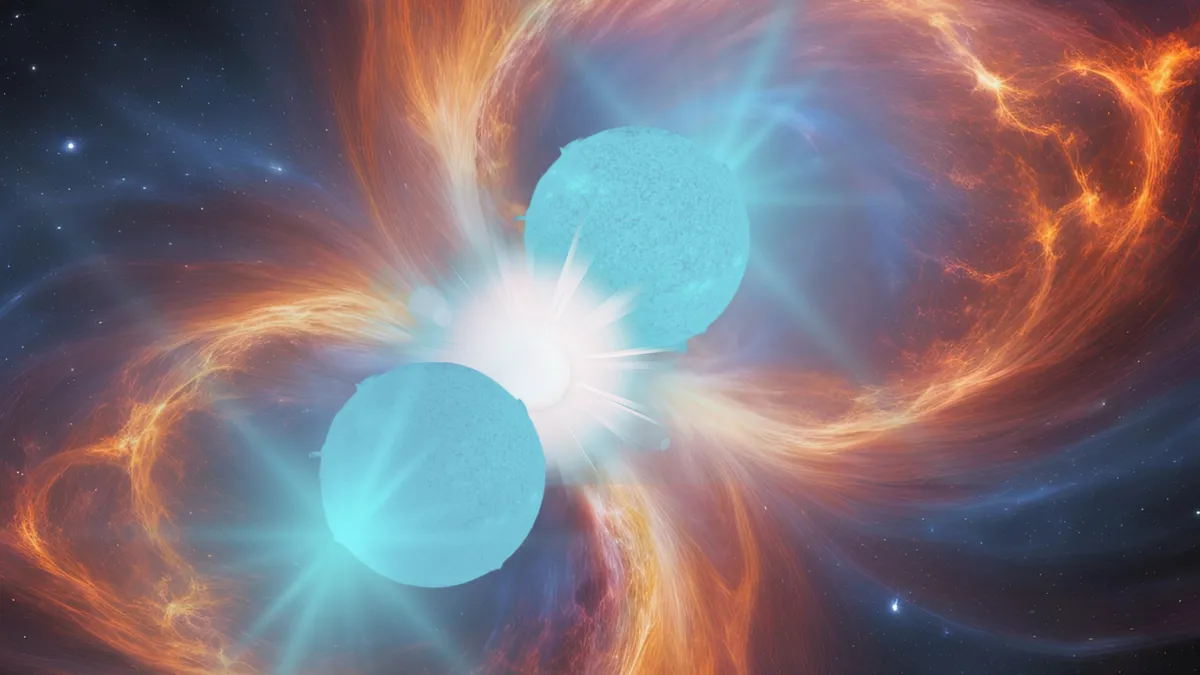
    Two blue circles surrounded by lots of yellow and orange swirls. There's a white light between the circles.

    An illustration shows two neutron stars colliding and merging. (Image credit: Robert Lea (created with Canva))

    To understand these high-energy particles and their origins, Murase and colleagues performed simulations tracking how cosmic rays of different masses would lose energy as they passed through vast cosmic distances to reach Earth. What this revealed was that atomic nuclei heavier than the atomic nucleus of iron lost energy much more slowly than lighter particles.

    “Our research showed that at energies comparable to that of the Amaterasu particle, ultraheavy nuclei lose energy more slowly than protons or intermediate-mass nuclei, making them better able to survive cosmic distances and reach Earth at extreme energies,” Murase said. “We are not saying that all ultrahigh-energy cosmic rays are ultraheavy nuclei. But if some of the highest-energy events are ultraheavy nuclei, that would impact how we search for their sources.”


    What to read next

    The team was also able to place constraints on how many heavy nuclei cosmic rays account for the overall population of high-energy cosmic rays.

    “The most promising sites for producing and accelerating such ultraheavy nuclei are massive star deaths involving explosive collapse into black holes or strongly magnetized neutron stars, as well as binary neutron-star mergers known to be powerful gravitational-wave emitters,” Murase said. “These violent cosmic phenomena can also power gamma-ray bursts that are among the most energetic explosions in the universe.

    “A contribution from these sources could also help explain a possible difference seen between the northern and southern skies in the ultrahigh-energy cosmic-ray spectrum. If ultraheavy nuclei contribute significantly at the highest energies, future data should indicate a composition heavier than iron.”

    These results were published on Thursday (May 7) in the journal Physical Review Letters.


    Source link

    Divya Sharma
    • Website

    Divya Sharma is a content writer at NewsPublicly.com, creating SEO-focused articles on travel, lifestyle, and digital trends.

    Related Posts

    Astrophotographer captures remarkable view of galactic ‘Eyes’ with backyard telescope

    May 13, 2026

    Blue Origin’s lunar lander mockup is ready for NASA Artemis astronaut training

    May 13, 2026

    ‘Smallville’ at 15: An imperfect Superman show, but the best Clark Kent story ever told

    May 13, 2026
    Leave A Reply Cancel Reply

    Demo
    Top Posts

    “Inside Gemini Robotics 1.5: How Robots Learn to Reason & Act

    November 22, 202524 Views

    How US Tariffs Are Reshaping the Global Growth Landscape?

    November 21, 202518 Views

    Pakistani Journalist Laughing at Tejas Fighter Jet Crash at Dubai Airshow Sparks Massive Outrage Worldwide

    November 23, 202517 Views

    Vibe-Coding Boom: How Non-Coders Build Apps With AI Agents

    November 22, 202515 Views
    Don't Miss

    The crypto Clarity Act returns to the Senate this week. The banks are already trying to kill it.

    May 13, 20269 Mins Read0 Views

    Hello and welcome to Regulator, the newsletter for Verge subscribers that goes into tech shenanigans…

    Fuel prices likely to rise if war continues: RBI Guv

    May 13, 2026

    Tata group’s Impetis out-licenses arthritis and autoimmune drugs to Vyome

    May 13, 2026

    Ford’s stock is the S&P 500’s biggest gainer. The carmaker is putting a very Tesla spin on things.

    May 13, 2026
    Stay In Touch
    • Facebook
    • Twitter
    • Instagram
    • YouTube
    • LinkedIn
    • WhatsApp

    Subscribe to Updates

    Get the latest creative news from SmartMag about art & design.

    Demo
    NEWSPUBLICLY
    Facebook X (Twitter) Instagram LinkedIn

    Home

    • About Us
    • Leadership
    • Advertise & Partner With Us
    • Pitch Your Story
    • Media Kit & Pricing
    • Career
    • FAQs

    Guidelines

    • Editorial & Submission
    • Partnership
    • Advertising & Sponsor
    • Intellectual Property Policy
    • Community & Comment
    • Security & Data Protection
    • Send Your Opinion

    Quick Links

    • Cookie Policy
    • Payment & Billing Terms
    • Refund & Cancellation
    • Copyright Policy
    • Complaint & Support
    • Sitemap
    • Contact Us

    Subscribe Us

    Get the latest news and updates!

    Copyright © 2026 Newspublicly (DIGITALIX COMMUNICATION). All Rights Reserved.
    • Privacy Policy
    • Terms of Use
    • Disclaimer