

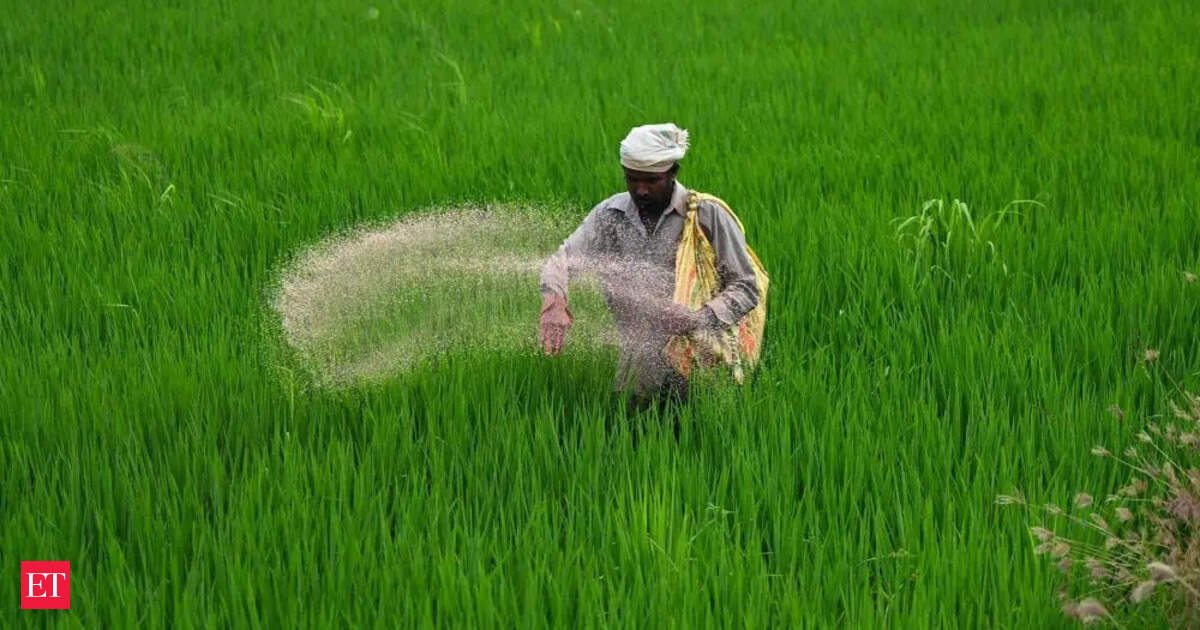
This is because India’s fertiliser security is deeply tied to global supply chains. The country imports a significant share (approximately 60%) of its diammonium phosphate (DAP) requirement, remains fully dependent on imported potash, and even domestic urea production relies heavily on imported liquefied natural gas. Nearly 50% of India’s natural gas and about 85% of its crude oil requirements are also met through imports.
Recent price movements underline the seriousness of the risk. Between February and April 2026, international crude oil and fertiliser prices rose sharply, by about 58% and 66%, respectively. In the Indian context, an economy-wide assessment, using the Rural Investment and Policy Analysis (RIAPA) framework by economists from IFPRI and ICAR, suggests that, had these shocks been fully passed on to producers and households, annual retail inflation in April 2026 could have risen to around 5%, instead of the actual 3.48%.
Rural households would have borne a disproportionate burden because food, transport, and fuel account for a large share of their expenditure. If the conflict persists through 2026, the risks could move beyond immediate price effects to broader macroeconomic stress. Under the scenario in which the government absorbs the full 45% rise in import prices of energy, fertilisers and fertiliser-related chemical inputs, along with a 10% shortage of urea and no additional fiscal or monetary response, the study estimates a decline of around 1% in the gross domestic product (GDP). The message is clear: a fertiliser shock is not merely an input-cost problem; it can become a macroeconomic risk through inflation, weaker consumption, lower investment, subsidy pressure, and a higher energy import bill.
The Covid-19 pandemic, the Russia-Ukraine war, and now the West Asia crisis have exposed the same weakness: India’s agricultural input system remains heavily dependent on imported energy, imported raw materials, and volatile global supply chains. Each crisis has been treated as an exceptional disruption. But repeated disruptions can no longer be treated as exceptions.

The immediate policy response in such situations is usually to cushion the price shock. The government absorbs all or part of the increase through subsidies to protect farmers from sudden spikes, while hoping for global markets to stabilise. This is necessary in the short run. Farmers cannot be left fully exposed to volatile global fertiliser prices. But when shocks become frequent, subsidy cushioning alone cannot be the core strategy.
India’s fertiliser policy has remained largely focused on price management. The challenge now is to build a fertiliser security strategy based on risk management. This means moving beyond the question of how to keep fertilisers affordable in the current season to asking how India can reduce its exposure to repeated external shocks over the next decade. Price management protects farmers after a shock has arrived; risk management builds resilience before the next one begins.Such a strategy must go beyond subsidy allocation. Fertilisers can no longer be viewed as a stand-alone farm input. They are a critical link in India’s wider food-system architecture, connecting energy security, import dependence, soil health, farm profitability, public finance, climate commitments, and food-price stability. A disruption in one part of this chain can travel quickly across the system: from gas markets to fertiliser factories, from shipping routes to import bills, from subsidy budgets to cultivation costs, and finally to household food prices.
The PM Programme for Restoration, Awareness Generation, Nourishment, and Amelioration of Mother Earth (PM-PRANAM) offers a useful example. Designed to incentivise states to reduce chemical fertiliser consumption and move towards more balanced nutrient use, the scheme points in the right direction. Yet, nearly three years after its approval, the government informed Parliament in March 2026 that no incentives had been disbursed to states or Union Territories. This is not just an administrative delay; it shows that a nutrient transition cannot be delivered through incentive design alone. States need reliable data, credible baselines, farmer-facing alternatives, extension capacity and assurance that productivity will not suffer.
This is where the case for food-systems governance becomes important. Fertiliser use is shaped not only by subsidy policy but also by cropping patterns, procurement incentives, irrigation practices, energy prices, import strategy, soil-health information, climate goals and farmer risk. These levers sit across different ministries and institutions, but their effects converge on the same farm. Without an institutional mechanism to connect them, India will continue to design input, energy, trade, soil-health and sustainability policies in separate silos.
Such a governance approach would not replace existing ministries or schemes. Its purpose would be to align them around shared outcomes: stable food prices, lower input vulnerability, efficient nutrient use, improved soil health, fiscal sustainability and climate resilience. It should also support an integrated fertiliser-risk monitoring system that links geopolitical risk, energy prices, shipping routes, domestic stocks, subsidy exposure, crop calendars and state-level demand. The West Asia crisis shows why this coordination is no longer an academic idea. It is a practical requirement for managing risk in an interconnected food economy.
Barun Deb Pal is Research Coordinator and Anjani Kunar is Senior Fellow at the International Food Policy Research Institute, South Asia Office; Smita Sirohi is ICAR-National Professor, MS Swaminathan Chair. Views are personal.