


This story was published by the Border Belt Independent in collaboration with Inside Climate News.
Viv Tolson Wayne rang the large dinner bell on her front porch along Britt Road in St. Pauls, North Carolina. The crowd on her front lawn hushed their conversations and turned toward the 75-year-old, who wore a red T-shirt and white cowboy hat.
On that April day, Tolson Wayne gathered dozens of her sorority sisters to protest pollutants in the Robeson County Landfill, whose entrance is about a half-mile from Tolson Wayne’s front door.
“We are here to let people know that they have a voice,” Tolson Wayne said from her porch, “so environmental injustice turns to environmental justice.”
Tolson Wayne is a member of the St. Pauls Community Association for Progress. The group, along with the Southern Environmental Law Center, is suing Robeson County over what it describes as contamination that seeps into drinking water.
The lawsuit, filed in the U.S. District Court for the Eastern District of North Carolina on Tuesday, accuses the county of violating the Resource Conservation and Recovery Act. The law governs the treatment, storage and disposal of solid and hazardous waste. The lawsuit alleges that the county is causing “an imminent and substantial endangerment to health or the environment” by knowingly allowing the landfill to leach per- and polyfluoroalkyl substances, a class of forever chemicals commonly called PFAS, since at least 2023.
PFAS exposure is linked to an increased risk of cancer, thyroid disease, reproductive problems and developmental delays in children, according to the U.S. Environmental Protection Agency.
The lawsuit comes as the Robeson County Board of Commissioners seeks to expand the landfill, located in rural St. Pauls, home to about 2,700 residents. It would be the seventh expansion in 30 years, adding about 35 acres to the 537-acre site.
Commissioners delayed voting on the expansion last year after Tolson Wayne and other community members raised concerns about pollution.
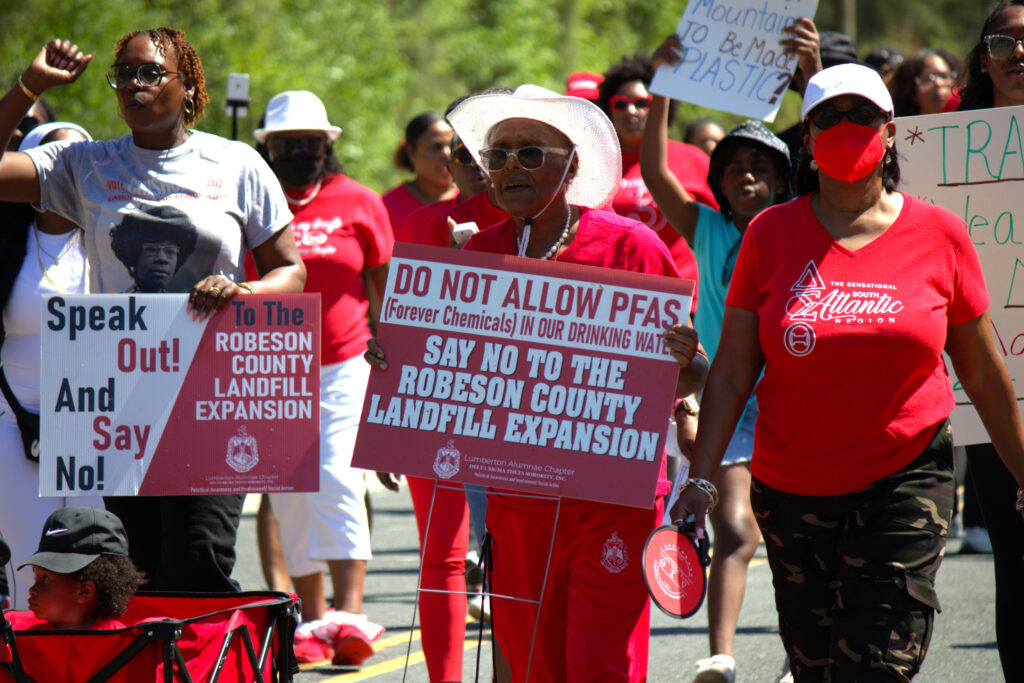
“I believe that the county is beginning to wake up, because we are not going to stop talking about it,” Tolson Wayne told the Border Belt Independent.
The landfill’s leachate—the water that runs through its trash—contains significantly higher amounts of several types of PFAS, including PFOS and PFOA, than most of North Carolina’s landfills.
One sample contained 1,060 parts per trillion of PFOS and 4,100 ppt of PFOA, according to a consultant’s sampling report released this year on behalf of the county. That’s over five times the average amount of PFOS and four times the average amount of PFOA in landfills across the state, according to a 2020 study that sampled nine in central and southeastern North Carolina.
Similar concentrations were found in leachate samples that were part of the landfill’s 2024 water quality analysis. That year, the N.C. Department of Environmental Quality sent a letter to Robeson County Solid Waste Director Gene Walters to alert him that the landfill’s groundwater exceeded the state’s allowed limits for various types of PFAS.
In a March letter to Walters, the division said that “further assessment efforts are warranted for a more thorough understanding of site conditions, extent of PFAS contamination associated with the facility, and possible contributing source(s).”
The lawsuit says the PFAS contamination is spreading to the county water through the Rocco Water Treatment Plant, which pulls water from wells as close as 2,089 feet from the landfill.
In November 2025, the Southern Environmental Law Center tested the county water from taps in more than a dozen homes within two miles of the landfill, including Tolson Wayne’s, for PFAS. Results showed the highest level of PFAS found in finished drinking water from any treatment plant in North Carolina.
“Comparable PFAS levels in Wilmington’s public water were considered a public health emergency,” said Maia Hutt, the center’s lead lawyer on the lawsuit. “So why isn’t this a public health emergency?”
Specific types of PFAS were found at alarming levels, Hutt said. Residents’ tap water contained almost 25 parts per trillion of GenX, the highest amount found in any water treatment system in the country. Two years ago, the EPA set a maximum contaminant level of 10 ppt for GenX, but President Donald Trump’s administration is eliminating that standard.
Chemours’ Fayetteville Works plant, nine miles northeast of St. Pauls, is the only source of GenX in North Carolina. Testing shows dozens of private drinking water wells in Robeson County contain GenX above 10 ppt, according to DEQ documents.
Some wells could have become contaminated with GenX through air deposition. The compounds are emitted through the Fayetteville Works’ stacks, travel on the wind, mix with rain and other moisture, then fall to the earth, where they contaminate groundwater, the source for the drinking water wells.
Chemours has already offered and provided alternative water supplies to Robeson County households with PFAS levels above thresholds detailed in a 2019 consent order.

The Robeson County landfill has also received 4.8 million pounds of debris, pallets and waste from the Chemours plant’s offices, kitchen and bathroom areas since 2017, according to publicly available shipping manifests. Since this is considered household waste, it is not generally tested before sending it to a landfill, according to a company spokesperson.
PFOA was found on average at 30.3 parts per trillion, over seven times higher than the EPA’s maximum contaminant level of 4 parts per trillion.
Tolson Wayne’s tap water contained the second-highest amount of PFOA among the tested households, at over 35 parts per trillion.
“We just want clean water,” Tolson Wayne said. “I might not see it in my lifetime, but for my child and my grandchildren, we want it to be an environment that they can live and grow in.”
An Ever-Expanding Landfill
Tolson Wayne said the land her home sits on has been in her family for a century. She recalled a childhood spent running around the property and catching catfish to eat in nearby streams.
Her mother and father were gardeners, Tolson Wayne said, growing much of the corn, peas and other produce on her dinner table. After a hot day working on the land, she said, her father would pump a mason jar of water from their well and comment on how refreshing it was.
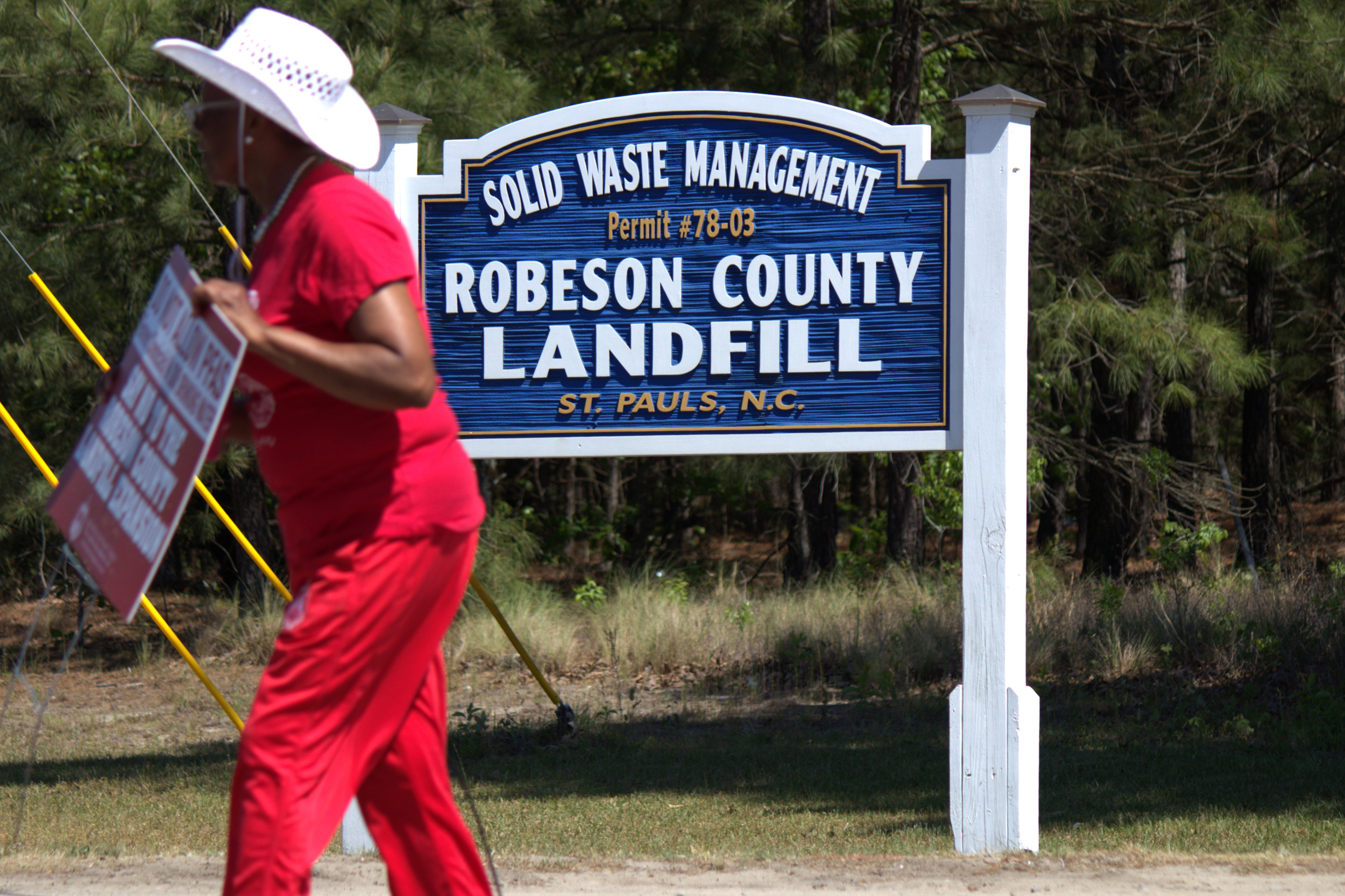
But those days are gone because of the landfill, Tolson Wayne said. She said she has to use a whistle to shoo off buzzards that roost in the tall pine trees in her front yard. While she still grows produce and goes fishing, she worries about the PFAS they might contain.
“If it’s in my water, then it’s in the air that I breathe,” she said. “And if it’s in the air that I breathe, it’s also in the vegetables that I grow. And if it’s in the vegetables that I grow, it’s also in the fish that I fish from the ponds and lakes around Robeson County.”
Robeson County Landfill started accepting municipal trash in 1985, according to DEQ historical records. Its first expansion was in 1996, when it added nine acres. It most recently grew by 11 acres in 2017.
In its more than four decades of operation, the landfill has accepted over 2.5 million tons of waste from Bladen, Robeson, Scotland, Cumberland, and Columbus counties, according to its most recent annual facility report.
Some of that waste came from known PFAS polluters, including Chemours’ Fayetteville Works plant, according to the Southern Environmental Law Center and Winyah Rivers Alliance. Elevated levels of GenX from Chemours are in samples from the landfill’s surface water, groundwater and leachate, according to the sampling report released this year.
This story is funded by readers like you.
Our nonprofit newsroom provides award-winning climate coverage free of charge and advertising. We rely on donations from readers like you to keep going. Please donate now to support our work.
Robeson County made about $3 million in profits from the landfill during the 2024-2025 fiscal year, according to a county audit. Tolson Wayne called the revenue “blood money” and said the county needs to use some of it to address the PFAS coming from the landfill. She said the county gave nearby residents water pitchers with filters, but she said it’s not enough; she wants water filters installed at the county water system level.
The Southern Environmental Law Center called on the county to install a carbon or reverse osmosis system at its Rocco Water Treatment Plant in its January notice of intent to sue before it formally filed its lawsuit.
Rob Davis, Robeson County’s attorney, said in an email sent in March to the Border Belt Independent that the county obtained a seven-acre tract of land to house the carbon filtration system. He also wrote that county officials met with a company that “has a system that would be installed at the landfill to mitigate any PFAS that may get into the landfill,” he wrote.
“Our team and our commissioners are taking this issue seriously and are making sure we keep moving forward to a solution that is in the best interest of the health and welfare of our citizens and residents,” Davis wrote.
“You Can’t Wait”
The signs advertising Mexican restaurants and stores along West Broad Street show St. Pauls’ growing Hispanic population and racial diversity. Over half of residents identify as a race other than white, according to data from the U.S. Census Bureau.
Many of St. Pauls’ residents, over 37 percent, live in poverty, census data shows. That’s triple the state average.
St. Pauls is home to about 2,700 people in northern Robeson County. Credit: Morgan Casey
Sibyl Farr, executive director of the St. Pauls Community Association for Progress, said the neighborhood near the proposed landfill expansion is especially underrepresented. The area within one mile of the county’s proposed landfill expansion site is 73 percent non-white, according to an environmental justice report compiled by LaBella Associates, a consulting firm hired by Robeson County. Additionally, 62 percent of residents near the site are considered low income.
“I’m tired of people walking over us,” Farr said. “I’m tired of people assuming that the underrepresented don’t have a voice, that it is OK to do whatever to them.”
Farr, 70, said the community association didn’t want to sue the county. She said members would prefer “money wasted on lawyers” to go toward a filtration system. However, she felt the county wasn’t moving fast enough.
Robeson County developed a PFAS Assessment Work Plan for further sampling of surface and groundwater at the landfill, along with its leachate. It submitted the plan to the N.C Department of Environmental Quality in April for review. The department approved the plan with some revisions in May, telling the county to implement it immediately.
The state says the county must have a PFAS mitigation plan by 2027 and implement it by 2029, according to Farr and Davis.
In his email, Davis said the county started its PFAS mitigation processes “very early and will be in a position to implement them well before any deadline mandated by the state.”
“You can’t wait,” Farr said of the county’s projected timeline. “Are we supposed to sit here and drink polluted water until they decide to send something to the state?”
Julia Odom isn’t waiting for the county to act. Last year, the 73-year-old said she took out a $6,000 loan to install a water purification system in her St. Pauls home two miles away from the landfill. She said disability is the only income she has to pay the loan’s $300 monthly payments after losing her preaching job.
Odom said she can feel the difference in the water. It doesn’t stink or come out yellow anymore, she said, and it’s no longer slick like oil.
“My life is worth it,” Odom said. “I’m just gonna have to do whatever I can do to get this loan paid off.”
Still, Odom said she worries about her neighbors who can’t afford a filtration system and how the county’s water will impact them for generations. Robeson County is already one of the least healthy in North Carolina, and has some of the highest rates of obesity and death by heart disease in the state. People born in the county have the second-lowest average life expectancy in the state, at 67.3 years.
A Threatened River
The Lumber River is America’s fourth-most threatened river this year because of the landfill’s PFAS pollution, according to the nonprofit advocacy organization American Rivers. (The Southern Environmental Law Center and the Winyah Rivers Alliance helped make the determination.)
In its intent to sue, the Southern Environmental Law Center raised concerns that the landfill is leaching PFAS into the Big Marsh Swamp, a tributary of the Lumber River. Stormwater samples taken in 2023 and 2024 from the landfill’s five outfalls—the final discharge point from the landfill into the Big Marsh Swamp—contain anywhere from over 600 parts per trillion to more than 11,000 parts per trillion of total PFAS, according to public records obtained by the law center.
South Carolina’s Department of Environmental Services issued a fish consumption advisory for some species in the Lumber River because of exposure to PFAS. North Carolina has issued an advisory for PFOS in fish for part of the Cape Fear River near East Arcadia in Bladen County, but none for the Lumber River, according to its advisory website.
The primary source of PFAS exposure for many people is eating fish and shellfish, according to Penn State Extension. Hutt, the Southern Environmental Law Center attorney, said many residents in St. Pauls rely on fish caught in the river for their next meal.
“I’m not trying to be scary, but we are talking about significant potential public health impacts,” Hutt said.

Tolson Wayne loves catfish and said she is still eating the ones she catches from her local fishing hole despite knowing the PFAS risk. After years of fighting the landfill’s pollution, she said she hopes to live to see the day when the county has water free of the forever chemicals.
“If you plant a tree today, I might not sit under that tree, but my son or my grandchild might sit under it and enjoy the shade,” she said. “That’s my mindset.”
Morgan Casey is a reporter for the Border Belt Independent, which is part of The Assembly Network.
Lisa Sorg, North Carolina reporter for Inside Climate News, contributed to this reporting.
About This Story
Perhaps you noticed: This story, like all the news we publish, is free to read. That’s because Inside Climate News is a 501c3 nonprofit organization. We do not charge a subscription fee, lock our news behind a paywall, or clutter our website with ads. We make our news on climate and the environment freely available to you and anyone who wants it.
That’s not all. We also share our news for free with scores of other media organizations around the country. Many of them can’t afford to do environmental journalism of their own. We’ve built bureaus from coast to coast to report local stories, collaborate with local newsrooms and co-publish articles so that this vital work is shared as widely as possible.
Two of us launched ICN in 2007. Six years later we earned a Pulitzer Prize for National Reporting, and now we run the oldest and largest dedicated climate newsroom in the nation. We tell the story in all its complexity. We hold polluters accountable. We expose environmental injustice. We debunk misinformation. We scrutinize solutions and inspire action.
Donations from readers like you fund every aspect of what we do. If you don’t already, will you support our ongoing work, our reporting on the biggest crisis facing our planet, and help us reach even more readers in more places?
Please take a moment to make a tax-deductible donation. Every one of them makes a difference.
Thank you,

Reporter, North Carolina
Lisa Sorg is the North Carolina reporter for Inside Climate News. A journalist for 30 years, Sorg covers energy, climate environment and agriculture, as well as the social justice impacts of pollution and corporate malfeasance.
She has won dozens of awards for her news, public service and investigative reporting. In 2022, she received the Stokes Award from the National Press Foundation for her two-part story about the environmental damage from a former missile plant on a Black and Latinx neighborhood in Burlington. Sorg was previously an environmental investigative reporter at NC Newsline, a nonprofit media outlet based in Raleigh. She has also worked at alt-weeklies, dailies and magazines. Originally from rural Indiana, she lives in Durham, N.C.