

4 min readNew DelhiUpdated: Aug 21, 2026 08:11 PM IST
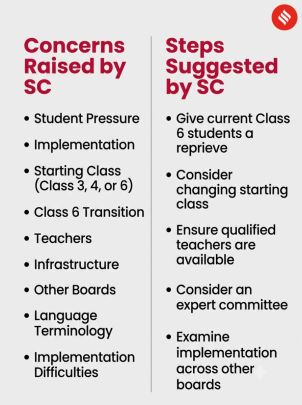
The Supreme Court on Thursday raised concerns over the implementation of the CBSE’s three-language policy for Class 9 students, saying children should not come under pressure because of the new requirement. A bench comprising Chief Justice Surya Kant and Justices Joymalya Bagchi and V Mohana said there was nothing wrong with introducing the policy, but the manner of its implementation needed to be examined.
The court was hearing petitions challenging the CBSE decision to make three languages compulsory for Class 9 students from July 1, 2026. The bench said issues related to the rollout, including the availability of qualified language teachers and the choice of the class from which the policy should begin, needed to be addressed.

Read | CBSE eases three-language policy; current Class 10 students exempted
The bench suggested that if Class 6 has been chosen as the starting point for the language policy, students entering Class 6 this year could be given a reprieve and the implementation could begin from the next academic year. It also said the authorities could consider whether the policy should begin from Class 6, Class 4 or Class 3, depending on the curriculum and the point at which the choice between two and three languages is introduced.
Also Read | Delhi schools to introduce vocational education, third language in Class 9 under revised rules
Teacher availability was another concern before the court. The bench said schools introducing additional languages must have the required teachers and resources. It also suggested that an expert committee could be formed to examine difficulties arising during implementation and recommend solutions.
The petitioners have also questioned the CBSE’s authority over the curriculum for Classes 6 to 8. Senior advocate Anand Grover, appearing for some petitioners, said the curriculum for these classes falls within the domain of NCERT.
The court also asked the Centre to consider how the policy would operate across boards other than CBSE.
Story continues below this ad
The CBSE has provided 23 language options under the new framework. The court said regional and indigenous languages should not be viewed as inferior and stressed the value of learning languages. Justice Bagchi also questioned the use of the term “native” language, saying it had a colonial connotation and that “indigenous” would be more appropriate.
Under the CBSE circular issued on May 15, Class 9 students from July 1, 2026, are required to study three languages — R1, R2 and R3 — with at least two being Indian languages. A foreign language can be chosen only as the third language after two Indian languages, or as an additional fourth language.
The CBSE has said the change is part of its alignment with the National Education Policy (NEP) 2020 and the National Curriculum Framework for School Education (NCF-SE), 2023. Until dedicated R3 textbooks are available, Class 9 students will use the Class 6 R3 textbooks for the 2026-27 academic session.
To limit the academic burden, the board has also said that there will be no Board examination for R3 at the Class 10 level. Schools were asked to update their R3 language options for Classes 6 to 9 on the OASIS portal.
Story continues below this ad
The Centre said thousands of experts were consulted while framing the policy and maintained that the move is aimed at supporting multilingual learning. The government will now take instructions on the concerns and suggestions raised by the Supreme Court. The matter has been posted for further hearing after 10 days.
(With PTI inputs)