

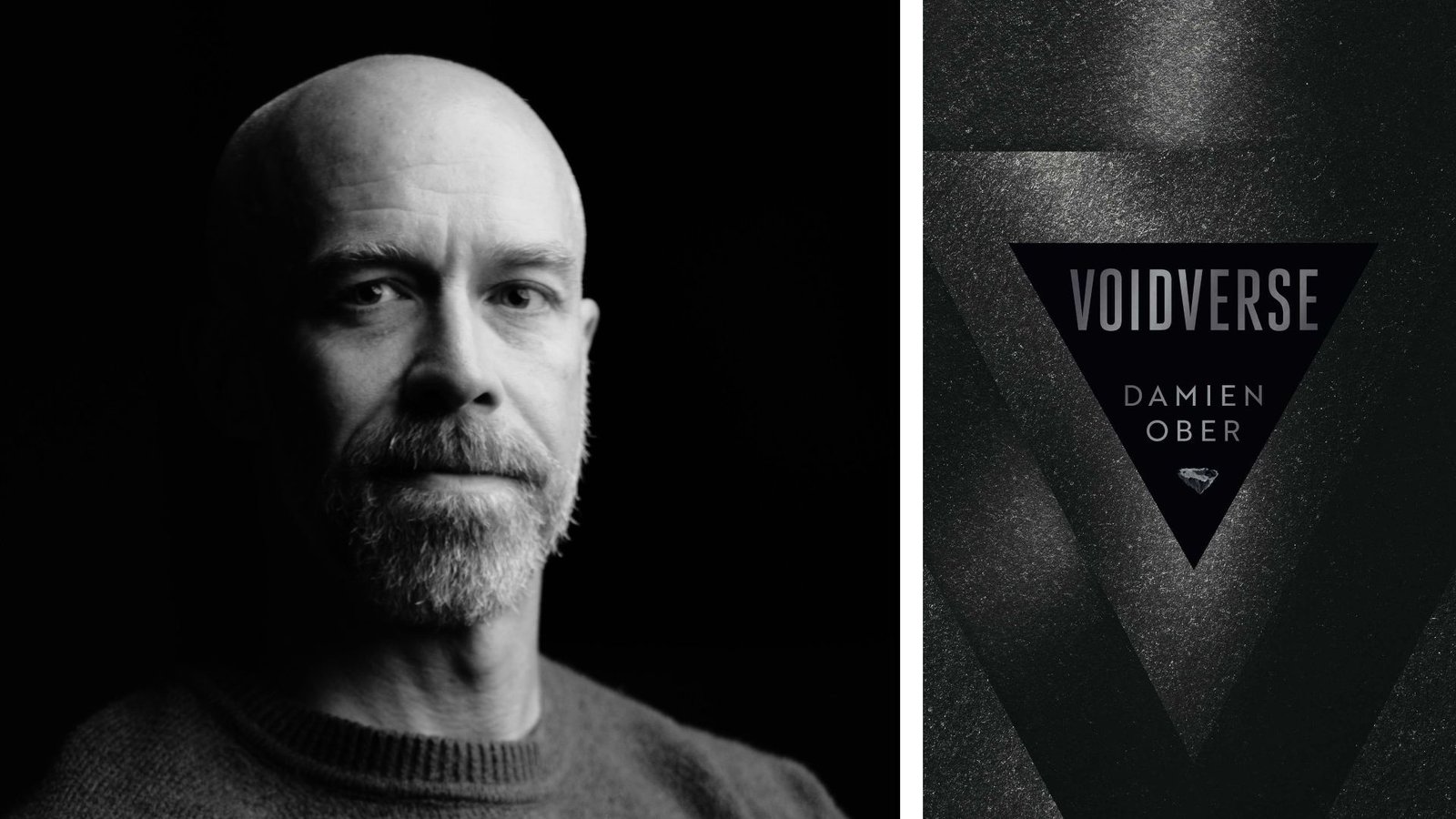
With Hollywood screenwriter Damien Ober’s name displayed on its enticing onyx-shaded jacket, readers are in for a strange and compelling tale with his first foray into space fantasy titled “Voidverse” (Saga Press). I mean, what else could you expect from one of the writers of Netflix’s cult supernatural mystery series, “The OA”?
“Voidverse’s” sci-fi western narrative is told across multiple protagonists amid an uncanny universe where people live on falling rock worlds, stacked vertically in an infinite emptiness. Inside this vast, mysterious void, denizens of the realm may explore these locales by either Rising or Sinking. Within the void, a girl named Sinker teams up with a mother seeking a cure for her sick son, and together they learn of an evil entity systematically destroying the stone lands.
“‘Voidverse’ first came to me in a dream, way back in 2004,” Ober tells Space. “Soon after, I wrote what would become the first chapter of the novel and started to flesh out the rest in notebooks and other little side writing projects. By the time I was working on ‘The OA,’ what would become ‘Voidverse’ was pretty far along, though still far away too. I had to move to LA for the job and brought my typewriter. I’d get up early and bang on ‘Voidverse’ before work and stay up late too. I’m sure my neighbors loved me.

“‘The OA’ was the perfect environment for me and for the novel right then. It was definitely a show that not only encouraged out-of-the-box thinking — on structure, character, tone, everything — but required it. What always impressed me most about the show was the amazing diversity of its fanbase. People of all kinds loved that show, from football jocks to kitty nanas.”

Ober is a formidable talent who’s been prolific over the last decade with scripts developed for Paramount+, AMC, Netflix, and Warner Bros. Described as “Dune” meets “Wool,” “Voidverse” is a high-energy quest where eternal forces are about to clash in a monumental showdown.
His research for the project included reading up on the effects of long-term weightlessness and sensory deprivation, as well as dipping into old Japanese legends and international fairytales.
“For the atmosphere and world of ‘Voidverse’ to work, I needed the characters and the prose to meld with the setting. Holding my hand out the window of the car on the freeway, sinking to the bottom of a pool, staring into darkness. How does it feel? What words can I use to describe it? How do I pull the reader into that in a primal way? How can the novel build a language of its own? Books like ‘Flatland‘ and ‘V.A.L.I.S.‘ had a huge effect on me. Each forces a new kind of physical understanding on your brain to deliver something so unique and viewpoint-shifting.”

The worldbuilding of “Voidverse” invariably reflects feelings and impressions of many of the movies and games Ober has absorbed and loved over the years, all filtered down and distilled through some mysterious brain process. “There’s a big adventure at the heart, something akin to ‘Beastmaster’ or ‘Krull,'” he explains.
“There’s a cool world and character mystery vibe that could remind you of ‘The Legend of Zelda.’ The western/samurai themes and the way the characters are built through action, the limited POV, and sparse language… Kurosawa and Leone, the old ‘Incredible Hulk’ TV show, but also existential road trip movies like ‘Two Lane Blacktop’ and the soul-crushing ‘Come and See.’
“Of course, scary space thrillers like ‘Saturn 3’ and ‘Event Horizon.’ ‘Metroid.’ ‘Lone Wolf and Cub.’ ‘Stalker.’ Though I didn’t really think of this when writing, a reviewer described ‘Voidverse’ as ”The Little Prince’ on steroids with an adult rating.’ I like that description a lot.”
Also — and this is one hell of an aside — but “Voidverse” has to be one of the best-smelling novels I have ever encountered. I’m serious. Maybe it’s the black-edged pages, but it exudes an intoxicating aroma of old leather with a hint of sweet seasoned charcoal.
Now enjoy an exclusive excerpt from Damien Ober’s “Voidverse” below:
As with all Decidings, most of the rock had gathered to watch. There were five new boys of age, lined up on the edge platform. Always the boys looked on display, things people had tidied and set up. The rise instructor beamed, his pocked, beefy face and beard all gone gray. He nodded encouragingly to the boys, and the friction rippled them as they stepped to the edge.
Their faces looked like apples, shined up with fear. I could see each boy’s breath, the heaving of their lungs, ribs expanding wide and contracting in. A cry burst from the platform. One of the boys had turned back to the crowd, face skin twisted around wild eyes, red cheeks about to rip apart from the rictus. He broke and ran into his mother’s arms, and they became a tangle of gripping the other tighter. They sobbed and scuttled away, and the only sound again was the roaring friction past the edge.
The other boys were pulling down their pack straps, clipping them tight. They moved fast, their hands trembling. None wanted to be the next to lose his nerve. With no further hesitation, they began leaping out into the void, one after the other, all four spreading their arms and legs in Kolatchi position as they’d been taught. They hovered a breath in stasis—as if the sink itself was now deciding—and then the friction took them and they began to rise, slowly, then picking up speed. Their faces lost distinction, their bodies smaller and smaller and then only specks in the overvoid.
It was hard to see at first, but a fifth speck had appeared, this one getting larger. “A sinker!” someone shouted.
The crowd mumbled and shifted as the sinker came slicing downward at impossible speed, arms and legs pinned tight, chin tucked under a matte black helmet. A clear circle spread in the crowd, and the sinker swooped and landed smoothly. His helmet was not matte black, after all, but scratched up and dulled by dings and scuffings. Only the snapped-down visor was polished, reflecting us back as he scanned the crowd. He was thin, lean and sleek, in a suit of tight-fit leather with lots of straps and buttoned-up pockets. The hilt of a sword protruded from his back, snug beside a pack as tight as an angry fist. Then the visor flipped up, and I could see this sinker was a woman, had been since she first appeared way above.
Everyone was silent and still as she moved through the crowd, studying faces. Finally, she settled and fixed on me, and in the wide black centers of her eyes was the empty darkness of the void. From the tight overlappings of her suit, she took a folded sheet of paper and held it up for all to see. “I call upon the code of this rock,” the Sinker said. “I have a letter.”
Copyright © 2026. Reprinted by permission of Saga Press at Simon & Schuster, Inc. All rights reserved.