

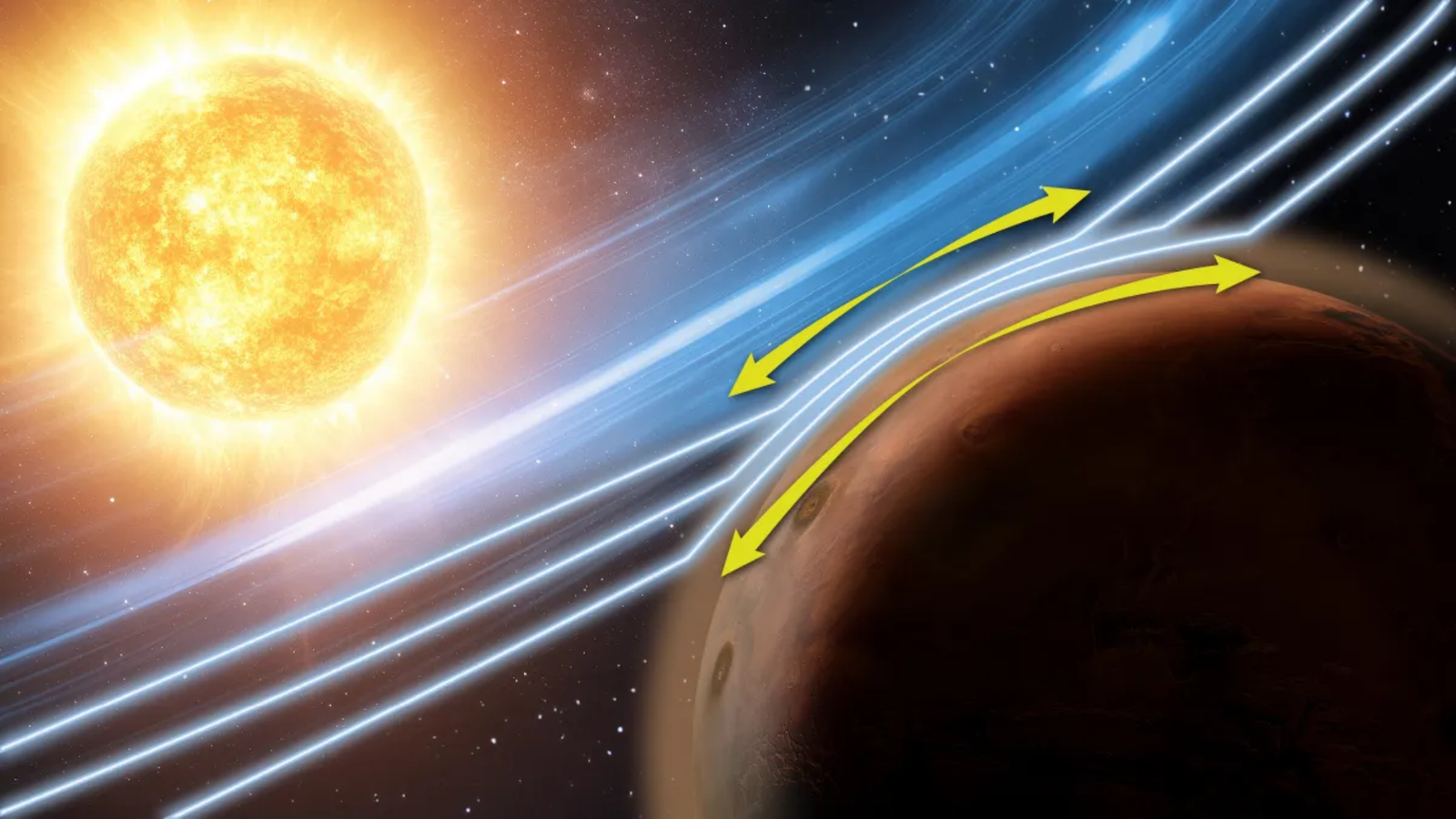
Even as NASA continues to try to restore contact with the MAVEN spacecraft after it fell silent in late 2025, scientists analyzing its data have spotted a phenomenon in Mars’ atmosphere that, until now, had only been observed around strongly magnetized planets like Earth.
The finding could help scientists better understand how space weather shapes worlds without protective magnetic shields, including planets such as Venus and Saturn’s largest moon Titan, the researchers say.
The phenomenon, known as the Zwan-Wolf effect, helps deflect the solar wind — the constant stream of charged particles flowing from the sun — as it encounters a planet’s magnetic environment. On Earth, a powerful magnetic field generated deep within the planet’s core creates a vast protective bubble, or magnetosphere, that continuously redirects those particles around the planet. Mars, however, lost most of its global magnetic field billions of years ago and today possesses only a much weaker, patchier magnetic environment formed when the solar wind interacts directly with the planet’s thin upper atmosphere.
This makes the new finding especially surprising, researchers say. Until now, the Zwan-Wolf effect had only been observed in the large magnetospheres surrounding strongly magnetized planets, not deep within a planetary atmosphere.
“No one expected that this effect could even occur in the atmosphere,” Christopher Fowler, a professor at West Virginia University who led the study, said in a statement. “That’s what makes this even more exciting.”
The discovery, he added, “introduces interesting physics that we haven’t yet explored and a new way the sun and space weather can change the dynamics in the Martian atmosphere.”
Fowler and his team identified the phenomenon while examining data collected by the now-silent MAVEN, short for Mars Atmosphere and Volatile Evolution, during the aftermath of a powerful solar storm that struck Mars in December 2023. Roughly 12 hours after the storm slammed into the planet, MAVEN recorded unusual fluctuations in Mars’ upper atmosphere, according to the study.
The team’s analysis showed charged particles were being funneled and squeezed along temporary magnetic structures created during the solar storm — behaving “like toothpaste coming out of a tube” — in a way that closely matched the Zwan-Wolf effect seen around Earth.
“When investigating the data, I all of a sudden noticed some very interesting wiggles,” Fowler said in the statement. “I would never have guessed it would be this effect, since it’s never been seen in a planetary atmosphere before.”
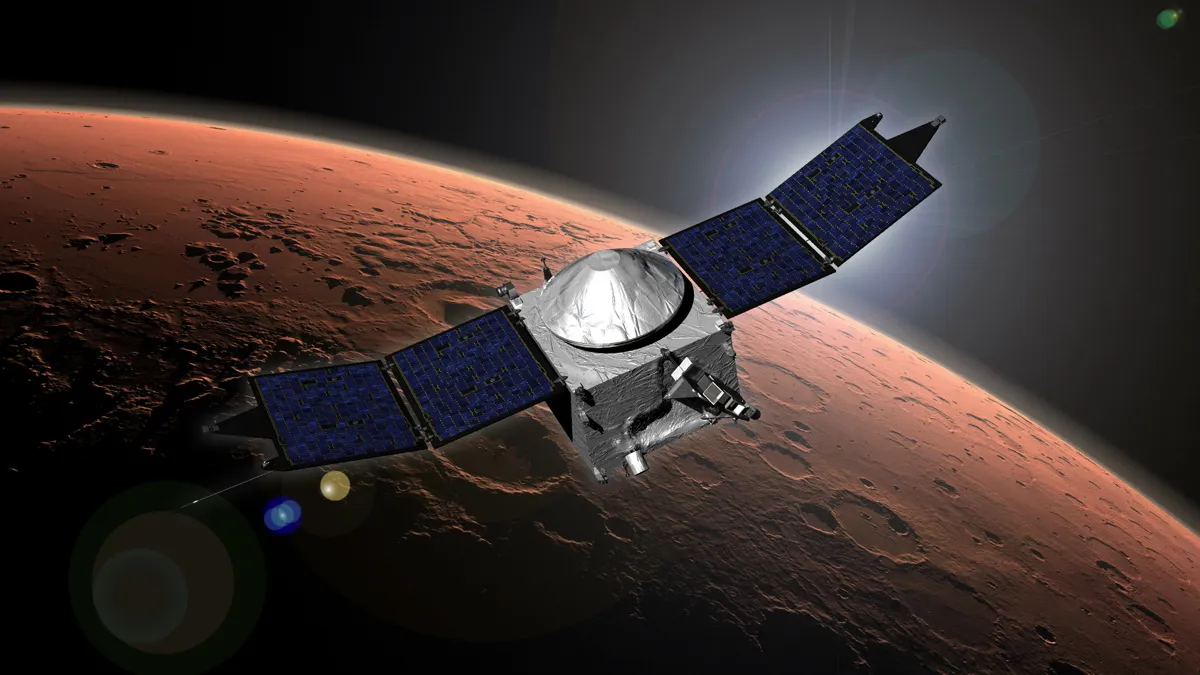
The findings also suggest the phenomenon may actually occur continuously on Mars, but under normal conditions it is likely too weak for MAVEN’s instruments to detect. Researchers say the intense solar storm temporarily amplified the effect enough for it to stand out clearly in the spacecraft’s observations.
“The effect likely operates continuously at Mars, but below instrumentation detection thresholds most of the time,” the study notes.
The discovery also arrives during an uncertain period for the MAVEN mission itself. The spacecraft, which has been studying Mars since 2014, lost contact with Earth in December 2025 after it was expected to emerge from behind Mars following a planned communications pause during a solar conjunction.
NASA’s attempts to reestablish contact have so far been unsuccessful, and the agency has launched an anomaly review board to assess the spacecraft’s condition and chances of recovery.
“We haven’t officially said MAVEN is lost yet,” Louise Prockter, director of NASA’s planetary science division, said during a town hall at this year’s Lunar and Planetary Science Conference in Texas.
“We’re still looking for it.”
The team’s results were published on May 18 in the journal Nature Communications.