

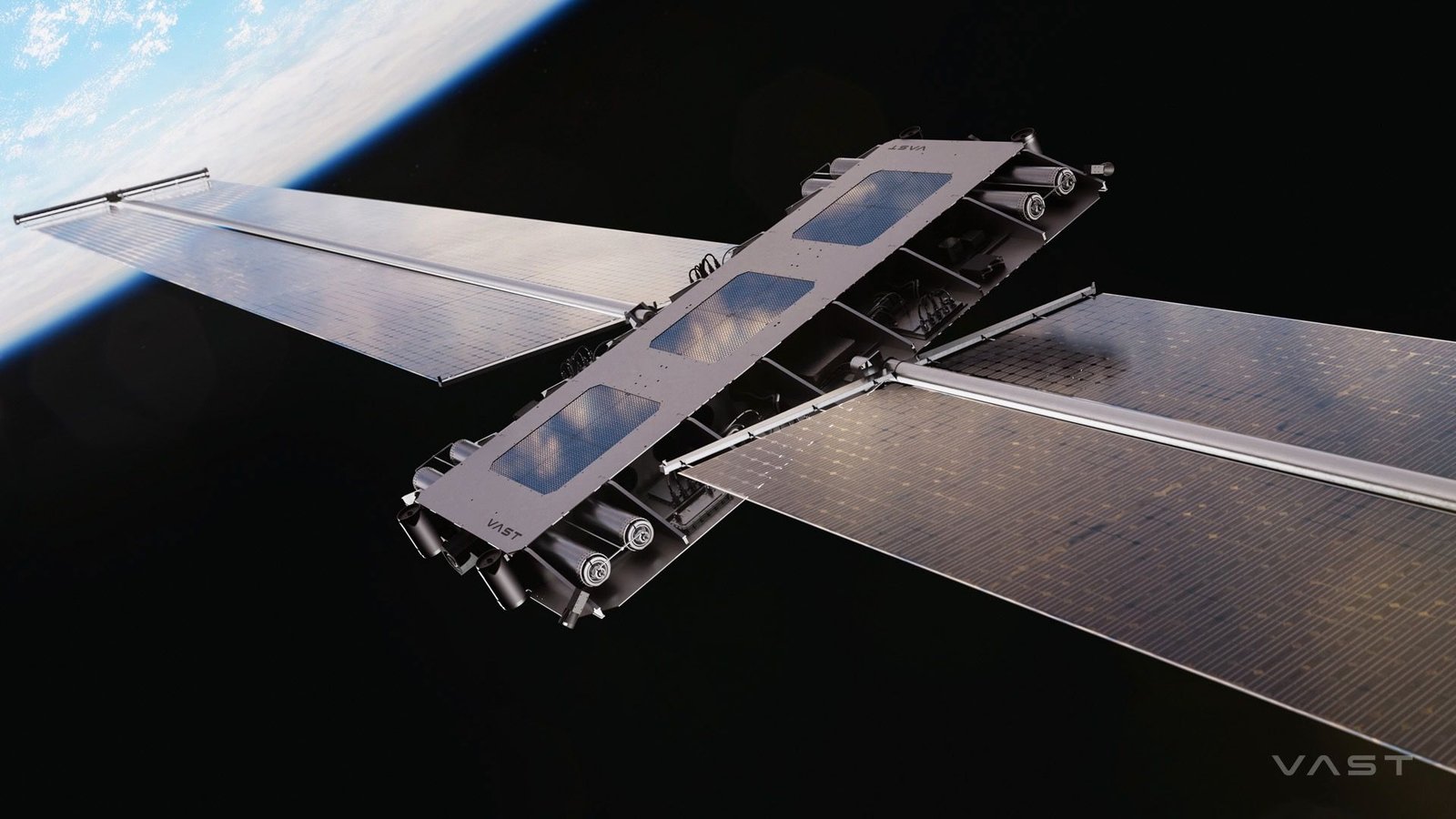
Vast isn’t just about private space stations anymore.
The California startup, which is developing the “Haven” series of private space stations, announced today (May 19) that it will build and sell satellites as well.
Vast Satellite will leverage technology that the company has already demonstrated in space, on a test flight called Haven Demo.
Haven Demo launched to low Earth orbit (LEO) aboard a SpaceX Falcon 9 rocket this past November, charged with verifying the performance of systems that will be key to the Haven orbital outposts — propulsion, power and avionics, for example. Everything went well, according to Vast, and the demonstrator performed a controlled deorbit into Earth’s atmosphere in February.
Haven Demo turned out to be a pathfinder for Vast Satellite as well, because Vast builds its core systems in house and will use them for the newly announced spacecraft buses, too.
“We believe Vast is uniquely positioned to compete in the high-power satellite market through the combination of our world-class engineering team, large-scale manufacturing capabilities and the on-orbit success of Haven Demo,” Vast CEO Max Haot said in the same statement.
“Customers can benefit from our experience designing, building and operating flight-proven large-scale spacecraft while gaining access to highly capable, flexible spacecraft platforms backed by operational expertise,” he added.
And Vast already has a customer — a confidential one that has committed to buy four satellites, with an option to purchase 200 more, according to the statement.

The first offering in the Vast Satellite line will be a 15 kilowatt-class bus “designed to support a wide array of power-intensive missions through flexible configurations,” Vast wrote in the statement.
That bus will weigh about 1,540 pounds (700 kilograms) unfueled and be capable of carrying more than 770 pounds (350 kg) of payload. It’s designed to operate for five years in LEO, though other orbits will be possible in the future. Vast plans to launch a batch of these spacecraft — 10 of them — to orbit for the first time in late 2027.
Meanwhile, the company continues to work on its Haven project, which aims to have the multimodule Haven-2 space station up and running by the time the International Space Station retires in the early 2030s.
The company plans to launch a pathfinder called Haven-1 in 2027. If all goes well, Haven 2’s first module will lift off in 2028, with additional modules going up every six months thereafter for the next four years.