

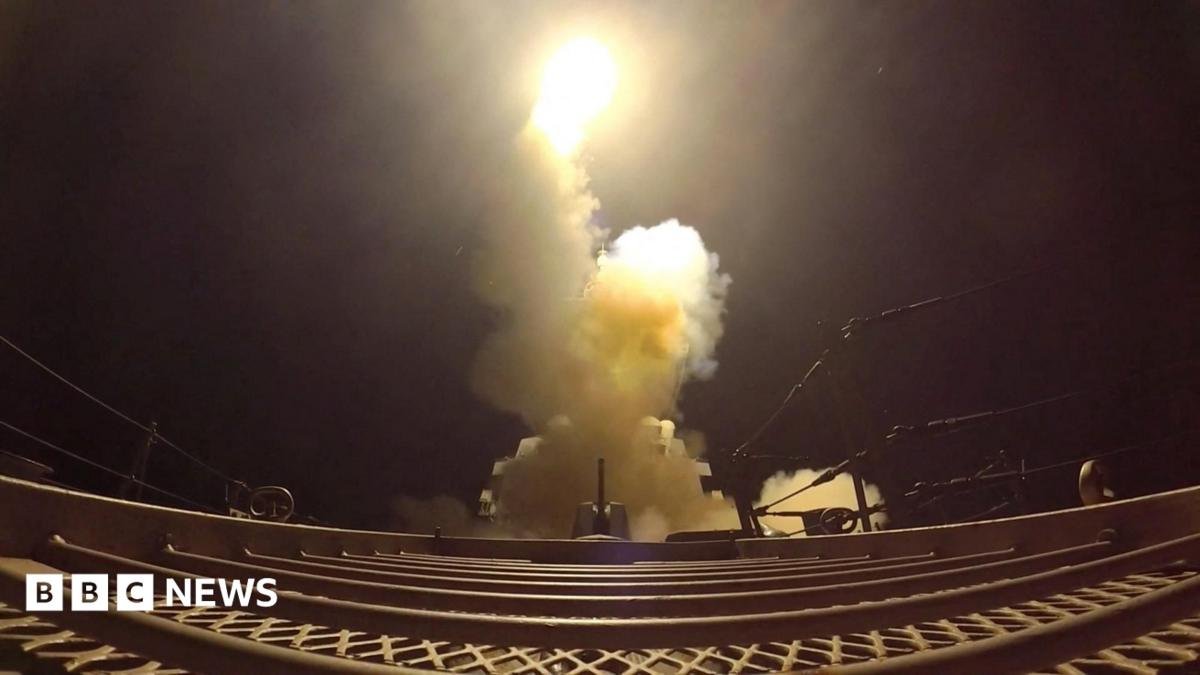
Shortly after 17:00 ET (21:00 GMT) on Sunday, US Central Command said it had begun a new round of strikes across Iran.
Fighter jets, naval vessels, and one-way attack aerial and sea drones targeted Iranian air-defence systems, coastal radar sites, and missile and drone capabilities, a later statement said.
US forces were “prepared to ensure that freedom of navigation remains available to commercial shipping despite Iran’s continued unwarranted aggression, harassment, threats, and arbitrary declarations,” it added.
Minutes before the initial Centcom announcement, Iranian state TV reported explosions in several locations along the country’s Gulf coast, including in Sirik, Qeshm Island, Bandar Abbas and Jask.
State news agency Irna reported that a US strike killed one person at a water pumping station in the south-western city of Mahshahr, in Khuzestan province.
A telecommunications company worker was also killed in a strike in Hormozgan province, to the east, it added.
On Monday afternoon, Irna cited an official in Khuzestan as saying that two people had been killed in US strikes in the border city of Abadan. It also said several fresh explosions had been heard in Qeshm and Bandar Abbas.
The Islamic Revolution Guard Corps (IRGC) said Iran had retaliated for the overnight strikes with a series of attacks on US military bases and infrastructure in the Middle East.
These included fuel tanks and ammunition dumps at the Prince Hassan air base in Jordan, a drone command-and-control centre and radar systems in Bahrain, a missile base in Kuwait, and a radar system in Oman.
The Jordanian armed forces said on Monday morning that they intercepted four missiles that entered the kingdom’s airspace from Iranian territory, and that no casualties or material damage were reported.
Kuwait’s military meanwhile said that its air defence systems engaged “hostile aerial targets” within its airspace, and Bahrain’s military said it had intercepted and destroyed “several treacherous Iranian aerial attacks”.
Later on Monday, Iranian state TV said the IRGC’s naval forces had fired “warning shots” at two ships attempting to “illegally” transit the Strait of Hormuz.
Iran pledged to allow the safe passage of commercial vessels through the strait according to the memorandum of understanding it signed with the US last month.
However, it has launched missiles and drones at a number of ships that it has said are using an unauthorised route through Omani territorial waters.
In an interview with Fox News on Monday, Trump said the US was hitting Iran “very hard” because it had broken the deal on the Strait of Hormuz.
“We’re going to keep the strait, and we’ll probably run it. We’ll become the guardian of the strait,” he added. “And we should be reimbursed for that.”
Later, Trump wrote on Truth Social that the US was immediately reinstating its naval blockade of Iranian ships and vessels using Iranian ports.
“All other countries will have fair and open use of the Strait,” he added.
“The U.S.A. will be, from this point forward, known as ‘THE GUARDIAN OF THE HORMUZ STRAIT,’ but as such, and as a matter of FAIRNESS, will be reimbursed, at the rate of 20% on all cargo shipped, for any and all costs necessary to do the job of providing safety and security to this very volatile section of the World.”
An IRGC spokesman said that by interfering in the Strait of Hormuz the US had “seriously endangered the security of the world’s oil and gas supply and must be held accountable”, according to Irna.
He also declared that Iran would “continue to exercise sovereignty over and management of the Strait of Hormuz”.
Iran’s foreign ministry said in a statement earlier on Monday that the US attacks were “rendering futile” all efforts to reduce tensions.
“The US regime has also caused the return of insecurity in the Strait of Hormuz and disruption of international commercial shipping by openly interfering in the process of Iran implementing the necessary arrangements in the Strait of Hormuz,” it added.
Foreign ministry spokesman Esmail Baqai told reporters that Iran was trying to agree a joint mechanism with Oman to manage traffic through the strait, but that pressure on Muscat from Washington was impeding progress.
Additional reporting by Goncheh Habibiazad.