

During the Biden administration, clean energy developers in the Philadelphia area planned to take advantage of new, expanded federal support for renewable projects for years. Now, as the Trump administration and congressional Republicans roll back many of those policies, sustainability work in the region is taking place on shifting terrain, requiring major players to reconfigure their plans around expiring tax credits and undermining those still to come.
Last year’s One Big Beautiful Bill Act (OBBBA) accelerated the phaseout of federal investment tax credits for renewable energy that had been expanded drastically in the Inflation Reduction Act (IRA), the climate-spending package passed by congressional Democrats and signed into law by President Joe Biden in 2022.
The Republican-backed OBBBA set a rapidly approaching July 4, 2026, deadline for renewable projects to begin spending to remain eligible for the credits during construction. The law therefore essentially cut the window during which developers could count on credits from nine more years to one. If they don’t meet the July 4 deadline, projects need to be completely operational by the end of 2027 to receive federal support, a tall task given permitting and approval needs, community resistance and complicated financing.
Public-sector clean energy projects in Philadelphia are moving the region toward sustainability goals that have long been difficult to achieve in fossil fuel-dependent Pennsylvania, but they also require facilitation and approval from slow-moving bureaucratic bodies. While some project leaders are confident they will meet the changed deadlines, others are likely to be left behind. David Masur, executive director of PennEnvironment, said it was safe to assume that the sunsetting of federal credits would result in slower grid-scale renewable growth in the commonwealth.
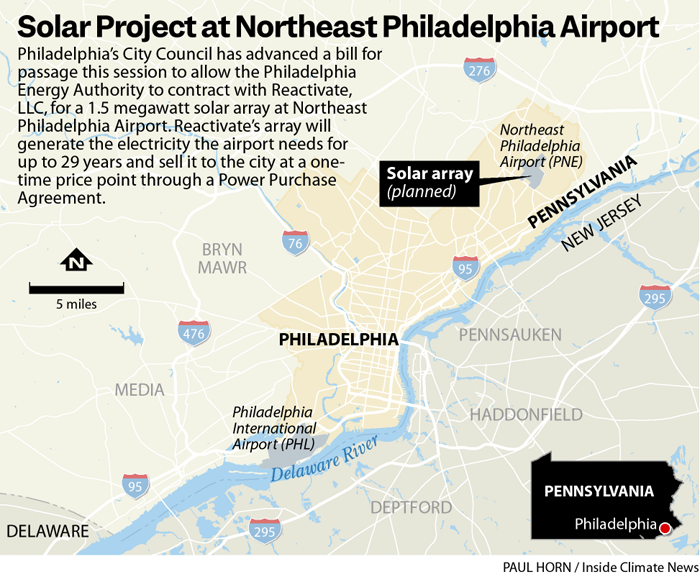
The Philadelphia Energy Authority (PEA) was established by the mayor and city council in 2010 as an independent municipal agency to facilitate large-scale energy projects that the city couldn’t. On June 12, Mayor Cherelle Parker signed into law a bill allowing the authority to contract with Chicago-based renewable energy company Reactivate to build and operate a 1.5 megawatt solar array at Northeast Philadelphia Airport—the smaller of the city’s two airports used for private and recreational flying. The project, once built, would be the largest municipal solar project within city limits and would satisfy all of the energy needs of the airport, its sole consumer. It is also a project that the PEA has tried to move through its bureaucratic process quickly to be in service by the end of 2027.
Because of the federal changes, project leaders made it a requirement to find a vendor confident they could complete construction by the end of 2027 and designed a more aggressive procurement timeline, said Lisa Shulock, director of commercial programs. While the agency will oversee, it’s ultimately Reactivate that must work to meet the operational deadline. Noting the legislative, financial and technical aspects of getting a project off the ground, Shulock said they also planned further ahead to give the necessary lead time—“whatever you think the timeline is plus 50 percent for each component of it”—while staying eligible. “We never know with a project like this what obstacles you might run into, but we have, I believe, enough time built into the schedule that we should achieve our goal of obtaining the [investment tax credit],” Shulock said.
The statewide Solar for Schools program—a rare bipartisan clean energy policy to pass Pennsylvania’s divided legislature in 2024—is another example of public sector renewable investment in the region that was designed with the federal tax credits in mind. The initiative, spearheaded by state Rep. Elizabeth Fiedler, secured $25 million in state funding each of its first two years to help schools across the commonwealth install solar arrays to meet their electricity needs.
The federal tax credits were “extremely helpful” for their complementary effect on the Solar for Schools program, Fiedler said in a statement. “Schools that received Solar for Schools funding in Year 1 have been working tirelessly to start and complete their projects in time to be eligible for remaining IRA tax credits.” Districts hoping to invest in solar typically must have their spending plans approved by school boards, a step that often poses more political and timing challenges.
Cuts to federal support were “cruel and short-sighted,” said Fiedler, who knows how difficult it is to get pro-environmental legislation through the Republican-controlled Senate and signed into law.
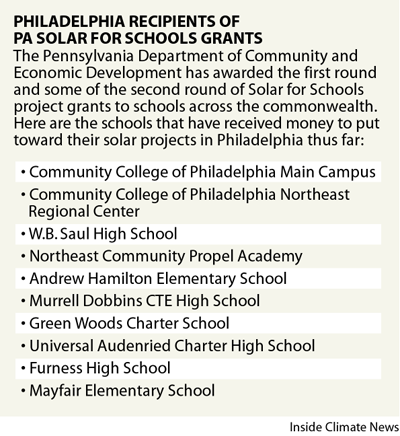
Some schools reportedly planned to use the federal credit to pay for as much as 50 percent of their projects, in combination with state funds. While most Solar for Schools recipients are moving forward, a small group of schools have had to abandon their renewable energy plans, said Shannon Crooker, Pennsylvania Director for Generation 180, a group that supports schools with solar installation. Some of these schools decided to do so after receiving state funding that wouldn’t be sufficient without federal funding and others decided not to apply for state grants at all. “A handful saw the writing on the wall […] that this new administration was likely to get rid of the [investment tax credit],” and saw it as a coupon that was likely to expire, Crooker explained.
Now, renewable projects must spend 5 percent of their total costs by July 4—one year after the Republican law’s original passage— to unlock four years of construction time while remaining eligible. Crooker said schools that don’t start spending by July 4 may struggle to bring projects online by the end of 2027 due to delays by regional utilities in securing grid connections.
Due to a federal judge’s ruling last week that struck down the Trump administration’s plan to further narrow the eligibility window for clean energy, even these tight timelines are more manageable than many were working with earlier this year. But the changes have added to the difficulties that current projects face to get off the ground and mean that they might be among the last new public-sector clean energy investments able to do so in time for federal support.
The One Big Beautiful Bill Act therefore takes the country back to a shifting landscape for clean energy that many of both parties hoped the IRA would stabilize.
The IRA expanded and extended the investment tax credit for renewable energy to 30 percent, sometimes more, of installation costs all the way through 2032 before gradually phasing out. While tax credits for clean energy long predate the Biden years, policy inconsistency caused by federal transitions of power made the large-scale investments necessary for a greener economy difficult. The IRA sought to change that by creating an extended period of stable, expanded support for potential renewable developers to rely on as they planned.
Pennsylvania had much to gain from federal support for renewable energy. With its powerful fossil fuel industry, the commonwealth has struggled to expand clean energy since the beginning of the fracking boom and ranked 49th in the U.S. in 2024 for the percentage of energy generated by renewable sources. Masur called Pennsylvania the “Bermuda Triangle” for clean energy, given the combination of major regional grid interconnection backlogs, weak incentives and efficiency standards at the state level, and, now, Trump-influenced resistance to clean energy in some counties and the administration’s recent sunsetting of federal financial support. The IRA repeal “becomes like death by a thousand cuts,” Masur said.
This story is funded by readers like you.
Our nonprofit newsroom provides award-winning climate coverage free of charge and advertising. We rely on donations from readers like you to keep going. Please donate now to support our work.
Fiedler’s office told Inside Climate News that it is “more important than ever for the state to take action and lead on renewable energy generation in the face of these federal IRA rollbacks,” but Masur said that he hasn’t heard much discussion among state lawmakers about renewable energy policies as the legislature moves into fiscal year 2027 budget negotiations. Rising electricity prices and data center concerns have taken priority in energy policy conversations in the legislature.
After President Trump’s election in 2024, it became clear that he would work with Republican majorities in both chambers of Congress to eliminate much of the IRA, including its expansions of the investment tax credit. But the economic investment in clean energy projects that followed the IRA—almost three-quarters of which took place in Republican-leaning states—convinced even some Republicans of the need for the IRA’s bigger and more consistent incentives. Those Republicans pushed for and secured a temporary “safe harbor” for clean energy projects—the 5 percent spending by July 4 option—and somewhat reduced the abruptness of the credit’s accelerated phaseout.
Republicans more hostile to sustainability efforts—specifically those in the House Freedom Caucus—pressured Trump last summer to use non-legislative mechanisms to undermine even that protection. He did that just days after signing the One Big Beautiful Bill Act into law, writing in an executive order that ending the tax credits was “vital to energy dominance, national security, economic growth, and the fiscal health of the Nation.”
The order created a short period in July 2025 during which renewable developers watched their once-comfortable window for federal tax credits not only shortened to just one more year, but become far narrower with an executive order requiring that projects show “substantial construction” completed by July 4, a much harder feat than spending 5 percent of costs.
On June 8, however, Judge Colleen Kollar-Kotelly of the U.S. District Court for the District of Columbia struck down the Internal Revenue Service guidelines that emerged from Trump’s order and decided they unfairly targeted solar and wind investments, restoring the 5 percent rule for now.

PEA was confident that it would reach a contract with Reactivate soon after city council approval. That process will set up the leasing of the land and allow PEA to buy back Reactivate’s solar energy for up to 29 years at a one-time rate, protecting the city from energy market volatility. Because of that symbiotic relationship, the city council seemed largely on board with the airport plans, so the task became more about securing their approval in time to begin operating by the end of 2027 than about convincing skeptics.
Katie Bartolotta, vice president of policy and strategic partnerships at PEA, highlighted the importance of projects like the airport array, both to “chip away” at the city’s carbon footprint and to provide visible evidence of the region’s energy transition. “I’m always really happy when we can partner with a city department to do exactly what we’re here to do, which is enable different types of projects,” Bartolotta said, describing PEA as an agency that allows the city to meet its long-term sustainability goals.
Solar for Schools has been seen as a slam dunk for those hoping to build more clean energy across Pennsylvania. State leaders like Fiedler and Gov. Josh Shapiro, and even some Republicans, cite the program as an example of successful climate legislation that came during a period when environmental activists grew frustrated by the protracted battle over joining the Regional Greenhouse Gas Initiative and the lack of long-term funding solutions for mass transit. As Fiedler and her allies fight to fund the program for a third year, however, a key part of the legislation’s original appeal will be missing.
Fiedler highlighted that schools will save money from solar even without federal IRA funds and that “state funds can make or break financial feasibility of installing solar panels.” Similarly, Bartolotta said it was too early to tell the full impact that the sunsetting tax credits will have on Philadelphia-area clean energy generation, but that she was optimistic there will continue to be a market for it.
At PEA, Shulock noted an uptick in organizations interested in building solar projects before credits expire. The upcoming deadlines have “definitely created urgency in all the conversations we have with commercial property owners, like, ‘Hey, if you’re thinking about solar, stop thinking and start acting,’” she said.
About This Story
Perhaps you noticed: This story, like all the news we publish, is free to read. That’s because Inside Climate News is a 501c3 nonprofit organization. We do not charge a subscription fee, lock our news behind a paywall, or clutter our website with ads. We make our news on climate and the environment freely available to you and anyone who wants it.
That’s not all. We also share our news for free with scores of other media organizations around the country. Many of them can’t afford to do environmental journalism of their own. We’ve built bureaus from coast to coast to report local stories, collaborate with local newsrooms and co-publish articles so that this vital work is shared as widely as possible.
Two of us launched ICN in 2007. Six years later we earned a Pulitzer Prize for National Reporting, and now we run the oldest and largest dedicated climate newsroom in the nation. We tell the story in all its complexity. We hold polluters accountable. We expose environmental injustice. We debunk misinformation. We scrutinize solutions and inspire action.
Donations from readers like you fund every aspect of what we do. If you don’t already, will you support our ongoing work, our reporting on the biggest crisis facing our planet, and help us reach even more readers in more places?
Please take a moment to make a tax-deductible donation. Every one of them makes a difference.
Thank you,

Fellow
Daniel Perrin is a Philadelphia-based fellow at Inside Climate News, covering urban environmental issues. He is a rising senior at Swarthmore College, where he studies economics, literature, and history. He just finished serving as Editor-in-Chief of The Swarthmore Phoenix, overseeing the campus paper and reporting on trends within higher education, economic policy, sustainability, transportation, and governance at all levels. Having grown up in Chapel Hill, NC, before moving to Baltimore, he is especially interested in how large political and economic developments ripple through the built environment of local communities.