

Close Menu

    Subscribe to Updates

    Get the latest news information from worldwide businesses.

    What's Hot

    Randy Orton’s wife shares family update

    June 9, 2026

    General Motors Is Bringing Sodium-Ion Battery Production To America

    June 9, 2026

    Toyota and Lexus are going big with their first 3-row electric SUVs

    June 9, 2026
    Facebook Instagram YouTube LinkedIn X (Twitter)
    Trending
    • Randy Orton’s wife shares family update
    • General Motors Is Bringing Sodium-Ion Battery Production To America
    • Toyota and Lexus are going big with their first 3-row electric SUVs
    • Las Vegas’ Food Scene Is All Grown Up—Here Are the 29 Best Restaurants in Sin City
    • Topical gel helps burn wounds heal faster using an existing FDA-approved drug
    • GM thinks EVs can help offset AI’s energy suck with vehicle-to-grid tech
    • GM joins race to build batteries for AI data centers and the grid
    • Bombay HC rejects Lilavati Trust’s interim application against HDFC Bank in ₹1,000 crore dispute
    Newspublicly
    • About Us
    • Advertise & Partner with us
    • Pitch Your Story
    • Contact Us
    Facebook Instagram LinkedIn X (Twitter)
    Subscribe
    • Home
    • World News
      • Asia
      • India
      • USA
      • UK & Europe
      • Middle East
    • Economy & Business
      • Global Economy
      • Corporate & Industry
      • Finance & Markets
      • Policy & Trade
    • Technology
      • Gadgets & Devices
      • Software & Apps
      • AI & Machine Learning
      • Robotics & Automation
    • Health & Medicine
      • Fitness & Nutrition
      • Research & Innovation
      • Disease & Treatment
      • Doctors, Clinics & Patient Care
    • Travel & Tourism
    • Automobile
      • Electric & Hybrid Vehicles
      • Auto Industry Insights
    • Sports
    • More
      • Education
      • Real Estate
      • Environment & Climate
      • Space & Astronomy
      • War & Conflicts
    Newspublicly
    Home»More»Space & Astronomy»Thruster breakthrough? New 2-in-1 propulsion system is about to get an in-space test
    Space & Astronomy

    Thruster breakthrough? New 2-in-1 propulsion system is about to get an in-space test

    AdminBy AdminJune 9, 2026No Comments4 Mins Read0 Views
    Share
    Facebook Twitter LinkedIn Copy Link WhatsApp


    It’s hard to fit everything on a small satellite, especially the fuel, but a new propulsion system could make it easier.

    Instead of having separate fuel for chemical thrusters and electrical thrusters, a Massachusetts Institute of Technology (MIT) study suggests that a single propellant can power both kinds of systems. And this idea will get an in-space test soon, if all goes according to plan.

    “If you can have chemical and electrical propulsion in one small package, it’s the best of both worlds,” Amelia Bruno, a former postdoctoral student at MIT who led the new study, said in a university statement on Monday (June 1). “This opens the door for small satellites to do even more science, more observations, and more interesting missions, all on a smaller and cheaper platform.”

    The study borrows from fuel research by the U.S. Air Force, and it was partially funded by NASA. The space agency’s Green Propulsion Dual Mode cubesat spacecraft will launch no earlier than November to see if the propulsion system and monopropellant, already tested on the ground, also works well in space.

    The mission to low Earth-orbit will serve as a valuable demo, the agency stated, for missions that go much farther from our planet — to places such as Mars, the eventual destination for human missions under NASA policy.


    You may like

    “NASA is looking to expand deeper into space to support future agency objectives. Major drivers for these activities include researching and developing new and advanced propulsion systems and capabilities,” agency officials wrote of the cubesat mission, which last year was expected to launch in October 2025, according to a SpaceNews report.

    The green monopropellant the mission is using, tested in a new MIT study in the Journal of Propulsion and Power, builds upon previous Air Force research. The propellant is called ASCENT, or Advanced Spacecraft Energetic Non-Toxic Propellant. The fuel is marketed as greener, or less toxic, than the usual high-efficiency hydrazine that is perfect for making big maneuvers in space but is dangerous to handle. It’s also been tested in space before, during NASA’s Green Propellant Infusion Mission in 2019-20 (when the fuel was called AF-M315E; it has since been renamed, according to the Air Force Research Laboratory, which developed it).

    Space

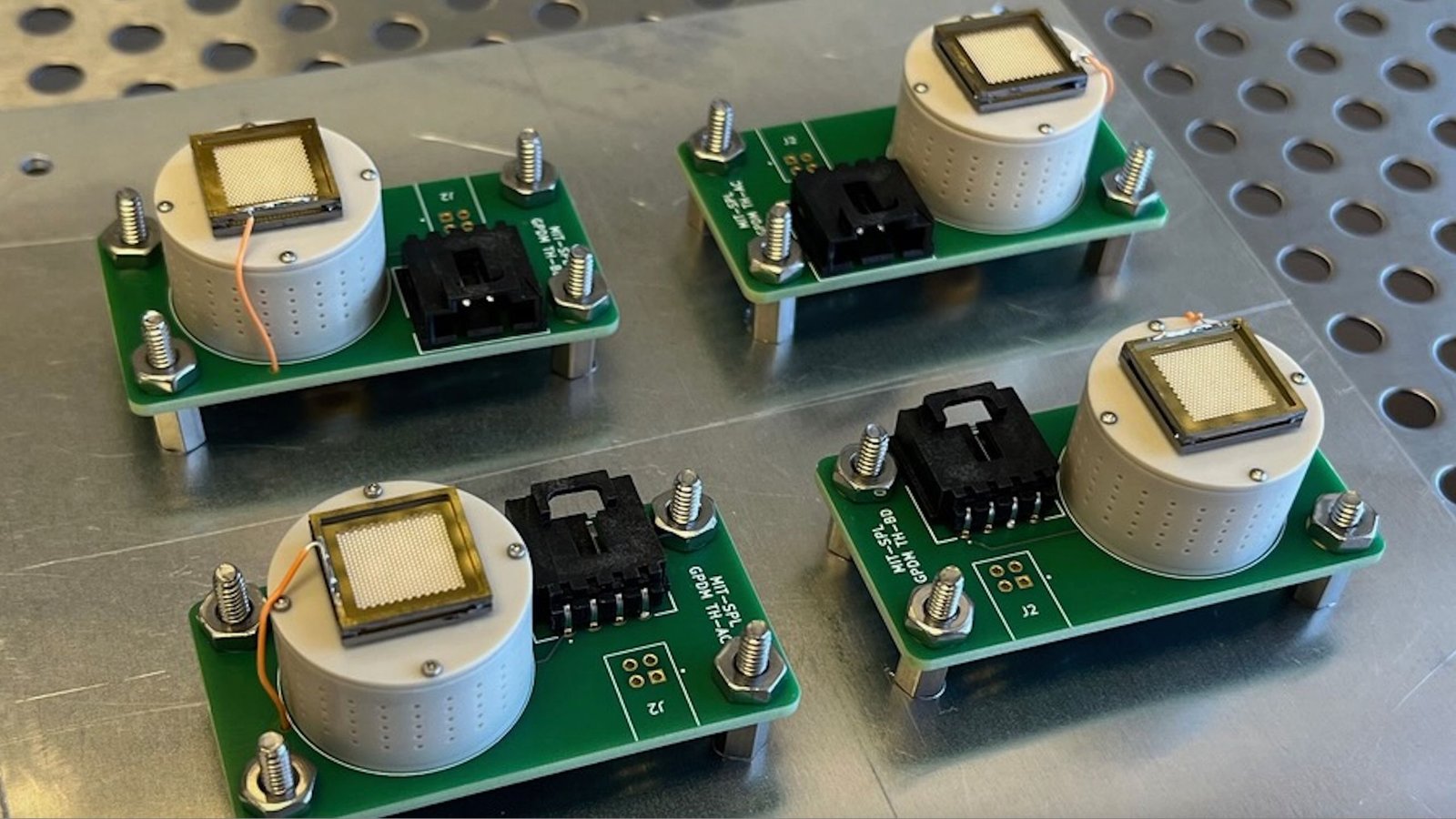
    What’s more, ASCENT — despite being originally envisioned for chemical thrusters that use fuel quickly, during big space moves like orbital insertions — may also be suitable for electrospray thrusters. These thrusters are designed to make smaller, long-term adjustments to a spacecraft’s trajectory. The tiny (thumbnail- to dime-sized) thrusters use an electric field to accelerate particles of liquid propellant. The acceleration fires the propellant into space as a spray (hence the name).

    The new MIT study appears to show that one fuel could serve different spacecraft needs. Engineers tested how well electrospray thrusters on the ground performed with ASCENT, using a model cubesat set on a testbed that magnetically suspended a device in a vacuum chamber, simulating the free-floating environment of space. The team tried out different voltage levels on the thrusters and examined the spray’s ability to maneuver and spin the cubesat.

    “Compared to our normal electrospray propellants, ASCENT can provide similar performance in terms of thrust,” Bruno said. “Now that we know our thrusters work with ASCENT, we can start thinking of all the ways we can make them even better.”

    While NASA’s focus is on distant destinations, ASCENT could also be repurposed for missions closer to home. Small satellites, for example, could make use of the propellant to save fuel during Earth-observing missions, especially when they’re tasked to pivot for a fast-moving weather event.

    “Say there’s a storm coming, and you’d want to deploy your constellation of small satellites to observe over one location,” study co-author Paulo Lozano, director of MIT’s space propulsion laboratory, said in the same statement. “You could choose to send them quickly, or slowly, depending on the nature of the observation. And the only way to do that is if you have two propulsion systems, which is now possible.”


    Source link

    Author

    • Admin

      NewsPublicly.com is News & Articles Platform that creating SEO-focused articles on travel, lifestyle, and digital trends.

    Admin
    • Website

    NewsPublicly.com is News & Articles Platform that creating SEO-focused articles on travel, lifestyle, and digital trends.

    Related Posts

    Don’t miss the moon and Saturn put on a spectacular show before sunrise June 10

    June 9, 2026

    Do galaxies have a ‘kill switch’ that makes them stop growing?

    June 9, 2026

    NASA reveals Artemis 3 astronaut crew

    June 9, 2026
    Leave A Reply Cancel Reply

    Demo
    Top Posts

    The Blue Moon rises on May 30— Where and when to see the second full moon of the month

    May 30, 202640 Views

    New SOCOM rifle allows barrel swapping and cartridge changes

    June 1, 202632 Views

    “Inside Gemini Robotics 1.5: How Robots Learn to Reason & Act

    November 22, 202525 Views

    525 pounds of cocaine seized after Nebraska K9 alerts troopers on I-80

    May 28, 202624 Views
    Don't Miss

    Randy Orton’s wife shares family update

    June 9, 20263 Mins Read0 Views

    Randy Orton’s wife shared a personal update today amid the legend’s absence from WWE. The…

    General Motors Is Bringing Sodium-Ion Battery Production To America

    June 9, 2026

    Toyota and Lexus are going big with their first 3-row electric SUVs

    June 9, 2026

    Las Vegas’ Food Scene Is All Grown Up—Here Are the 29 Best Restaurants in Sin City

    June 9, 2026
    Stay In Touch
    • Facebook
    • Twitter
    • Instagram
    • YouTube
    • LinkedIn
    • WhatsApp

    Subscribe to Updates

    Get the latest creative news from SmartMag about art & design.

    Demo
    NEWSPUBLICLY
    Facebook X (Twitter) Instagram LinkedIn

    Home

    • About Us
    • Leadership
    • Advertise & Partner With Us
    • Pitch Your Story
    • Media Kit & Pricing
    • Career
    • FAQs

    Guidelines

    • Editorial & Submission
    • Partnership
    • Advertising & Sponsor
    • Intellectual Property Policy
    • Community & Comment
    • Security & Data Protection
    • Send Your Opinion

    Quick Links

    • Cookie Policy
    • Payment & Billing Terms
    • Refund & Cancellation
    • Copyright Policy
    • Complaint & Support
    • Sitemap
    • Contact Us

    Subscribe Us

    Get the latest news and updates!

    Copyright © 2026 Newspublicly (DIGITALIX COMMUNICATION). All Rights Reserved.
    • Privacy Policy
    • Terms of Use
    • Disclaimer