

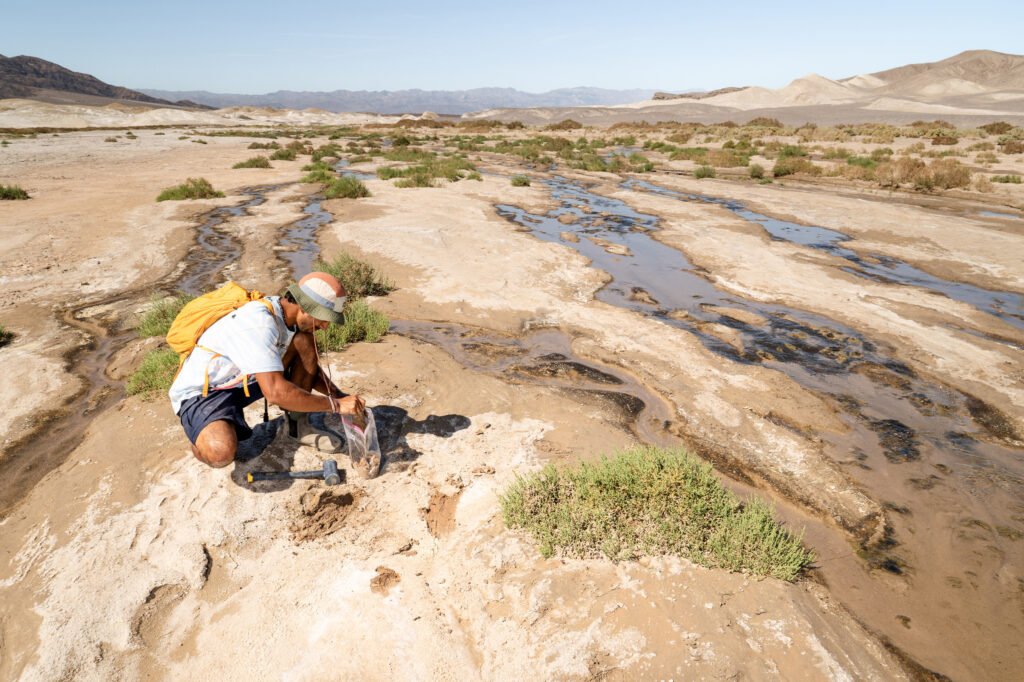
Hidden underground around the world lie 110 quadrillion kilometers of arbuscular mycorrhizal fungal networks—webs of ultra-thin threads that, if connected in a single line, would stretch almost a billion times thge distance between the Earth and the sun, according to new research published in Science on Thursday.
These fungal communities form intimate relationships with the roots of plants, which they provide with nutrients like phosphorus and nitrogen in exchange for carbon, 1 billion tons of which the networks sequester underground annually, previous research has found. If the fungal network wasn’t storing it, that carbon would be warming the atmosphere.
But those networks have never been mapped globally until now. The new study led by Society for the Protection of Underground Networks, or SPUN, an organization founded to map mycorrhizal fungi networks, used a combination of literature review, soil samples from around the globe, machine learning and laboratory testing to estimate the distribution and mass of these systems and map where they are densest.
“This is the moment where we went from knowing that this system exists to really knowing where it is, how dense it is and where it’s been,” said Toby Kiers, executive director and co-founder of SPUN and a co-author of the study.
For decades, researchers have known arbuscular mycorrhizal fungi form intimate symbiotic relationships with roughly 80 percent of the globe’s plant species and are found nearly everywhere plants are. But the extent of those networks and where they are densest, such as grasslands, and where they are being lost, like in agricultural areas, hasn’t been well understood until now.
“[The study] helps us come to grips with how important these below ground organisms can be to everything that we see above ground,” said James Bever, a professor of ecology and evolutionary biology at the University of Kansas who studies the interactions between plants and microbes like fungi in soils but was not involved in the new study.
Justin Stewart, an evolutionary ecologist at SPUN and lead author of the study, said previous studies the team had done on biodiversity of fungi were similar to asking someone to describe the forest outside their home.
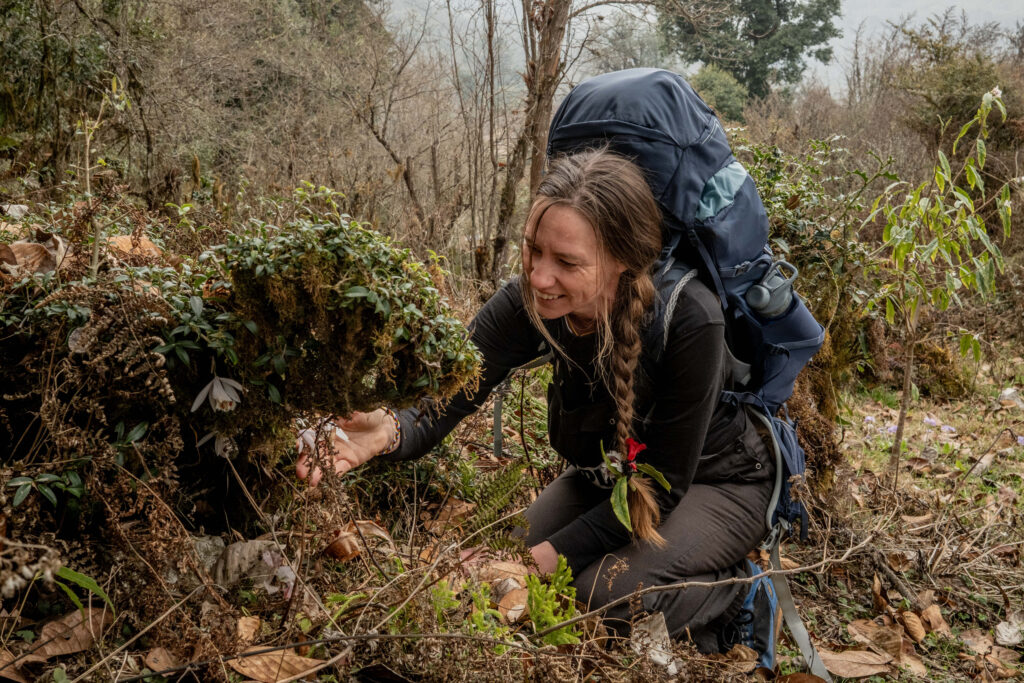
Justin Stewart, an evolutionary ecologist at SPUN, samples soil in Tucson, Ariz. Credit: John Burcham/SPUN
“They could say ‘well there are three tree species in it.’ That’s great. That tells me about the biodiversity,” he said. “But you don’t actually know how big the forest is, how far apart the trees are. You don’t have information on its structure.”
Mycorrhizal fungal networks are made up of hyphae, each smaller than a strand of human hair. These living pipes transport the nutrients and carbon between the plants and fungi.
Because they are so long and thin, Stewart said, they can reach deeper into soils than roots, getting nutrients deep underground that plants can’t reach, while simultaneously storing carbon where it can stay put for a long time under the right conditions.
“You’re getting a win-win,” Stewart said. “The plants are growing better, and carbon’s being drawn down. That all depends on having dense fungal networks and soils that are active and alive.”
This story is funded by readers like you.
Our nonprofit newsroom provides award-winning climate coverage free of charge and advertising. We rely on donations from readers like you to keep going. Please donate now to support our work.
Quantifying these fungal networks started with a review of existing studies on mycorrhizal fungi. Those studies contained 16,000 core samples taken from ecosystems around the world to understand the length of the fungal threads in a volume of soil. Each sample was geolocated, and from there the team was able to use machine learning to create predictive maps of fungal networks globally, and identify where the model is performing well and where uncertainties show more data is needed.
Working with AMOLF, a research institute in Amsterdam, they developed a technique using a robot with a camera that recorded fungal networks growing over time in a lab, to get better estimates of their widths. From there, the team was able to calculate the network’s mass, which amounted to about five times the weight of all humans on Earth.
The study only covers living arbuscular mycorrhizal fungal networks, Stewart said, and doesn’t include dead fungal networks, which also help to store carbon and add to the total biomass and influence of the networks on ecosystems. Research into dead fungal networks is still being explored.
The study also found where these networks are most threatened. Fungal network densities across croplands are about half of what they are in wild ecosystems. Meanwhile, wild grassland ecosystems hold about 40 percent of the world’s arbuscular mycorrhizal biomass. Yet those grasslands are among Earth’s least protected ecosystems, and they are converted into farmland at four times the rate of forests, posing a potential threat to these networks and the benefits they bring to plant life and carbon storage.
Previous research from SPUN hasfound 90 percent of fungal communities across the globe are unprotected, and many ecosystems, like the deserts of the American Southwest, are understudied.
What exactly is driving mycorrhizal fungi losses, and the consequences of that decline, need to be explored next, the researchers said, which is why the SPUN team will be at this year’s United Nations Climate Change Conference—COP31—to present to policymakers about the importance of the networks and the role they could play in protecting ecosystems and sequestering carbon.
Understanding mycorrhizal fungi more deeply at the ground level is key, said Corentin Bisot, an AMOLF biophysicist and co-author of the study.
“We’re still far from completely understanding how, if you have a grassland next door, and you want to [increase] microbes and fungi there,” Bisot said. “We don’t have the toolbox for you to do it.”
This study, Stewart said, is just the first map. And like the first maps the Spaniards drew of California—which presented the state as an island, he said, there will be new discoveries about the density of fungi networks around the globe to grow the public’s understanding of them.
About This Story
Perhaps you noticed: This story, like all the news we publish, is free to read. That’s because Inside Climate News is a 501c3 nonprofit organization. We do not charge a subscription fee, lock our news behind a paywall, or clutter our website with ads. We make our news on climate and the environment freely available to you and anyone who wants it.
That’s not all. We also share our news for free with scores of other media organizations around the country. Many of them can’t afford to do environmental journalism of their own. We’ve built bureaus from coast to coast to report local stories, collaborate with local newsrooms and co-publish articles so that this vital work is shared as widely as possible.
Two of us launched ICN in 2007. Six years later we earned a Pulitzer Prize for National Reporting, and now we run the oldest and largest dedicated climate newsroom in the nation. We tell the story in all its complexity. We hold polluters accountable. We expose environmental injustice. We debunk misinformation. We scrutinize solutions and inspire action.
Donations from readers like you fund every aspect of what we do. If you don’t already, will you support our ongoing work, our reporting on the biggest crisis facing our planet, and help us reach even more readers in more places?
Please take a moment to make a tax-deductible donation. Every one of them makes a difference.
Thank you,

Reporter, Phoenix
Wyatt Myskow covers drought, biodiversity and the renewable energy transition throughout the Western U.S. Based in Phoenix, he previously reported for The Arizona Republic and The Chronicle of Higher Education. Wyatt has lived in the Southwest since birth and graduated from Arizona State University with his bachelor’s degree in journalism.