

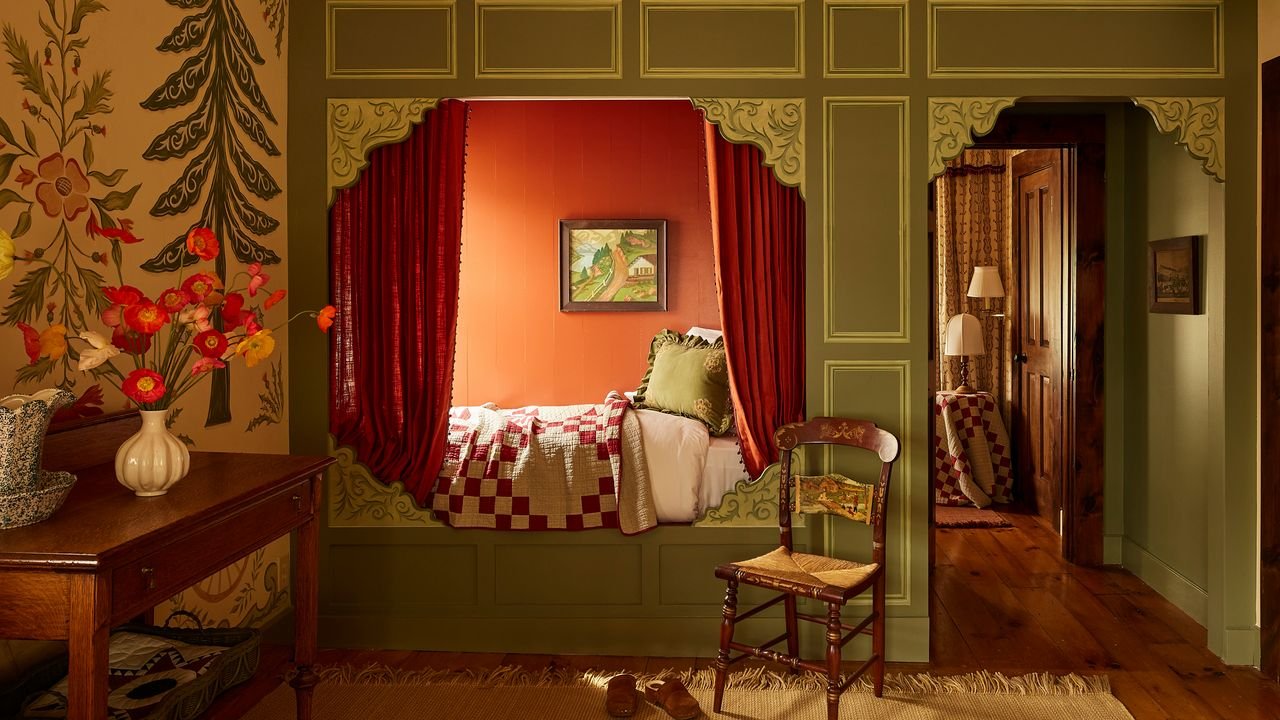
“Britain is a country of great eccentrics,” muses interior designer Adam Greco, whose own view of ‘British whimsy’ manifests in charming chintz and heirloom curios, filtered through the lens of cultural treasures like Sherlock Holmes and Mary Poppins. It’s a highly romanticized spin, something the New York City–based designer, who’s worked on properties like London’s The Ned and Oslo’s Sommerro, felt wanting in the hospitality space, even across many landmark British hotels. “As a foreigner I remember walking into a grand hotel on London’s Regent’s Street and thinking it looked like a function room in Cincinnati inside,” he says. “It was disappointing.”
Recently, though, a wave of UK properties have started to embrace the kinds of cultural eccentricities that Greco saw as lacking in those hotels. This updated approach to the whimsical British aesthetic, all vintage bric-a-brac set alongside some serious art collections and sumptuous fabrics, is best expressed in the UK at properties like the Three Horseshoes in Batcombe, about 20 miles south of Bath, and the Fort Road Hotel in Margate along the southeast coast.


Lately, the design aesthetic has captured America’s attention, and found a home in upstate New York: Soho Farmhouse is due to open its outpost in Rhinebeck, New York, next year. The team behind the Cotswolds’ Estelle Manor is said to be searching for a property in a similar patch close to the Hudson Valley and the Catskills. These new builds are a bid to lure affluent New Yorkers who have outgrown the Hamptons, and, as former magazine editor turned hotelier Dorian Greenspan puts it, “provide something wilder, that feels genuinely rural rather than relocated.”

Greenspan’s own property, Maison Monna, is only 40 minutes from the city in Old Chatham, a charming hamlet he discovered when vacationing in the area with his partner. With Monna, he wanted to speak to this new breed of luxury traveler, someone who wants to feel “comfortable, cared-for, but not smothered,”—a natural companion to British whimsy’s lived-in, been-here-for-decades sensibility.
Maison Monna was a perfect canvas for the expression of this trend, largely because it had sat untouched on the market for so many years. The style of the three-bedroom house is Greek Revival, though records show its bones date back to the Quakers (it makes sense, then, that scenes for Mona Fastvold’s award-winning The Testament of Ann Lee were shot close by).