

Close Menu

    Subscribe to Updates

    Get the latest news information from worldwide businesses.

    What's Hot

    ICMR-NIN consortium calls for healthier school food environment, stricter regulations on marketing

    July 23, 2026

    PMOS Linked to 4-Fold Increase in Heart Disease Risk

    July 23, 2026

    Google hit with $1 billion fine for breaking EU antitrust rules

    July 23, 2026
    Facebook Instagram YouTube LinkedIn X (Twitter)
    Trending
    • ICMR-NIN consortium calls for healthier school food environment, stricter regulations on marketing
    • PMOS Linked to 4-Fold Increase in Heart Disease Risk
    • Google hit with $1 billion fine for breaking EU antitrust rules
    • AMD to invest up to $5 billion in Anthropic under AI infrastructure deal
    • Farmers should be ‘businessmen’ who respond to market demand, not just grow rice and wheat: NITI Aayog’s Ashok Lahiri
    • Wipro buys TTK’s Good Home, Eva Brands for Rs 256 crore
    • Replay: Marco Rubio addresses Middle East and Ukraine conflicts
    • Lavrov tells Rubio ‘unacceptable’ for US to continue arms sales to Kyiv
    Newspublicly
    • About Us
    • Advertise & Partner with us
    • Pitch Your Story
    • Contact Us
    Facebook Instagram LinkedIn X (Twitter)
    Subscribe
    • Home
    • World News
      • Asia
      • India
      • USA
      • UK & Europe
      • Middle East
    • Economy & Business
      • Global Economy
      • Corporate & Industry
      • Finance & Markets
      • Policy & Trade
    • Technology
      • Gadgets & Devices
      • Software & Apps
      • AI & Machine Learning
      • Robotics & Automation
    • Health & Medicine
      • Fitness & Nutrition
      • Research & Innovation
      • Disease & Treatment
      • Doctors, Clinics & Patient Care
    • Travel & Tourism
    • Automobile
      • Electric & Hybrid Vehicles
      • Auto Industry Insights
    • Sports
    • More
      • Education
      • Real Estate
      • Environment & Climate
      • Space & Astronomy
      • War & Conflicts
    Newspublicly
    Home»More»Space & Astronomy»The James Webb Space Telescope’s disappearing ‘Little Red Dots’ may lead to another cosmic puzzle
    Space & Astronomy

    The James Webb Space Telescope’s disappearing ‘Little Red Dots’ may lead to another cosmic puzzle

    AdminBy AdminJuly 23, 2026No Comments5 Mins Read0 Views
    Share
    Facebook Twitter LinkedIn Copy Link WhatsApp


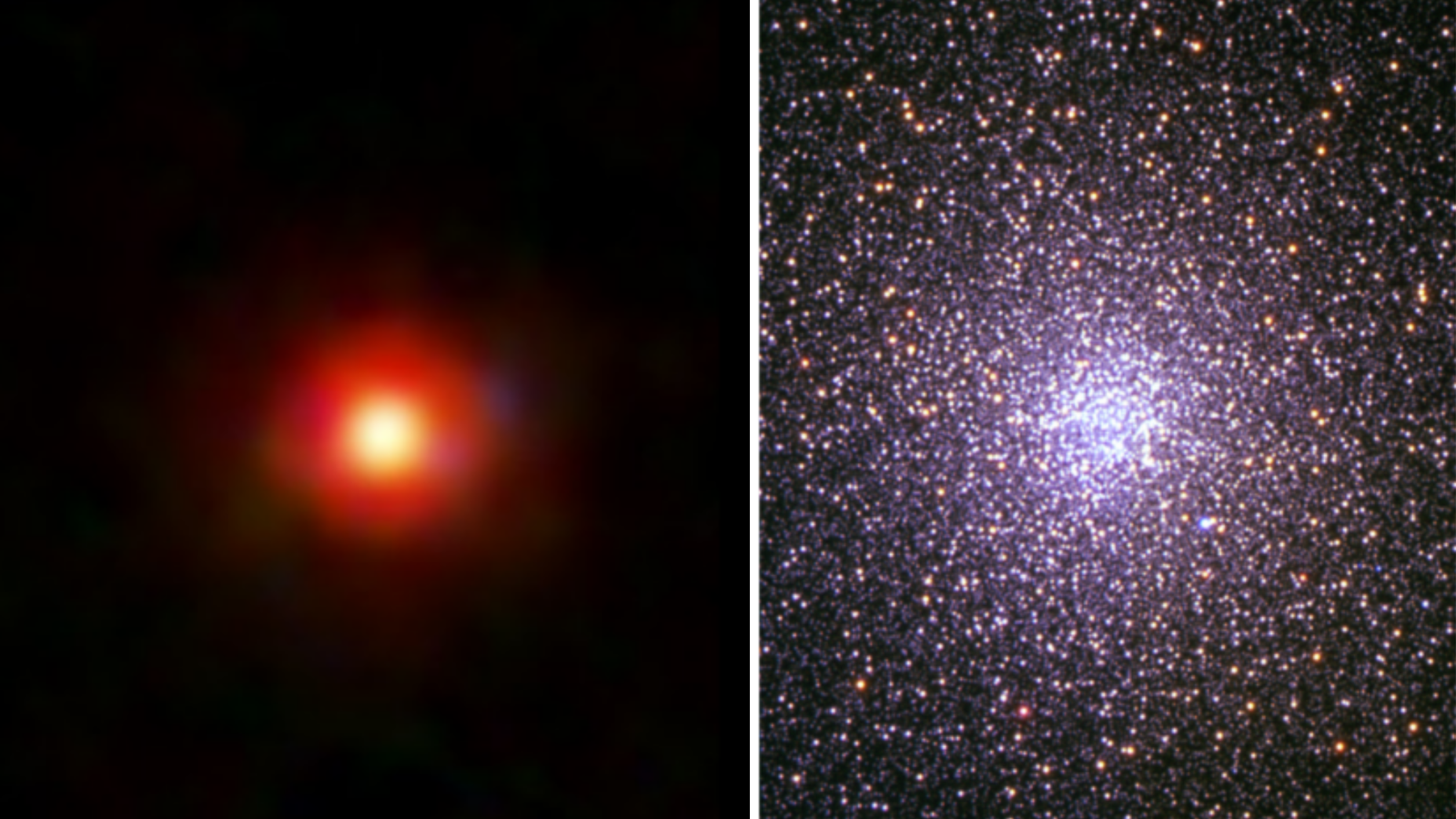
    Paleontologists now know that many of the dinosaurs didn’t disappear but instead evolved into modern birds, and new research suggests that “cosmic dinosaurs” observed by the James Webb Space Telescope (JWST) didn’t go extinct either. Rather, they may have evolved into familiar sights in the modern universe: vast conglomerations of densely packed stars called “globular clusters.”

    Little Red Dots became quite the puzzle for astronomers in 2022, when the JWST began to routinely spot them in abundance around 600 million years after the Big Bang. That is because these objects seemingly disappear before the cosmos gets to around 2 billion years old.

    Astronomers have proposed many different explanations for Little Red Dots, including the suggestion that they could be “black hole stars,” or black holes wrapped in vast shrouds of dense gas and dust. This team theorizes that a forming globular cluster with a supermassive star, a hypothetical short-lived stellar body with between 1,000 and 10,000 times the mass of the sun, would also look a lot like a Little Red Dot at its heart.

    “These may not be just a strange new JWST population with no connection to the universe around us today,” team leader John Chisholm of the University of Texas Austin said in a statement. “Instead, Little Red Dots may persist past the early universe, evolving into something relatively familiar.

    “Little Red Dots could be galaxies, they could involve black holes, or they could be something even more unexpected. Our work shows that forming globular clusters with supermassive stars should be part of that conversation.”

    An unfamiliar side to a familar sight

    Globular clusters are generally seen in large galaxies and are densely packed with up to many millions of ancient stars. Our galaxy, the Milky Way, is host to at least 150 globular clusters, and though familiar, astronomers still aren’t quite sure how they form.

    “We usually see them [globular clusters] after billions of years of evolution, at a time when their massive stars are gone, their gas has been cleared out, and dynamical processes have changed their masses and structures,” team member Danielle Berg of UT Austin said in the statement. “That makes it very hard to reconstruct the original conditions they formed in.”


    You may like

    It is thought that the stars in globular clusters all formed at the same time in the early universe. However, at this time the cosmos should only have had hydrogen, helium and a smattering of heavier elements (which astronomers call “metals”) available for star construction. Yet, many stars in globular clusters are strangely abundant in helium and metals like nitrogen, sodium and aluminum, while lacking the expected levels of carbon, oxygen and magnesium.

    “This specific pattern indicates nuclear fusion at very high temperatures, much higher than in the cores of even massive normal stars,” team member Mike Boylan-Kolchin of UT Austin said in the statement. “A supermassive star is precisely the kind of environment that could produce this combination.”

    Space

    Globular cluster NGC 6638 looks like a sparkling conglomerate of blueish stars.

    Globular cluster NGC 6638, as seen by the Hubble Space Telescope. (Image credit: ESA/Hubble & NASA, R. Cohen)

    Supermassive stars capable of generating this kind of heat would form in the dense environments of early globular clusters in which stellar collisions and mergers would be expected to occur over and over again. The resultant supermassive stars would be short-lived, lasting just around 1 million years (remember the sun is middle-aged at 4.6 billion years old) — but this would be sufficient time to forge the elements needed to explain the peculiar chemistry of globular clusters.

    When these supermassive stars die in supernova explosions, the elements they forged would be blasted out to become the building blocks of the next generation of stars. This would provide the stars of modern globular clusters with their unusual chemical fingerprints.

    “In our model, the supermassive star that helps make the object look like a Little Red Dot would live for only a short time,” Chisholm continued. “Once that star dies, the object may no longer look like a Little Red Dot, even if the cluster itself survives billions of years.”

    Six of the "little red dot" galaxies discovered by the JWST. They all look like blurry red dots of different shapes and sizes against a dark background.

    Just some of the “little red dot” galaxies discovered by the JWST. (Image credit: NASA, ESA, CSA, STScI, Dale Kocevski (Colby College))

    Strange chemistry isn’t the only thing linking early globular clusters with Little Red Dots, however. Not only does the team propose that the distribution of Little Red Dots in the early universe matches the distribution of modern globular clusters, but they also say models of Little Red Dot evolution show that their estimated masses could easily lead to the masses of globular clusters seen in the recent universe.

    There is also the issue of timing. Little Red Dots appear around 600 million years after the Big Bang, and that is also the time that scientists estimate that globular clusters would have begun to form.

    “There’s no single smoking gun at this point that says Little Red Dots are globular clusters, but it would explain a lot of diverse and surprising observations,” said Boylan-Kolchin.

    This study is currently available to view as a pre-print on the paper repository arXiv.


    Source link

    Author

    • Admin

      NewsPublicly.com is News & Articles Platform that creating SEO-focused articles on travel, lifestyle, and digital trends.

    Admin
    • Website

    NewsPublicly.com is News & Articles Platform that creating SEO-focused articles on travel, lifestyle, and digital trends.

    Related Posts

    China’s record-breaking Gravity-1 rocket launches 9 satellites from a ship at sea (video)

    July 22, 2026

    5 disturbing things we saw after digging into the recent ‘Dune: Part 3’ trailer

    July 22, 2026

    After nearly 30 years, NASA realized this near-Earth asteroid is actually a comet

    July 22, 2026
    Leave A Reply Cancel Reply

    Demo
    Top Posts

    The Blue Moon rises on May 30— Where and when to see the second full moon of the month

    May 30, 202640 Views

    New SOCOM rifle allows barrel swapping and cartridge changes

    June 1, 202633 Views

    “Inside Gemini Robotics 1.5: How Robots Learn to Reason & Act

    November 22, 202527 Views

    525 pounds of cocaine seized after Nebraska K9 alerts troopers on I-80

    May 28, 202624 Views
    Don't Miss

    ICMR-NIN consortium calls for healthier school food environment, stricter regulations on marketing

    July 23, 20264 Mins Read0 Views

    An ICMR-linked consortium has recommended healthier school food environment, stricter regulation of marketing of unhealthy…

    PMOS Linked to 4-Fold Increase in Heart Disease Risk

    July 23, 2026

    Google hit with $1 billion fine for breaking EU antitrust rules

    July 23, 2026

    AMD to invest up to $5 billion in Anthropic under AI infrastructure deal

    July 23, 2026
    Stay In Touch
    • Facebook
    • Twitter
    • Instagram
    • YouTube
    • LinkedIn
    • WhatsApp

    Subscribe to Updates

    Get the latest creative news from SmartMag about art & design.

    Demo
    NEWSPUBLICLY
    Facebook X (Twitter) Instagram LinkedIn

    Home

    • About Us
    • Leadership
    • Advertise & Partner With Us
    • Pitch Your Story
    • Media Kit & Pricing
    • Career
    • FAQs

    Guidelines

    • Editorial & Submission
    • Partnership
    • Advertising & Sponsor
    • Intellectual Property Policy
    • Community & Comment
    • Security & Data Protection
    • Send Your Opinion

    Quick Links

    • Cookie Policy
    • Payment & Billing Terms
    • Refund & Cancellation
    • Copyright Policy
    • Complaint & Support
    • Sitemap
    • Contact Us

    Subscribe Us

    Get the latest news and updates!

    Copyright © 2026 Newspublicly (DIGITALIX COMMUNICATION). All Rights Reserved.
    • Privacy Policy
    • Terms of Use
    • Disclaimer