

Close Menu

    Subscribe to Updates

    Get the latest news information from worldwide businesses.

    What's Hot

    The easiest way to learn the summer night sky starts with these 3 stars

    July 24, 2026

    Marvel Tokon Fighting Souls beginner combo guide

    July 24, 2026

    Adidas Promo Codes & Coupons July 2026

    July 24, 2026
    Facebook Instagram YouTube LinkedIn X (Twitter)
    Trending
    • The easiest way to learn the summer night sky starts with these 3 stars
    • Marvel Tokon Fighting Souls beginner combo guide
    • Adidas Promo Codes & Coupons July 2026
    • Can Rain Really Make Joint Pain Worse? Experts Explain
    • Nature prescriptions: Can time outdoors become part of healthcare?
    • Can Weight Loss (GLP-1) Drugs Cause Hair Loss? Large Study Answers
    • The US government can’t enforce its own drone ban
    • Facebook launches a dedicated Marketplace app for sellers, adds a free verification system
    Newspublicly
    • About Us
    • Advertise & Partner with us
    • Pitch Your Story
    • Contact Us
    Facebook Instagram LinkedIn X (Twitter)
    Subscribe
    • Home
    • World News
      • Asia
      • India
      • USA
      • UK & Europe
      • Middle East
    • Economy & Business
      • Global Economy
      • Corporate & Industry
      • Finance & Markets
      • Policy & Trade
    • Technology
      • Gadgets & Devices
      • Software & Apps
      • AI & Machine Learning
      • Robotics & Automation
    • Health & Medicine
      • Fitness & Nutrition
      • Research & Innovation
      • Disease & Treatment
      • Doctors, Clinics & Patient Care
    • Travel & Tourism
    • Automobile
      • Electric & Hybrid Vehicles
      • Auto Industry Insights
    • Sports
    • More
      • Education
      • Real Estate
      • Environment & Climate
      • Space & Astronomy
      • War & Conflicts
    Newspublicly
    Home»Health & Medicine»Research & Innovation»The hidden atomic gap that could break next-generation computer chips
    Research & Innovation

    The hidden atomic gap that could break next-generation computer chips

    AdminBy AdminMay 12, 2026No Comments4 Mins Read0 Views
    Share
    Facebook Twitter LinkedIn Copy Link WhatsApp


    For decades, smaller and more powerful electronic components have fueled major advances in technology. Now scientists are searching for the next breakthrough in computer chip design, and many researchers believe 2D materials could play a key role. These ultrathin materials, made from just one or a few atomic layers, have been viewed as promising candidates for building even tinier electronic devices.

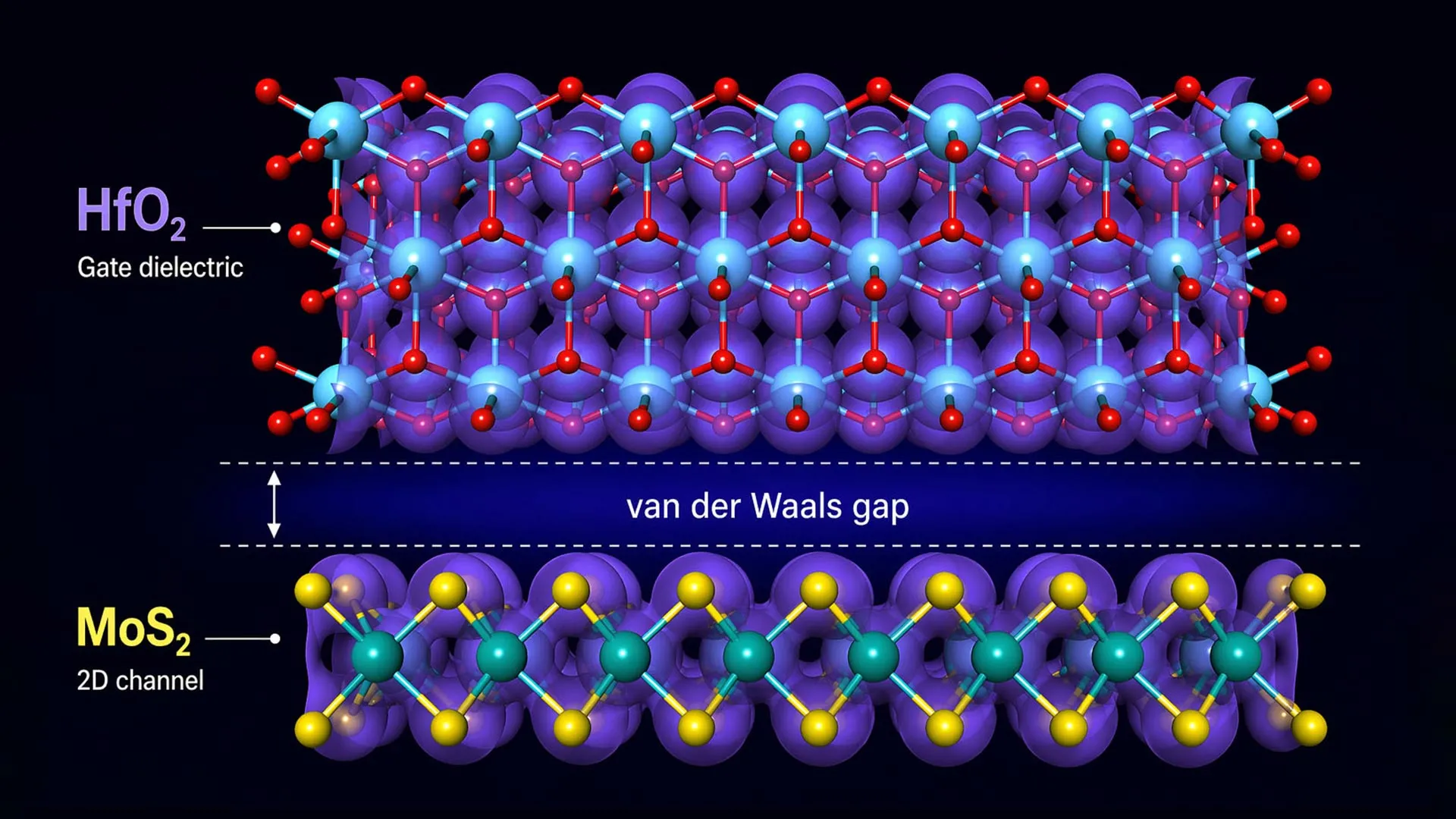
    But new research from TU Wien suggests that many of these materials may not work as expected in real-world chip technology. The problem is not just the material itself. Scientists found that when 2D materials are paired with insulating layers required for electronic devices, an unavoidable atomic-scale gap forms between them. That tiny separation can significantly reduce performance and create a fundamental barrier to further miniaturization.

    The findings could help the semiconductor industry avoid spending billions of dollars on approaches that may never overcome these physical limitations.

    Why Interfaces Matter in 2D Electronics

    “For many years, researchers have quite rightly been fascinated by the remarkable electronic properties of novel 2D materials such as graphene or molybdenum disulfide,” says Prof. Mahdi Pourfath, who carried out the research together with Prof. Tibor Grasser at TU Wien’s Institute for Microelectronics. “What is often overlooked, however, is that a 2D material alone does not make an electronic device. We also need an insulating layer — usually an oxide. And this is where things become more complicated from a materials science perspective.”

    Modern transistors work by switching a semiconductor between conductive and nonconductive states. In future chips, that semiconductor could be an ultrathin 2D material. The process is controlled by a gate electrode, which must be separated from the active material by an insulating layer.

    To keep devices as small and efficient as possible, the insulating layer needs to be extremely thin. However, the TU Wien team found that this creates a major issue at the atomic scale.

    The Tiny Gap Creating a Big Problem

    “In many combinations of 2D materials and insulating layers, the bonding between them is relatively weak,” explains Grasser. “They are held together only by so-called van der Waals forces, which provide only a weak attraction between the semiconductor and the insulator. As a result, the two layers do not come into close contact — there is always a gap between them.”

    That gap measures only about 0.14 nanometers, making it thinner than a single sulfur atom. Even so, it has a dramatic effect on electronic behavior. For perspective, a SARS-CoV-2 virus is about 700 times larger.

    “This gap weakens the capacitive coupling between the layers. No matter how good the intrinsic properties of the materials may be, the gap can become the limiting factor. As long as it exists, it imposes a fundamental limit on how far these devices can be miniaturized.”

    According to the researchers, many studies have focused heavily on the impressive properties of 2D materials themselves while paying less attention to the interfaces formed inside complete devices. Their work shows that these interfaces may ultimately determine whether future chip technologies succeed or fail.

    “Zipper Materials” Could Offer a Solution

    “If the semiconductor industry wants to succeed with 2D materials, the active layer and the insulating layer must be designed together from the very beginning,” emphasizes Mahdi Pourfath.

    One possible answer is the use of so-called “zipper materials.” In these systems, the semiconductor and insulating layer bond together much more strongly instead of remaining loosely connected by van der Waals forces. This tighter connection removes the problematic gap.

    “Our work is good news for the semiconductor industry,” says Tibor Grasser. “We can predict which materials are suitable for future miniaturization steps — and which are not. But if one focuses only on the 2D materials themselves, without considering the unavoidable insulating layers from the outset, there is a risk of investing billions in an approach that simply cannot succeed for fundamental physical reasons.”


    Source link

    Author

    • Admin

      NewsPublicly.com is News & Articles Platform that creating SEO-focused articles on travel, lifestyle, and digital trends.

    Admin
    • Website

    NewsPublicly.com is News & Articles Platform that creating SEO-focused articles on travel, lifestyle, and digital trends.

    Related Posts

    New antibody drug stops aggressive prostate cancer from spreading

    July 22, 2026

    New quantum gravity theory links entropy, dark energy, and life

    July 22, 2026

    Dying Sun-like stars may kick themselves through space

    July 22, 2026
    Leave A Reply Cancel Reply

    Demo
    Top Posts

    The Blue Moon rises on May 30— Where and when to see the second full moon of the month

    May 30, 202640 Views

    New SOCOM rifle allows barrel swapping and cartridge changes

    June 1, 202633 Views

    “Inside Gemini Robotics 1.5: How Robots Learn to Reason & Act

    November 22, 202527 Views

    525 pounds of cocaine seized after Nebraska K9 alerts troopers on I-80

    May 28, 202624 Views
    Don't Miss

    The easiest way to learn the summer night sky starts with these 3 stars

    July 24, 20266 Mins Read0 Views

    There is a particular moment every July when the night sky makes perfect sense to…

    Marvel Tokon Fighting Souls beginner combo guide

    July 24, 2026

    Adidas Promo Codes & Coupons July 2026

    July 24, 2026

    Can Rain Really Make Joint Pain Worse? Experts Explain

    July 24, 2026
    Stay In Touch
    • Facebook
    • Twitter
    • Instagram
    • YouTube
    • LinkedIn
    • WhatsApp

    Subscribe to Updates

    Get the latest creative news from SmartMag about art & design.

    Demo
    NEWSPUBLICLY
    Facebook X (Twitter) Instagram LinkedIn

    Home

    • About Us
    • Leadership
    • Advertise & Partner With Us
    • Pitch Your Story
    • Media Kit & Pricing
    • Career
    • FAQs

    Guidelines

    • Editorial & Submission
    • Partnership
    • Advertising & Sponsor
    • Intellectual Property Policy
    • Community & Comment
    • Security & Data Protection
    • Send Your Opinion

    Quick Links

    • Cookie Policy
    • Payment & Billing Terms
    • Refund & Cancellation
    • Copyright Policy
    • Complaint & Support
    • Sitemap
    • Contact Us

    Subscribe Us

    Get the latest news and updates!

    Copyright © 2026 Newspublicly (DIGITALIX COMMUNICATION). All Rights Reserved.
    • Privacy Policy
    • Terms of Use
    • Disclaimer