

Tesla reports its second-quarter 2026 financial results tomorrow, July 22, after the market closes, with the earnings call to follow at 5:30 p.m. ET.
The setup is different this time. Tesla just posted its best-ever second quarter on deliveries, so now Wall Street wants to know whether all those cars actually made money.
Tesla Q2 2026 deliveries and energy deployment
We already have the volume numbers. Tesla delivered 480,126 vehicles in Q2, up 25% from a year ago and roughly 74,000 above the analyst consensus. It’s the company’s strongest second quarter ever and its first year-over-year delivery growth in two years.
Production came in at 451,758, which means Tesla delivered about 28,000 more cars than it built. It worked down inventory instead of stacking it up, a clean reversal from Q1, when it built roughly 50,000 vehicles it couldn’t sell.
The 25% jump also narrowed the gap with BYD, whose own battery-electric sales fell about 8% in the same quarter. Tesla is still second, but the two are finally moving in opposite directions.
On the energy side, Tesla deployed 13.5 GWh of storage, up more than 40% from 9.6 GWh in Q2 2025 and a big jump from the 8.8 GWh it managed in Q1. It landed just under the roughly 13.8 GWh analysts wanted, but energy remains the most consistent growth story Tesla has.
So the top line should look healthy. The question is everything underneath it.
Tesla Q2 2026 revenue
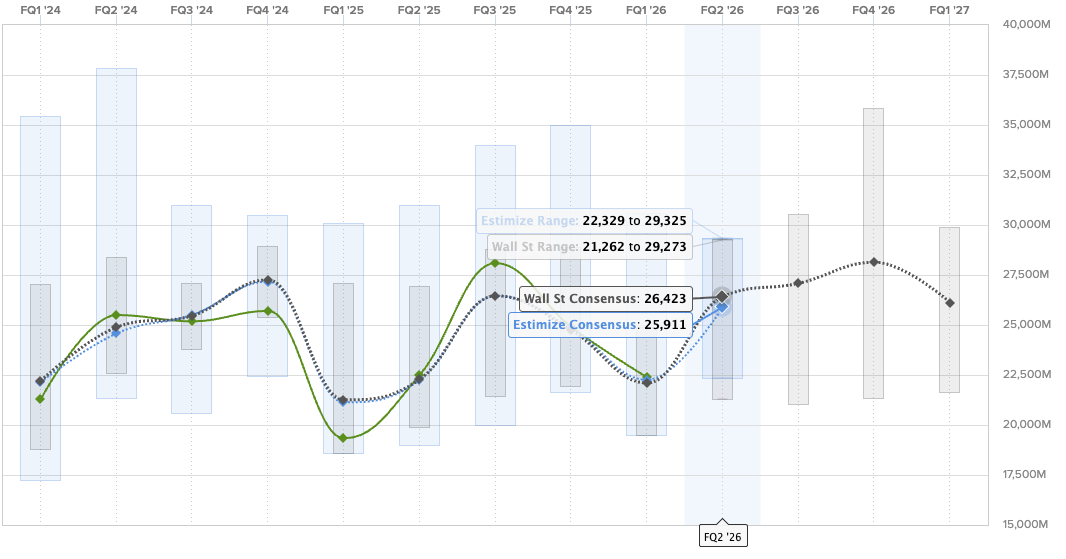
Wall Street consensus on Estimize puts Q2 2026 revenue at about $25.9 billion, while the broader analyst consensus sits higher at roughly $26.4 billion. Either way, that’s up from $22.5 billion in Q2 2025, or somewhere around 15 to 17% growth. It would be Tesla’s first real revenue growth in over a year.
For context, that easily tops the $22.38 billion Tesla reported in Q1 2026, driven by the 34% sequential jump in deliveries.
The range is wide. Estimates run from about $22.3 billion on the low end to more than $29 billion on the high end. That spread is a sign analysts don’t agree on how much Tesla had to discount to move a record number of cars.
Tesla Q2 2026 earnings
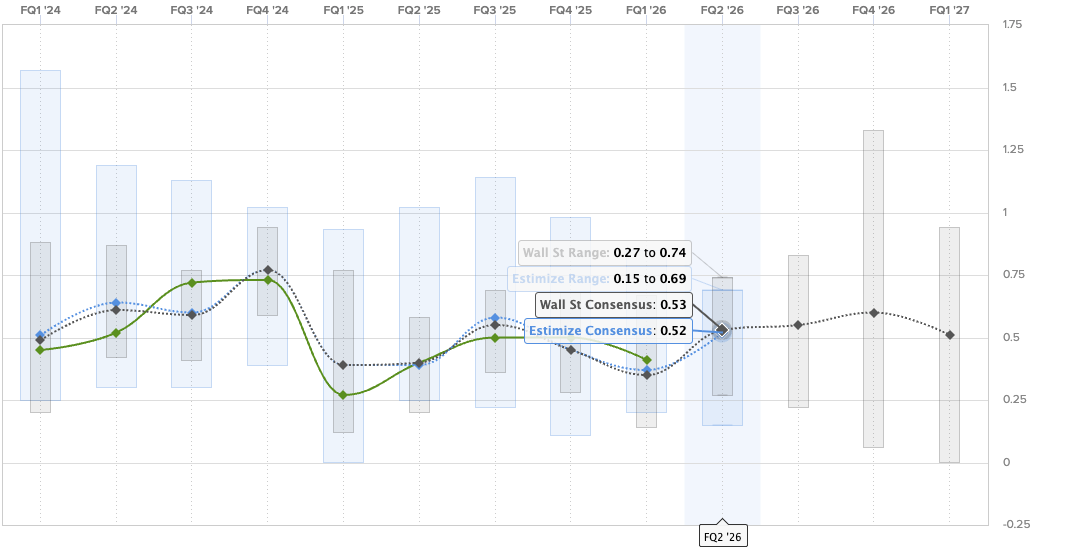
On profit, analysts expect non-GAAP earnings of about $0.53 per share, up from $0.40 in Q2 2025, a roughly 33% year-over-year increase. Estimize’s crowd sits a touch lower at $0.52.
Here too, the spread tells the story. Wall Street estimates range from $0.27 to $0.74 a share, and Deutsche Bank is out at just $0.36. When the low estimate is barely half the high one, nobody’s sure whether the delivery surge dropped to the bottom line or got eaten by price cuts.
That’s the number that matters tomorrow. Tesla’s automotive gross margin excluding regulatory credits sat around 12.5% in Q1. If it holds at record volume, the quarter is genuinely strong. If it fell, then Tesla bought those 480,000 deliveries with discounts and cheap financing. Volume without profit.
And the regulatory credit cushion is thinning fast. Tesla booked $439 million in credit sales in Q2 2025, already down more than 50% from the year before, and that line has kept shrinking since the $7,500 federal EV tax credit expired on September 30, 2025. Options traders are bracing for the reaction: about a 7.6% swing in either direction is priced in for after the report.
Most-upvoted Tesla shareholder questions for Q2 2026
Tesla runs its earnings Q&A through Say Technologies, where shareholders submit and upvote questions weighted by the number of TSLA shares they hold. By the time submissions closed Monday, 425 questions had come in from about 1,710 participants representing 8.6 million shares. That’s up from roughly 300 questions when we broke down the list last week.
More voting, but the top hasn’t budged. The two highest-share questions are still soft: one asks the “current status of Optimus Gen 3 production ramp,” the other the “main constraints to expanding robotaxi operations faster.” Each now represents about 5.3 to 5.4 million shares, up from 4.8 million apiece. That points again to a single large holder pushing the two friendliest questions to the top.
But look at raw votes and a different question wins. The most-upvoted question on the whole board, with 732 votes, is the accountability one: “Tesla has missed short term guidance on robotaxi 3 earnings reports in a row… what is keeping Tesla back from accomplishing these short term goals that they’ve set for themselves?” It represents 1.5 million shares now, up from under a million last week. Retail is pushing it, the whale is burying it.
Electrek’s Take
For once, the delivery line isn’t the worry. A 25% jump and the best Q2 ever is a real result, and I’m not going to pretend otherwise. But a delivery number is a volume number, not a profit number, and this whole quarter comes down to one line Tesla hasn’t shown us yet: automotive gross margin without regulatory credits.
Here’s the tension. Tesla delivered more cars than it produced and drew down inventory, which is good for the balance sheet. If margins held, the rebound is real. If they slipped, Tesla just proved it can move metal only by giving up profit, right as the regulatory-credit gravy train winds down and the federal tax credit is gone. A year ago we previewed this same quarter as being on the road to unprofitability. This is where we find out if that road bends back.
But ultimately, this should have little impact on Tesla’s stock as most of its value is attached to ever-delayed projects such as Robotaxi and Optimus. It’s fairly ironic that as Tesla’s EV sales stalled, shareholders have been claiming that it doesn’t matter because “Tesla is not an automaker anymore.” And yet, it finally has a good quarter for the first time in 2 years, and it is entirely due to EV sales.
Tomorrow’s earnings call won’t touch your power bill, but going solar will. If you own a Tesla or any EV, charging it on home solar is one of the smartest ways to lock in low fuel costs for good. With electricity rates up almost 10% last year and expected to keep climbing, going solar is one of the best ways to protect yourself against rising costs. And with lease and PPA options, you can do it with zero upfront cost and start saving immediately. If you want to find the best deal, check out EnergySage. It’s a free service with hundreds of pre-vetted installers competing for your business, so you save 20 to 30% compared to going it alone. No sales calls until you pick an installer. Get your free quotes here.


FTC: We use income earning auto affiliate links. More.