

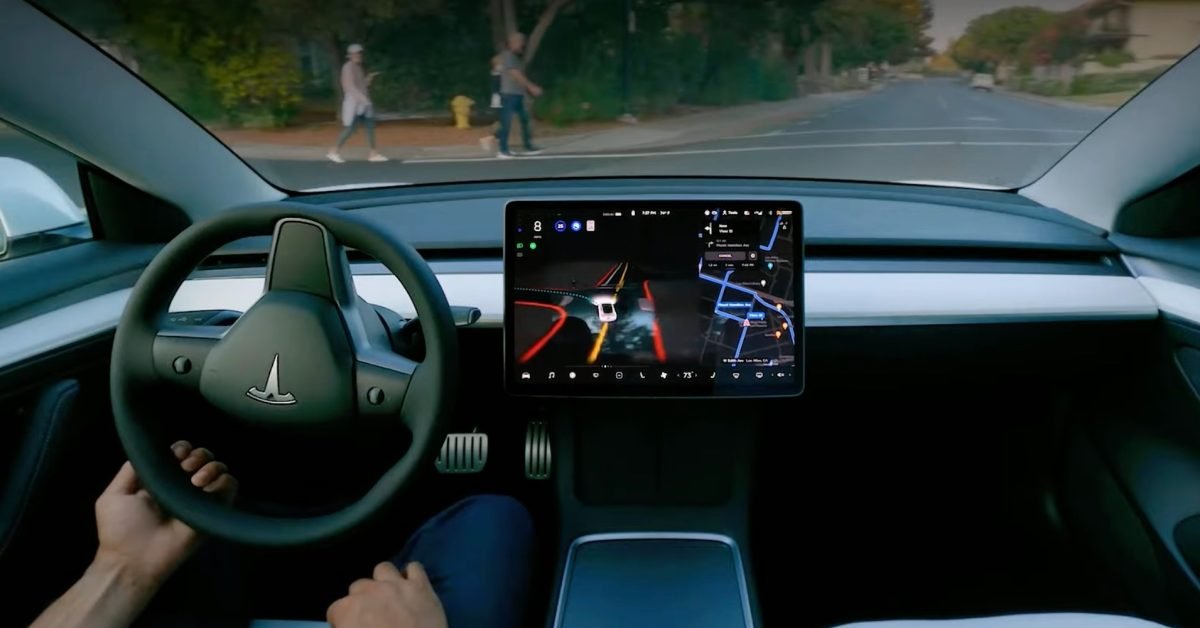

Denmark has provisionally approved Tesla’s “Full Self-Driving” (Supervised) system, making it the fourth European country to clear the software in roughly eight weeks.
The Danish Road Traffic Authority, Færdselsstyrelsen, confirmed the decision today — notably after Denmark had previously raised concerns about the technology at the EU level.
Denmark accepts Dutch approval after its own review
Færdselsstyrelsen said it accepted the provisional type approval originally issued by the Dutch vehicle authority, RDW, on April 10. But the Danish authority stressed it conducted its own independent review before signing off.
“After a thorough review and assessment of the technical documentation, Færdselsstyrelsen agrees with RDW’s assessment that the system will contribute positively to road safety by assisting the driver while driving,” the authority said in its official statement.
The authority was clear about what FSD Supervised is not: “The system does not make the car self-driving. The driver is still fully responsible for driving.”
Denmark joins the Netherlands, Lithuania, and Estonia in clearing the system through national recognition of the Dutch certification — a process that bypasses the slower EU-wide approval path.
A notable reversal
What makes Denmark’s approval particularly interesting is that the country was previously identified as one of several Nordic states — alongside Sweden, Finland, and Norway — that had raised objections to FSD at the European level.
Those concerns centered on FSD’s tendency to exceed posted speed limits, its performance on icy roads, and whether the “Full Self-Driving” name overstates the technology’s capabilities. A Swedish Transport Agency investigator wrote in April that he was “quite surprised” Tesla allowed FSD to speed.
Despite those reservations at the bloc level, Denmark chose to grant national recognition after reviewing the technical documentation independently. That gap between EU-level skepticism and national-level approval highlights the two-track regulatory process now playing out across Europe.
EU-wide approval still nowhere in sight
The national-recognition route keeps moving, but the EU-wide process remains stalled. The Netherlands notified the European Commission on April 13, and RDW presented its case to the Technical Committee on Motor Vehicles (TCMV) on May 5.
The committee’s June 30 meeting agenda allocates time for continued discussion — but no vote. Industry trackers now place the earliest realistic bloc-wide vote in October or December, with full EU recognition potentially slipping into early 2027.
A qualified majority requires at least 15 of 27 member states representing 65% of the EU population. Nordic opposition could complicate that math.
Færdselsstyrelsen was blunt about the stakes: if the EU Commission ultimately rejects the system, the Dutch provisional approval becomes invalid after six months, and the Danish clearance falls with it. FSD Supervised would then no longer be permitted for sale in any EU country.
The competitive picture shifts
The approval arrives as both Mercedes-Benz and BMW have pulled back from their Level 3 autonomous driving systems in Europe. Mercedes paused Drive Pilot from the upcoming S-Class and EQS facelifts, while BMW discontinued its Personal Pilot L3 system. Both are pivoting to Level 2+ systems that compete more directly with Tesla’s approach.
That leaves Tesla’s FSD Supervised — a Level 2 system that works on any road but requires constant driver attention — as the most capable driver-assistance system widely available in Europe. The subscription runs €99 per month, with a discounted €49/month rate for owners who previously purchased Enhanced Autopilot.
Belgium and Greece are reportedly moving quickly toward their own national approvals, while Ireland, Germany, France, Italy, and Spain are still reviewing or testing.
Electrek’s Take
Denmark’s approval is significant precisely because Denmark’s regulators were one of the skeptics. When a country that raised concerns about speeding and icy-road performance turns around and approves the system two months later, it suggests the technical documentation was more convincing than the initial political objections implied.
That said, we shouldn’t overstate what’s happening here. National approvals through mutual recognition are the low-hanging fruit. Each country is essentially rubber-stamping the Dutch review rather than conducting rigorous independent testing. The real test will be the EU-wide vote, where the politics of autonomous driving — safety concerns, liability questions, the optics of the “Full Self-Driving” name — will all come into play.
The fact that both Mercedes and BMW have abandoned Level 3 in favor of Level 2+ systems makes this moment even more interesting. Tesla’s approach, cheaper, works everywhere, but requires driver attention, is winning the regulatory race in Europe by default, while the “more advanced” Level 3 systems from German automakers proved too expensive and too limited to survive commercially.
I think a lot of it lies in the willingness to take responsibility for the systems, and most of them appear unwilling.
The big unknown remains the EU Commission vote. If it goes against Tesla, all four national approvals evaporate within six months. That’s a real risk Tesla owners considering the €99/month subscription should understand.
If you’re a Tesla owner looking to reduce your energy costs further, pairing your EV with home solar is one of the smartest investments you can make. With electricity rates climbing nearly 10% last year, home solar protects you against future rate increases. And with lease and PPA options, you can go solar with zero upfront cost and start saving immediately. If you want to find the best deal, check out EnergySage. It’s a free service with hundreds of pre-vetted installers competing for your business, so you save 20 to 30% compared to going it alone. No sales calls until you pick an installer. Get your free quotes here.


FTC: We use income earning auto affiliate links. More.