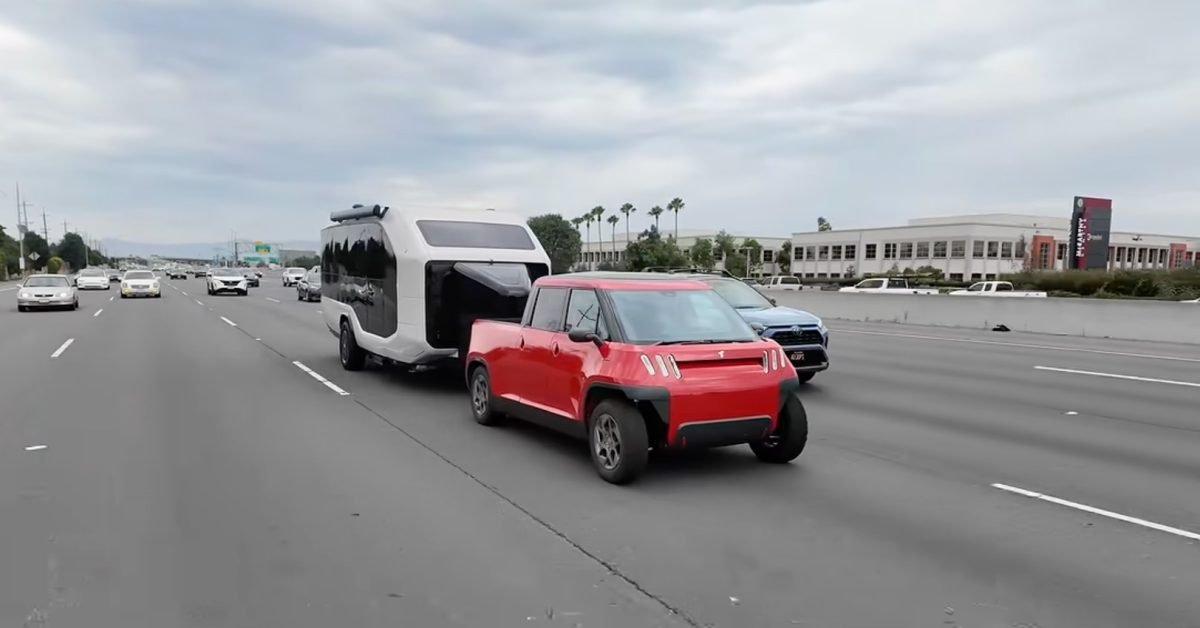
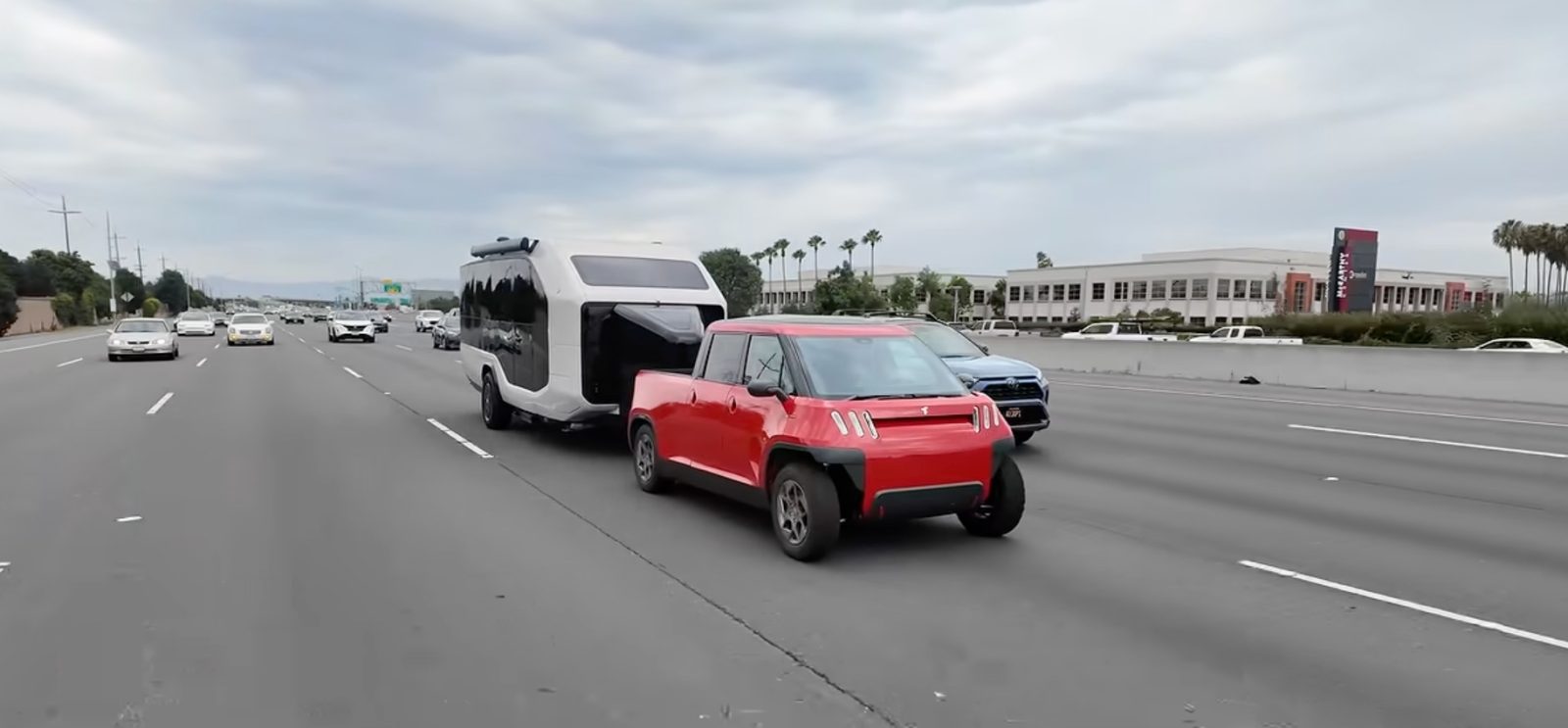
Telo is raising the tow rating on its Mini-sized electric truck to 8,000 lbs, up from the 6,600 lbs it previously advertised.
The startup says months of real-world towing convinced it the little MT1 can safely pull more than a truck that size looks like it should. That new number puts a 152-inch pickup roughly on par with a base Ford F-150.
Co-founder and CTO Forest North announced the change in a video, framing it around his own needs. “In the beginning, we set a stake in the ground that we wanted to be able to tow over 6,000 pounds. I personally have a travel trailer and I wanted to make sure that I could tow that,” he said. “Now that we’re further into it, we have towed a bunch of things. We understand towing and what this vehicle can do.”
The MT1 is about as small as a modern pickup gets. At 152 inches long, it’s the size of an electric Mini Cooper, yet it carries a full 60-to-96-inch bed and seats up to five. It runs a dual-motor all-wheel-drive setup rated at 500 hp, with a 77 kWh standard pack good for 260 miles or a 106 kWh long-range pack rated at 350-plus miles. Telo starts it at $41,520 and is targeting first deliveries in late 2026.
Why Telo thinks a small truck can tow big
North’s argument leans on the physics that favor an electric drivetrain when there’s a trailer on the hitch.
The first is braking. A four-wheel-drive electric truck that can move a lot of power in and out of its pack can regen down a long grade almost indefinitely, he argues, instead of cooking its brakes. “That means that we can regen for miles and miles and miles going down a pass — you’re not touching your brakes and yet you have complete control over your vehicle and your trailer,” North said.
Heat is the other half of it. Combustion trucks dump most of their energy as heat and then have to shed even more of it under load, which is exactly what SAE’s J2807 tow standard is built to stress with tests like the 11-mile, 6% Davis Dam grade run. North says that math barely applies to an EV: “For us, it really doesn’t change the equation that much. We have so much torque and so much horsepower together, and it’s instant. That makes starting on a grade so easy.”
Then there’s the packaging. The MT1’s hitch sits close to the rear axle, giving a shorter lever arm so trailer tongue weight doesn’t lift the front end the way it would on a longer truck. And despite its footprint, the MT1 isn’t light — North puts it at over 4,000 lbs — riding on a steel chassis with a crossmember tying the hitch to the frame. Small, in his telling, is a structural advantage: the same strength takes less mass than it would on a full-size truck.
North was blunt about the limits. For long hauls, “a big diesel truck is probably going to be better for the near term.” The MT1’s pitch is shorter trips, where a compact, easy-to-park truck that tows well is more convenient than a full-size rig.
The 8,000-lb number unlocks a new class of trailer
The jump from 6,600 to 8,000 lbs isn’t a random bump. It’s aimed at a wave of trailers that carry their own batteries and motors.
Telo already showed this off in July, when the MT1 towed Pebble’s 5,800-lb Flow electric travel trailer. The Flow’s “Easy Tow” active propulsion system uses the trailer’s own drivetrain and regen to cut the effective load on the tow vehicle, which is how a truck the size of a Mini pulled a full-size camper without drama. North says a lot of these new powered trailers land in the 6,000-to-8,000-lb range, so the higher rating is what lets the MT1 be a real option for them.
That same electrical headroom is what makes the regen story credible. Telo confirmed 400 kW sustained charging for the MT1 in June, running a dual 800V/400V pack architecture. A truck that can absorb that many kilowatts on a charger can also absorb a lot of regen coming down a hill.
How 8,000 lbs stacks up against other trucks
Against full-size electric pickups, 8,000 lbs is on the low end. But the point isn’t the number on its own — it’s the number relative to the size of the truck.
Here’s where the MT1 lands:
- Telo MT1 (152 in): 8,000 lbs
- Ford F-150 Lightning: 10,000 lbs
- Tesla Cybertruck: 11,000 lbs
- Rivian R1T: 11,000 lbs
- GMC Hummer EV pickup: 12,000 lbs
- Chevy Silverado EV: 12,500 lbs
For gas comparison, a 2025 F-150 tows anywhere from about 8,400 lbs with the base 2.7L V6 up to 13,500 lbs fully optioned. So Telo’s tiny truck now claims to tow roughly what an entry-level full-size F-150 does, in a package nearly four feet shorter and thousands of pounds lighter. None of the full-size EV trucks come close to the MT1 on footprint or on the $41,520 starting price.
Electrek’s Take
This is impressive and exciting, but I still think it’s worth staying skeptical.
Telo has done a lot with very little. The company has raised roughly $20 million total — including a Series A led by Tesla co-founder Marc Tarpenning — and it’s trying to get to production readiness and pass federal requirements on that. In an industry where startups routinely burn through hundreds of millions before building a single sellable vehicle, that capital efficiency is genuinely notable. The towing physics North describes are real, too. Instant torque and heavy regen do make EVs good tow vehicles – albeit for shorter distances depending on the energy capacity.
But Telo is trying to build a Swiss army knife: a truck that’s tiny yet tows 8,000 lbs, charges at 400 kW, seats five, carries a Hummer-sized bed, and starts at $41,520. Each of those is a strong claim on its own. Stacking all of them into one production vehicle, and hitting every one consistently once real units are rolling off a line, is a much harder problem than showing it on a prototype. Tow ratings especially tend to get conservative once liability and warranty teams get involved.
And all of it still hangs on the biggest “if” of all: whether Telo actually reaches volume production. The prototype work is impressive. Deliveries are targeted for late 2026. We’ll see if the production truck can do everything the pre-production one promises.
If you’re towing with an EV, you’re going to lean on your home charger, and powering it with your own solar is the cheapest way to keep it topped up. With electricity rates up almost 10% last year and expected to keep climbing, going solar is one of the best ways to protect yourself against rising costs. And with lease and PPA options, you can do it with zero upfront cost and start saving immediately. If you want to find the best deal, check out EnergySage. It’s a free service with hundreds of pre-vetted installers competing for your business, so you save 20 to 30% compared to going it alone. No sales calls until you pick an installer. Get your free quotes here.


FTC: We use income earning auto affiliate links. More.