

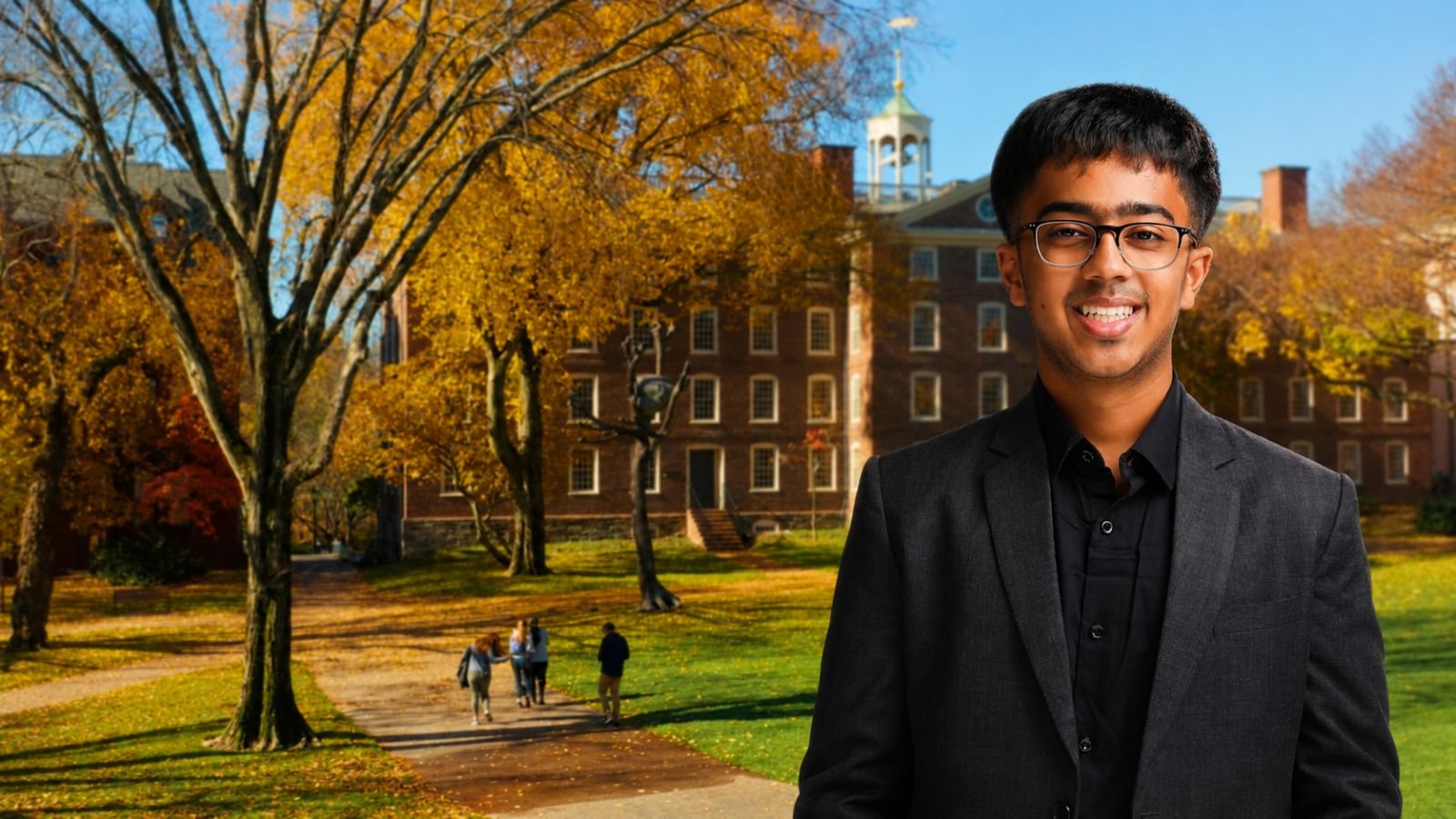
Pranav Ilango is 17, and until recently, his home was Erode, a district in Tamil Nadu. This year, he received a full scholarship worth Rs 3.55 crore to attend Brown University in the US, one of the eight Ivy League institutions, alongside Harvard and Yale. Founded in 1764, Brown predates the United States itself.
Pranav is an only child; both his parents teach at colleges in Erode, his father in textile technology, his mother in IT. He first heard of the mentorship programme through a senior in his area who’d won a scholarship to the University of Chicago a few years earlier.

Growing up, his schooling was split across two towns. “Up till 10th grade, I was in Erode, and then I went to Coimbatore,” he says. “That’s a different branch of the same school, and there I did my A-levels.” He’d switched from CBSE to the Cambridge IGCSE board back in class 6, a decision his parents weren’t sure about at the time. “Everybody around them was telling, switch to CBSE, take JEE, write NEET, go for engineering or medicine, because that was a very common path,” he shares. “Some teachers suggested they put me in IGCSE for two more years to see if things panned out well.” They did. He scored ‘A+Star’ in all nine of his IGCSE subjects, then also in all six of his A-level subjects, scoring the highest grade possible in both systems.
Behind this run of grades was a mentorship programme offered by Dexterity Global, which he joined in class 8. “They taught me about college applications, about personal development, about doing service for the country, about impacting society,” he says. What the programme gave him, more than anything, was a sense that studying abroad was actually possible. “A lot of people choose JEE and NEET because they are not aware of the opportunities abroad,” he says. “Even if they are aware, they do not know how to attain them.”
What began as a love for data evolved into a student-led effort
Numbers came before all of this. “Growing up, it was predominantly mathematics that interested me,” he says. “I wanted to master numbers very early. I had that hunger within.” Public health arrived later, and through a specific project. In class 11, Pranav and a friend started TNCSP, the Tamil Nadu Cancer Statistics Project, collecting data from the Adyar Cancer Institute, the state’s cancer data body. They built it into a website, tncsp.org, and then took it further.
“With the data and our findings, we started conducting awareness campaigns in and around Erode, Coimbatore and a bunch of nearby districts,” he says. “We have pamphlets printed out with our findings in Tamil, and we hand them over to people and explain why early screening is important.” The reasoning came from what the data showed him: “A lot of people in Tamil Nadu, based on initial symptoms, think they have a different disease. They don’t think it’s cancer. They put it off so much that at some point it becomes not curable via therapy.”
Outside of school and research, Pranav plays competitive chess, holding a FIDE rating (International Chess Federation) of 1800 and having represented Tamil Nadu in tournaments in France. He also co-founded HS Incubator, an online notes platform for A-level students that now has between 10,000 and 20,000 users. “We found that the notes already available did not capture the content of the syllabus accurately,” he explains. “So we made notes ourselves and published them online,” he adds, so students “get the most out of it,” rather than just another stack of PDFs.
Story continues below this ad
What lies ahead
At Brown, he’ll study under what the university calls an ‘Open Curriculum’, where students don’t declare a degree until the end of their second year. “Out of 30 courses, only 16 are enough to get a degree,” he explains. “The other 14 I can use to get another degree.” He’s chosen to combine applied mathematics with public health. “Applied mathematics has an aspect of computer science to it, and this will make me technically sound,” he says. “The public health part will give me the management knowledge and the field knowledge to start a startup.”
That startup, or possibly a non-profit, is the plan he keeps returning to. “I want to return to the country and do something here,” he says. “Given my background in public health with cancer data studies, it’ll help me get a better sense of the Indian health system, and I’ll be able to come back and start something of my own.” A master’s degree may come first, likely abroad again, but the endpoint doesn’t change. “The final plan is to come back to India.”
His backup plan? He applied to Hong Kong and Singapore as fall-back options, since both offer scholarships, if smaller ones than in the US, and skipped Indian colleges altogether. What struck him most, comparing systems, was how differently applicants are judged. “The US evaluates your entire profile,” he says.
“They create this 3D model of your personality, qualities, what you stand for, and what your goals are.” He reflects on the contrast with home: “Here, there’s a lot of focus on entrance exams. We develop strong test-taking skills, but there is also value in building a more well-rounded approach to learning,” he says.