

Close Menu

    Subscribe to Updates

    Get the latest news information from worldwide businesses.

    What's Hot

    This EV Never Hit Peak Power. But It Still Beat Its Charging Claim

    August 6, 2026

    BMW fast-tracks i3 production with stronger than expected demand

    August 6, 2026

    Julieta Venegas’s Latest Album, Norteña, Is an Ode to Her Hometown of Tijuana

    August 6, 2026
    Facebook Instagram YouTube LinkedIn X (Twitter)
    Trending
    • This EV Never Hit Peak Power. But It Still Beat Its Charging Claim
    • BMW fast-tracks i3 production with stronger than expected demand
    • Julieta Venegas’s Latest Album, Norteña, Is an Ode to Her Hometown of Tijuana
    • A star’s violent death exposed a hidden supermassive black hole
    • Fiona Phillips’ Alzheimer’s Journey: Beyond Memory Loss
    • It’s the last day to get $350 gift cards with Samsung Galaxy Z Fold 8 preorders
    • eBay continues to bet on live shopping after record quarter
    • India-Israel investment agreement in force: Modi, Netanyahu discuss enhanced bilateral ties
    Newspublicly
    • About Us
    • Advertise & Partner with us
    • Pitch Your Story
    • Contact Us
    Facebook Instagram LinkedIn X (Twitter)
    Subscribe
    • Home
    • World News
      • Asia
      • India
      • USA
      • UK & Europe
      • Middle East
    • Economy & Business
      • Global Economy
      • Corporate & Industry
      • Finance & Markets
      • Policy & Trade
    • Technology
      • Gadgets & Devices
      • Software & Apps
      • AI & Machine Learning
      • Robotics & Automation
    • Health & Medicine
      • Fitness & Nutrition
      • Research & Innovation
      • Disease & Treatment
      • Doctors, Clinics & Patient Care
    • Travel & Tourism
    • Automobile
      • Electric & Hybrid Vehicles
      • Auto Industry Insights
    • Sports
    • More
      • Education
      • Real Estate
      • Environment & Climate
      • Space & Astronomy
      • War & Conflicts
    Newspublicly
    Home»More»Space & Astronomy»SpaceX’s Falcon 9 wasn’t the first rocket to crash into the moon. Here’s a rundown.
    Space & Astronomy

    SpaceX’s Falcon 9 wasn’t the first rocket to crash into the moon. Here’s a rundown.

    AdminBy AdminAugust 6, 2026No Comments5 Mins Read0 Views
    Share
    Facebook Twitter LinkedIn Copy Link WhatsApp


    A spent rocket body hitting the moon made headlines this week, but the reality is that the unplanned collision by a SpaceX upper stage was just the latest in a long history of human-made objects meeting their end by impacting the lunar surface.

    Astronomers around the world kept their telescopes trained on the moon early Wednesday morning (Aug. 5), when the rocket stage from a January 2025 U.S. commercial lunar landing mission was calculated to strike the celestial body. Though the fate of the SpaceX Falcon 9 part was unintentional — solar activity and gravitational forces caused the stage to slam into the moon — the impact offered a rare opportunity to try to observe the flash from the impact and the plume of lunar material it sent flying.

    By noon (EDT) on Wednesday, there were no confirmed reports of the impact being caught on film, but a telescope in Chile spotted the debris plume, according to the Associated Press.

    “This rare occurrence has decades of history, going back to the Apollo era,” wrote Jared Isaacman, NASA’s administrator, in a post to his social media accounts. “The reality is that meteoroids strike the lunar surface hourly, with impacts comparable to this upper stage occurring roughly every six days.”

    Inventorying the impacts

    The moon is peppered with the scattered metal remains of missions that missed their mark, came down too quickly or were purposefully sent careening into the regolith to learn more about the makeup of Earth’s natural satellite.


    You may like

    In fact, the very first mission to successfully fly by the moon was intended to be an impactor. The former Soviet Union’s Luna 1 probe was designed to hit the moon but instead zoomed past its target and entered orbit around the sun on Jan. 2, 1959.

    Luna 2, launched nine months later, became humanity’s first object to reach the lunar surface, purposefully slamming into Sinus Lunicus (“Bay of Lunik”), along the southeastern edge of Mare Imbrium, on Sept. 14, 1959.

    Space

    The U.S. followed suit, though not as NASA intended, with the Ranger 4 probe impacting the far side of the moon on April 26, 1962. The mission had included an impactor, but both it and its lander failed to operate due to a failure to deploy the spacecraft’s solar arrays.

    Once humans began arriving on the moon with NASA’s Apollo program, scientists found another reason to direct spent rocket and spacecraft stages into a collision course with the surface. Beginning with Apollo 11 in 1969 and concluding with Apollo 16 in 1972, seismometers were placed on the moon to measure natural “moonquakes” and the effects on the moon when the missions’ Saturn SIV-B stages and Apollo lunar module descent stages made hard landings.

    The data collected helped geologists learn more about the interior makeup of the moon, including that a rocky mantle exists under the outer crust.


    What to read next

    four side-by-side images of moon craters, seen from space by a lunar orbiter

    These four images, captured by NASA’s Lunar Reconnaissance Orbiter, show craters formed by impacts of Apollo SIV-B stages. Crater diameters range from 35 to 40 meters (38.2 to 43.7 yards) in the longest dimension. (Image credit: NASA/Goddard/Arizona State University)

    After Apollo, planned impacts (and missions) slowed down, if not outright stopped, but the SpaceX collision on Wednesday was not the first in more than 50 years. Between 1993 and today, 11 probes — four from China, three from Japan, two from the U.S. and one each from India and the European Space Agency (ESA) — were intentionally deorbited at the end of the end of their missions around the moon.

    Some of these impacts were performed to discard the craft, but others — like Lunar Prospector, LCROSS and Chandrayaan-1 — helped confirm the presence of water by examining the resulting plume.

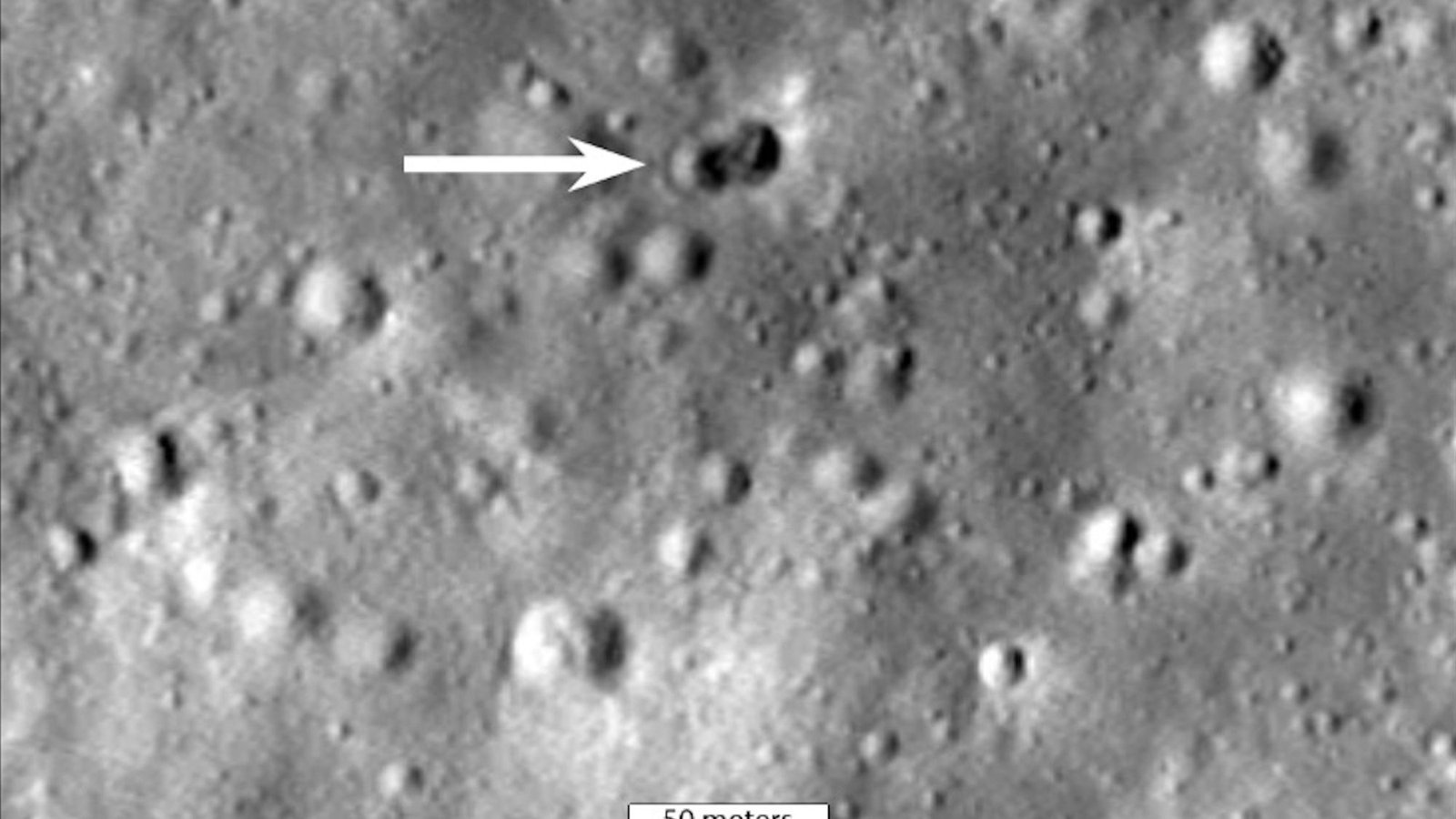
    Unintentional collisions are fewer in number, as are rocket stages, but are not unprecedented. A rocket body that hit the moon’s far side in March 2022, leaving behind a small double crater, was later identified as a Long March 3C rocket that launched China’s Chang’e 5-T1 mission around the moon in 2014.

    Litter versus liability

    Without a large human population on the moon, the risk that these planned and unplanned impacts present at current is minimal. But the concern rises as NASA and other world space agencies, as well as commercial interests, begin to increase the pace on establishing their now-planned sustainable facilities for astronauts to live and work on the lunar surface.

    “The future lunar base will incorporate reusable spacecraft that not only deliver astronauts and payloads, but also become part of the infrastructure itself,” Isaacman said in his post, referring to how reuse can be a way to reduce the number of vehicles needed to be discarded of on the moon.

    The Artemis Accords, an internationally agreed-upon set of standards led by NASA and currently signed onto by 70 countries, also includes a provision for its members that spacecraft and their associated rocket components must be disposed of safely.


    Source link

    Author

    • Admin

      NewsPublicly.com is News & Articles Platform that creating SEO-focused articles on travel, lifestyle, and digital trends.

    Admin
    • Website

    NewsPublicly.com is News & Articles Platform that creating SEO-focused articles on travel, lifestyle, and digital trends.

    Related Posts

    Plan your perfect 2026 total solar eclipse experience with these smartphone apps

    August 6, 2026

    Where will the total solar eclipse 2026 be visible from?

    August 6, 2026

    ‘Warhammer 40,000’ animated series coming to Prime Video, with Henry Cavill onboard as executive producer

    August 5, 2026
    Leave A Reply Cancel Reply

    Demo
    Top Posts

    The Blue Moon rises on May 30— Where and when to see the second full moon of the month

    May 30, 202640 Views

    New SOCOM rifle allows barrel swapping and cartridge changes

    June 1, 202633 Views

    “Inside Gemini Robotics 1.5: How Robots Learn to Reason & Act

    November 22, 202527 Views

    525 pounds of cocaine seized after Nebraska K9 alerts troopers on I-80

    May 28, 202624 Views
    Don't Miss

    This EV Never Hit Peak Power. But It Still Beat Its Charging Claim

    August 6, 20264 Mins Read0 Views

    The 75-kWh Zeekr 7GT charged from 10% to 80% in about 11 minutes, beating Zeekr’s…

    BMW fast-tracks i3 production with stronger than expected demand

    August 6, 2026

    Julieta Venegas’s Latest Album, Norteña, Is an Ode to Her Hometown of Tijuana

    August 6, 2026

    A star’s violent death exposed a hidden supermassive black hole

    August 6, 2026
    Stay In Touch
    • Facebook
    • Twitter
    • Instagram
    • YouTube
    • LinkedIn
    • WhatsApp

    Subscribe to Updates

    Get the latest creative news from SmartMag about art & design.

    Demo
    NEWSPUBLICLY
    Facebook X (Twitter) Instagram LinkedIn

    Home

    • About Us
    • Leadership
    • Advertise & Partner With Us
    • Pitch Your Story
    • Media Kit & Pricing
    • Career
    • FAQs

    Guidelines

    • Editorial & Submission
    • Partnership
    • Advertising & Sponsor
    • Intellectual Property Policy
    • Community & Comment
    • Security & Data Protection
    • Send Your Opinion

    Quick Links

    • Cookie Policy
    • Payment & Billing Terms
    • Refund & Cancellation
    • Copyright Policy
    • Complaint & Support
    • Sitemap
    • Contact Us

    Subscribe Us

    Get the latest news and updates!

    Copyright © 2026 Newspublicly (DIGITALIX COMMUNICATION). All Rights Reserved.
    • Privacy Policy
    • Terms of Use
    • Disclaimer