

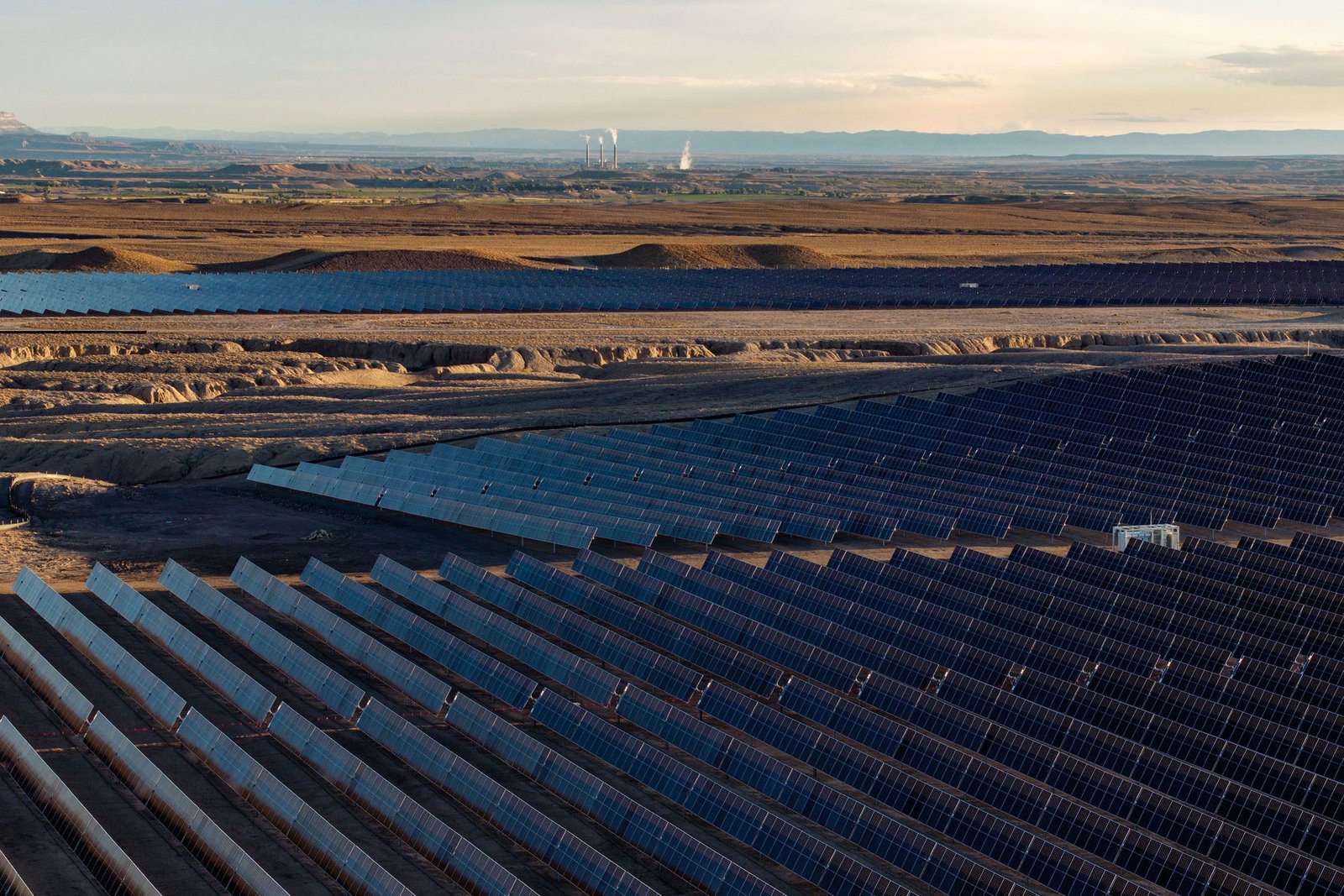
It’s been a wild first half of the year in the U.S. power sector, with announcements of gigantic natural gas power plants and some long-awaited renewable energy projects coming online.
At times of rapid change, forecasting is difficult. So I feel a measure of comfort focusing on something concrete like the list of 368 utility-scale plants that began operation from January to June, according to data from the U.S. Energy Information Administration. The group is dominated by utility-scale solar.
This is a top-heavy list, led by SunZia Wind South and SunZia Wind North in New Mexico, which went online this spring and are the largest wind farms in the country, with a combined generating capacity of 3,650 megawatts. SunZia has been in the works for about a decade and arrives at a time when U.S. onshore wind power development has dwindled for a host of reasons related to regulations and public opinion.
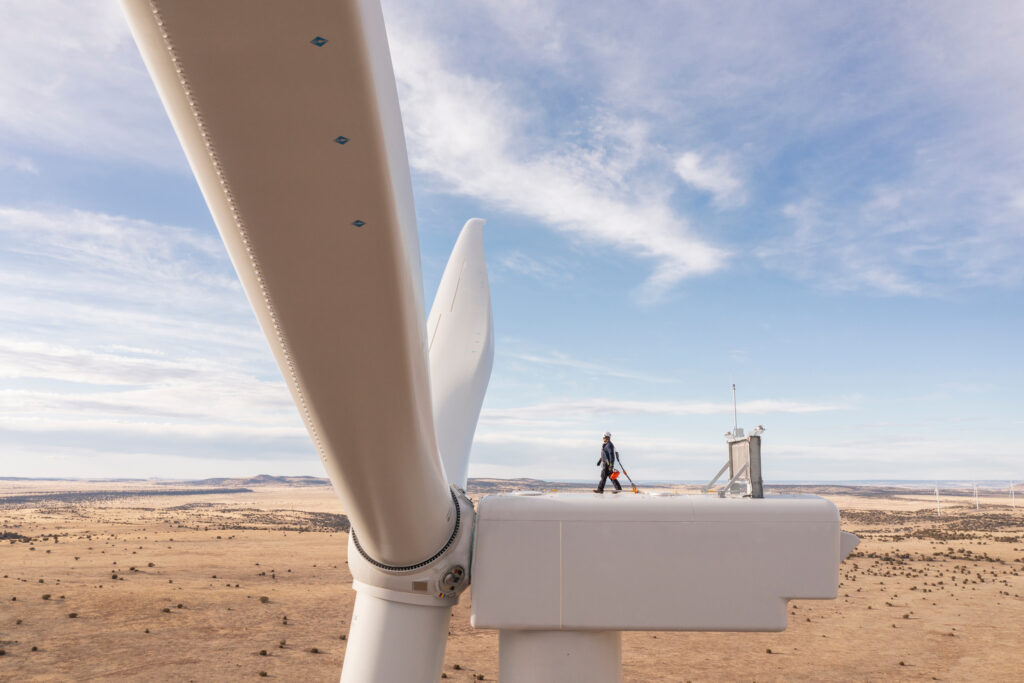
In other words, the SunZia is not indicative of an onshore wind-energy boom. It is more like an echo from a past boom.
Next is Trumbull Energy Center in Ohio, a 900-megawatt combined-cycle natural gas plant that is part of an expansion of natural gas power in the PJM Interconnection grid region, which covers parts of the Mid-Atlantic, Midwest and South.
The fourth-largest new power plant—if we’re counting SunZia as two—is Vineyard Wind, the offshore wind project near Massachusetts, which, much like SunZia, has been in development for a long time and whose completion doesn’t reveal much about future trends.
It isn’t until the fifth-largest new plant that we see one that is connected to the broader trend in the data: Green River Energy Center in Utah, with 800 megawatts that includes 400 megawatts of solar and 400 megawatts of batteries.
Indeed, the story of power plant completions in the first half of 2026 was mainly about utility-scale solar and batteries.
Utility-scale solar led in the number of projects coming online, with 207, followed by batteries, with 95.
Next were natural gas combustion turbines, with 22, and natural gas internal combustion engines, with 21.
Onshore wind had 9 projects.
Combined-cycle natural gas, despite having massive amounts of announced capacity in development, had just 3 projects that went online. The high tide of new gas plants won’t arrive for another few years.
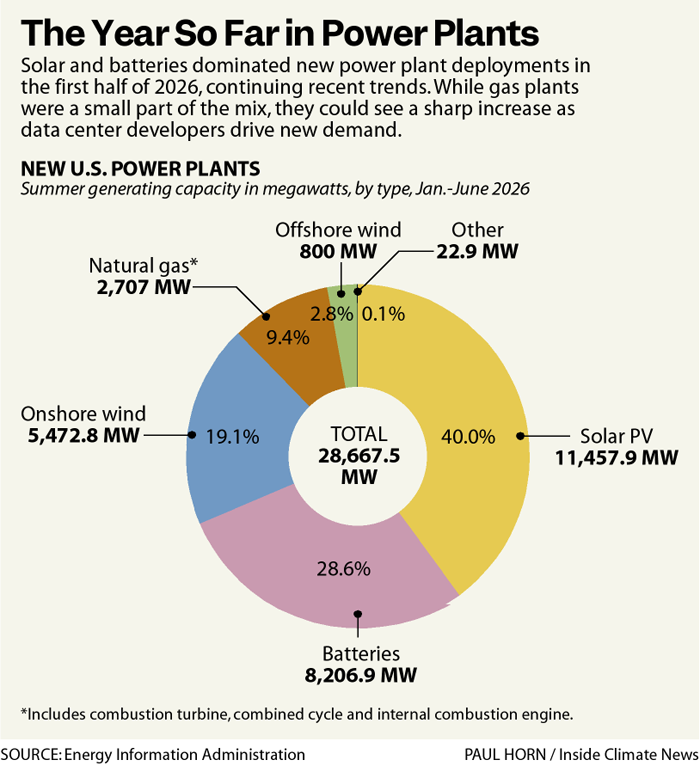
If we look at projects in terms of generating capacity, utility-scale solar led with 11,458 megawatts, followed by batteries, 8,207 megawatts, and then onshore wind, mostly because of the SunZia projects, with 5,473 megawatts.
The three largest types of natural gas plants added a total of 2,707 megawatts of new capacity.
Small-scale solar, including rooftop solar, is not part of this database.
A perpetual caveat: Power plant technologies have important differences to keep in mind when comparing generating capacity. The most obvious one is that solar doesn’t produce power at night. Another is that many gas plants only run a few days or weeks per year, when they’re needed to handle peak demand.
What do these numbers tell us? I asked Eric Gimon, a senior fellow at Energy Innovation, a San Francisco-based think tank.
Gimon explained that the bulk of new projects are small and mid-size utility-scale solar. They are not attention-grabbing. But they’re almost everywhere. Many of the solar projects are paired with batteries.
“These kinds of smaller-size projects are just easier to build, and the site possibilities are much more diverse and easy to find,” he said.
Now, let’s look at the new power plants in terms of where they were built. Three states account for about half of the country’s new generating capacity: Texas, New Mexico and Arizona.
Texas was the leader, with a power mix that leaned more heavily on batteries and gas than other states. The leading category in Texas was batteries, with 3,067 megawatts, followed by utility-scale solar, with 2,311 megawatts, and then natural gas combustion turbines or natural gas internal combustion engines, with 1,154 megawatts.
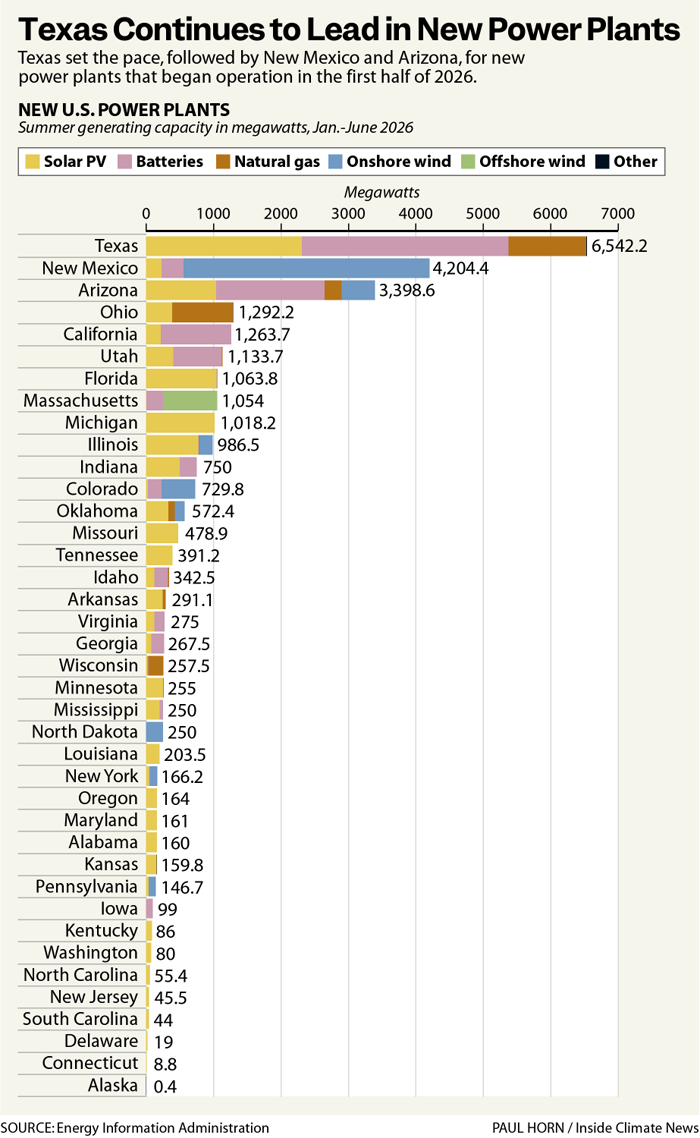
Texas’ policies have prioritized gas and battery plant construction to help bolster the power grid’s reliability at times of high demand.
Also, Texas illustrates how challenging the market is for new onshore wind. The state is the national leader in onshore wind, but brought no new projects online in the first half of the year.
One of Gimon’s takeaways is that the first half of 2026 is that we’re firmly in the era of utility-scale solar, with batteries playing a supporting role.
“The real underlying workhorse is solar plus battery,” he said.
Some other observations from this data:
- Illinois ranked first in the number of new utility-scale solar projects, with 36, ahead of California, with 22, and Texas, with 16. Illinois’ projects tended to be on the small side, which is why it could lead in the number of projects but barely cracked the top 10 in overall generating capacity coming online. This is policy-driven and shows that state laws encouraging small and medium-size solar are leading to completed projects.
- The “other” category of power technologies almost always has something interesting, with some tiny plant that isn’t indicative of anything, but is probably a good story. One that caught my eye is the 4 megawatts of hydropower that went online in Dakota County, Minnesota, which is in the Minneapolis-St. Paul metro area. The project at the Byllesby Dam is a replacement of hydropower turbines that have operated on the Cannon River since 1910, and got local media coverage when the county government announced the project a few years ago.
- A 2.8-megawatt biomass power plant went online just a few miles from my house in Ohio, operated by the Columbus city government. It’s fueled by methane captured from waste at a sewage-treatment plant. I was unaware of this project and now want to take a closer look.
This story is funded by readers like you.
Our nonprofit newsroom provides award-winning climate coverage free of charge and advertising. We rely on donations from readers like you to keep going. Please donate now to support our work.
Looking ahead, the Energy Information Administration’s list of planned power plants shows that the utility-scale solar boom is likely to continue, and the final years of this decade are shaping up to bring a boom in natural gas power plants.
But it’s tough to pin down the size of the solar and gas booms because of uncertainty about many factors, including how much electricity demand will grow and what share of the growth will be driven by AI data centers.
So take some comfort in what we know for sure, which is the stuff that’s actually built, and realize that just about everything else comes with a question mark.
Other stories about the energy transition to take note of this week:
Here’s What the New Solar Tariffs Do, and What They Mean: The Trump administration last week announced new tariffs on imported polysilicon and related products used in solar panels, part of an attempt to impose a price floor to respond to what the administration has said is unfair competition. Julian Spector of Canary Media explains the new tariffs and how they fit into the history of the push and pull between reliance on inexpensive imports and policymakers’ efforts to help U.S.-based solar manufacturers compete.
Sunrun Focuses on Direct Sales Amid Larger Market Challenges: Sunrun, the country’s largest rooftop solar provider, reported disappointing second-quarter financial results as the company deals with a slowdown in rooftop solar and is trying to shift its business to focus less on sales through affiliates, as Brian Martucci reports for Utility Dive. Sunrun’s sales were affected by the bankruptcy of Freedom Forever, a partner company that does installations.
Amazon’s Plans to Use Texas Gas Plant at Odds With Climate Commitments: Amazon has confirmed that it plans to be the primary user of a proposed 7.6-gigawatt natural gas power plant in Texas, which would be one of the largest of its type in the world, as Hiroku Tabuchi reports for The New York Times. The company, which plans to use the plant to power a data center, has said this major expansion into gas power does not affect the company’s commitment to reach net-zero emissions by 2040, but it’s not clear how this is possible. We wouldn’t know of Amazon’s involvement in the gas plant if not for reporting from Michael Thomas of the market intelligence firm Cleanview, who has used satellite images, government filings and general sleuthing to track the growth of data centers and their power plants.
The Offshore Wind Bust Is Leaving Workers Behind: Building trades spent years preparing to spend at least a generation building offshore wind farms but have now been abandoned by U.S. policies hostile to development, as my colleague Ajani Stella reports. The scale of the reversal is shocking, with billions of dollars in investment and thousands of jobs vanishing in the face of obstruction from the Trump administration.
Inside Clean Energy is ICN’s weekly bulletin of news and analysis about the energy transition. Send news tips and questions to [email protected].
About This Story
Perhaps you noticed: This story, like all the news we publish, is free to read. That’s because Inside Climate News is a 501c3 nonprofit organization. We do not charge a subscription fee, lock our news behind a paywall, or clutter our website with ads. We make our news on climate and the environment freely available to you and anyone who wants it.
That’s not all. We also share our news for free with scores of other media organizations around the country. Many of them can’t afford to do environmental journalism of their own. We’ve built bureaus from coast to coast to report local stories, collaborate with local newsrooms and co-publish articles so that this vital work is shared as widely as possible.
Two of us launched ICN in 2007. Six years later we earned a Pulitzer Prize for National Reporting, and now we run the oldest and largest dedicated climate newsroom in the nation. We tell the story in all its complexity. We hold polluters accountable. We expose environmental injustice. We debunk misinformation. We scrutinize solutions and inspire action.
Donations from readers like you fund every aspect of what we do. If you don’t already, will you support our ongoing work, our reporting on the biggest crisis facing our planet, and help us reach even more readers in more places?
Please take a moment to make a tax-deductible donation. Every one of them makes a difference.
Thank you,

Reporter, Clean Energy
Dan Gearino covers the business and policy of renewable energy and utilities, often with an emphasis on the midwestern United States. He is the main author of ICN’s Inside Clean Energy newsletter. He came to ICN in 2018 after a nine-year tenure at The Columbus Dispatch, where he covered the business of energy. Before that, he covered politics and business in Iowa and in New Hampshire. He grew up in Warren County, Iowa, just south of Des Moines, and lives in Columbus, Ohio.