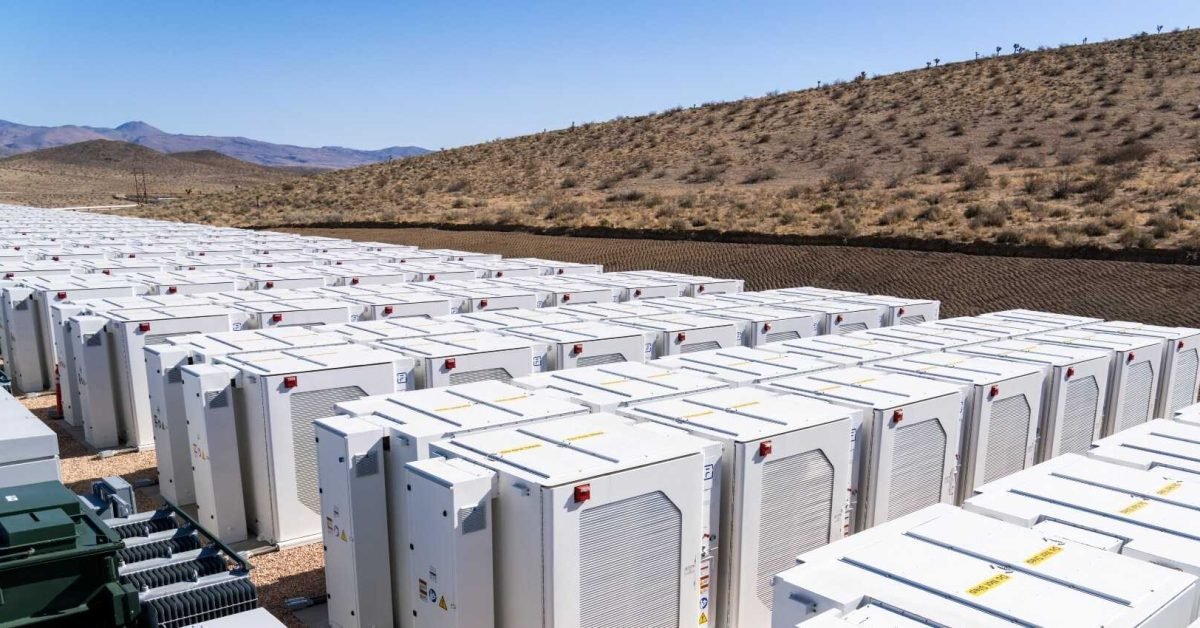

The US energy storage industry kicked off 2026 with its strongest Q1 on record, despite the Trump administration continuing to attack clean energy.
According to the latest US Energy Storage Market Outlook released today from the Solar Energy Industries Association (SEIA) and Benchmark Mineral Intelligence, the US installed 9.7 gigawatt-hours (GWh) of new energy storage capacity in Q1 2026. That’s a 32% year-over-year jump.
Global instability is causing growth
Utility-scale batteries made up the vast majority of new installations, with 7.8 GWh added during the quarter. The commercial and industrial segment installed 648 megawatt-hours (MWh), while residential storage added 515 MWh.
And the industry expects even more growth ahead. The report has been revised upward to forecast more than 610 GWh of energy storage installations by 2030.
A major reason is instability in the global fossil fuel market due to the war in Iran.
As gas prices remain volatile and supply disruptions continue to affect natural gas and gas turbines, solar and battery storage are increasingly attractive because they don’t rely on fuel. More battery storage equipment is also being manufactured in the US, helping shield projects from overseas supply shocks.
SEIA interim president and CEO Darren Van’t Hof said, “While long-term forecasts are validating that the demand for this technology is rising as off-takers seek energy security, actions in Washington to stall permitting are threatening to slow that progress. Storage can help America meet rising energy demand and strengthen American energy independence, but only if Washington lets the solar and storage industry build.”
AI and data centers are driving demand
The report also points to exploding power demand from AI and data centers. Companies like Google and Meta have already announced deals this year to procure tens of thousands of megawatt-hours of energy storage capacity.
Battery storage is increasingly being framed as critical infrastructure for powering AI growth while keeping electricity prices from spiking for everyone else.
“A supportive policy landscape for BESS will be crucial to enabling the rollout of AI and data centers, while mitigating adverse cost impacts to regular consumers,” said Benchmark Mineral Intelligence’s BESS and energy lead Shan Tomouk.
SEIA’s report warns that federal permitting bottlenecks could push household electricity bills even higher. Analysis found that 467 solar and storage projects currently have permits pending and may face politically motivated delays or cancellations.
Red-state energy storage growth continues
Texas, Arizona, and California remained the country’s top utility-scale storage markets in Q1. Notably, 71% of all utility-scale storage installed during the quarter was built in red states.
The report also noted that 13 states now have explicit energy storage targets in place, helping drive more investment. Georgia, Iowa, and Mississippi all posted notable storage growth in Q1.
Read more: Batteries are so cheap now, solar power doesn’t sleep
If you’ve ever considered going solar, make it easy by finding a trusted, reliable solar installer near you that offers competitive pricing by checking out EnergySage. It has hundreds of pre-vetted solar installers competing for your business, ensuring you get high-quality solutions and save 20-30% compared to going it alone. Plus, it’s free to use, and you won’t get sales calls until you select an installer and share your phone number with them.
Your personalized solar quotes are easy to compare online, and you’ll get access to unbiased Energy Advisors to help you every step of the way. Get started here.


FTC: We use income earning auto affiliate links. More.