

Close Menu

    Subscribe to Updates

    Get the latest news information from worldwide businesses.

    What's Hot

    AI won’t replace you but someone using AI might

    May 25, 2026

    RBI to examine role of quantum technology in strengthening financial sector

    May 25, 2026

    India bars piped natural gas customers from buying LPG cylinders, order shows

    May 25, 2026
    Facebook Instagram YouTube LinkedIn X (Twitter)
    Trending
    • AI won’t replace you but someone using AI might
    • RBI to examine role of quantum technology in strengthening financial sector
    • India bars piped natural gas customers from buying LPG cylinders, order shows
    • These underdogs are a big reason S&P 500 profit growth is the fastest in nearly 5 years
    • India proposes broad revamp of industrial output index ahead of new series
    • Oil prices fall below $100 a barrel on hopes of Iran peace deal | Oil
    • ‘Horse-trading at horse-speed’: Stalin attacks TVK after 3 AIADMK MLAs quit; EPS alleges ‘pre-planned conspiracy’ | India News
    • DHSE Plus Two Result Kerala Board at results.kite.kerala.gov.in, examresults.kerala.gov.in, results.kerala.nic.in
    Newspublicly
    • About Us
    • Advertise & Partner with us
    • Pitch Your Story
    • Contact Us
    Facebook Instagram LinkedIn X (Twitter)
    Subscribe
    • Home
    • World News
      • Asia
      • India
      • USA
      • UK & Europe
      • Middle East
    • Economy & Business
      • Global Economy
      • Corporate & Industry
      • Finance & Markets
      • Policy & Trade
    • Technology
      • Gadgets & Devices
      • Software & Apps
      • AI & Machine Learning
      • Robotics & Automation
    • Health & Medicine
      • Fitness & Nutrition
      • Research & Innovation
      • Disease & Treatment
      • Doctors, Clinics & Patient Care
    • Travel & Tourism
    • Automobile
      • Electric & Hybrid Vehicles
      • Auto Industry Insights
    • Sports
    • More
      • Education
      • Real Estate
      • Environment & Climate
      • Space & Astronomy
      • War & Conflicts
    Newspublicly
    Home»More»Space & Astronomy»Scientists just found a supercharged supernova — powered up by a magnetic star corpse
    Space & Astronomy

    Scientists just found a supercharged supernova — powered up by a magnetic star corpse

    AdminBy AdminMay 25, 2026No Comments6 Mins Read0 Views
    Share
    Facebook Twitter LinkedIn Copy Link WhatsApp


    NASA’s Fermi Gamma-ray spacecraft has observed a super-bright, supercharged supernova explosion that may have been powered up by a highly magnetic dead star, a type of neutron star called a magnetar. This magnetar would have actually been born in the supernova itself, forced into existence when the core of a star that was much more massive than the sun underwent gravitational collapse at the end of its life.

    During these core-collapse supernovas, stellar cores with between one and two times the mass of the sun crush down to a radius of around 12 miles (20 kilometers) to create a neutron star, just like scientists say they see here. Not only does this rapid compression mean that neutron stars are made of material so dense that one teaspoon of it brought to Earth would weigh around 10 million tons (think 350 Statues of Liberty sitting on a teaspoon), but it also causes them to spin at rates as rapid as 700 times every second. The magnetic field lines of these dead stars are also forced together, intensifying the strength of neutron stars’ magnetic fields, which makes magnetars the most powerful magnetic objects in the known universe.

    “For nearly 20 years, astronomers have searched Fermi data for gamma-ray signals from thousands of supernovae, and while a few intriguing hints have been reported, none were definitive until now,” team leader Fabio Acero of the University of Paris-Saclay said in a statement.

    You may like

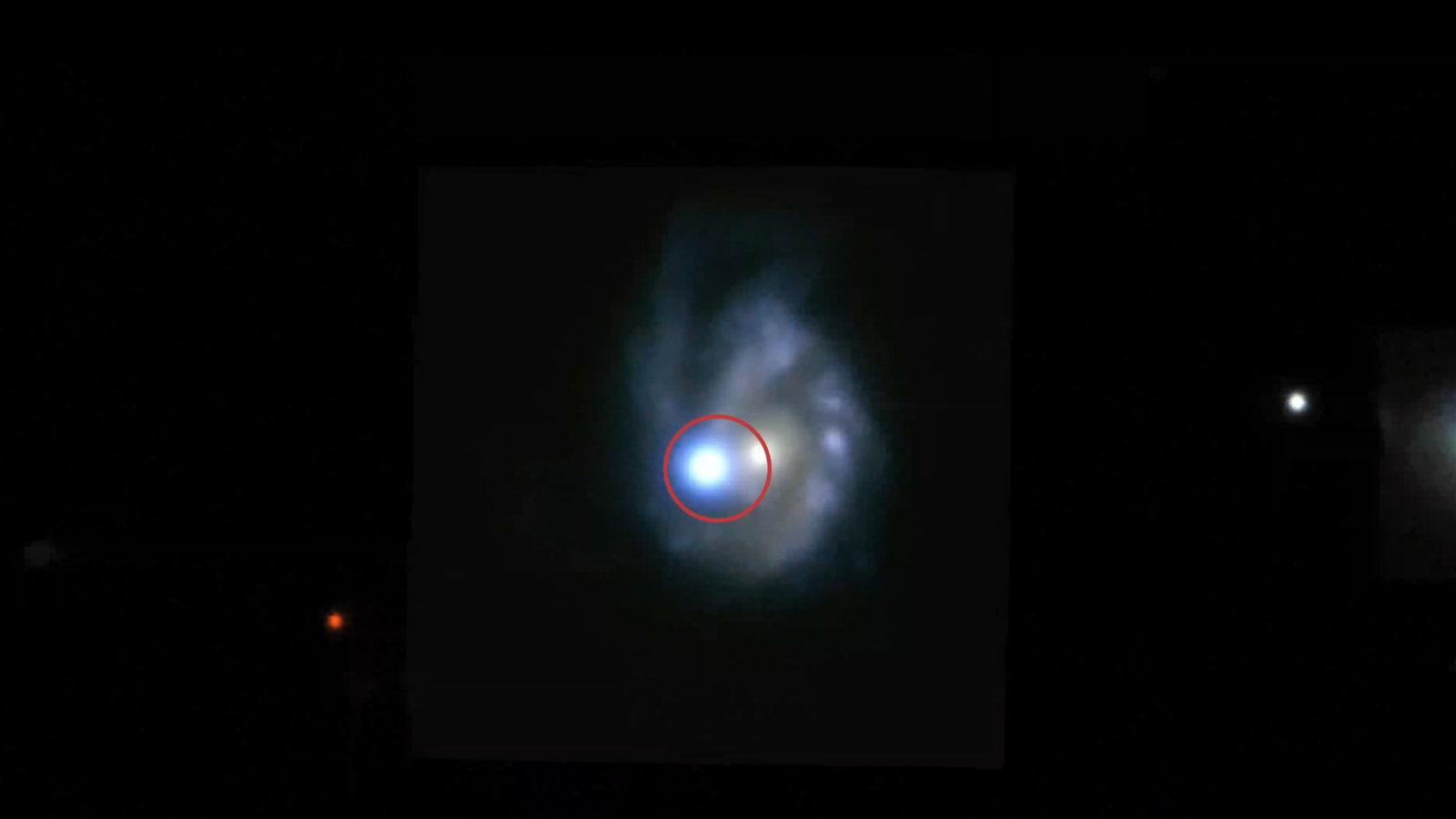
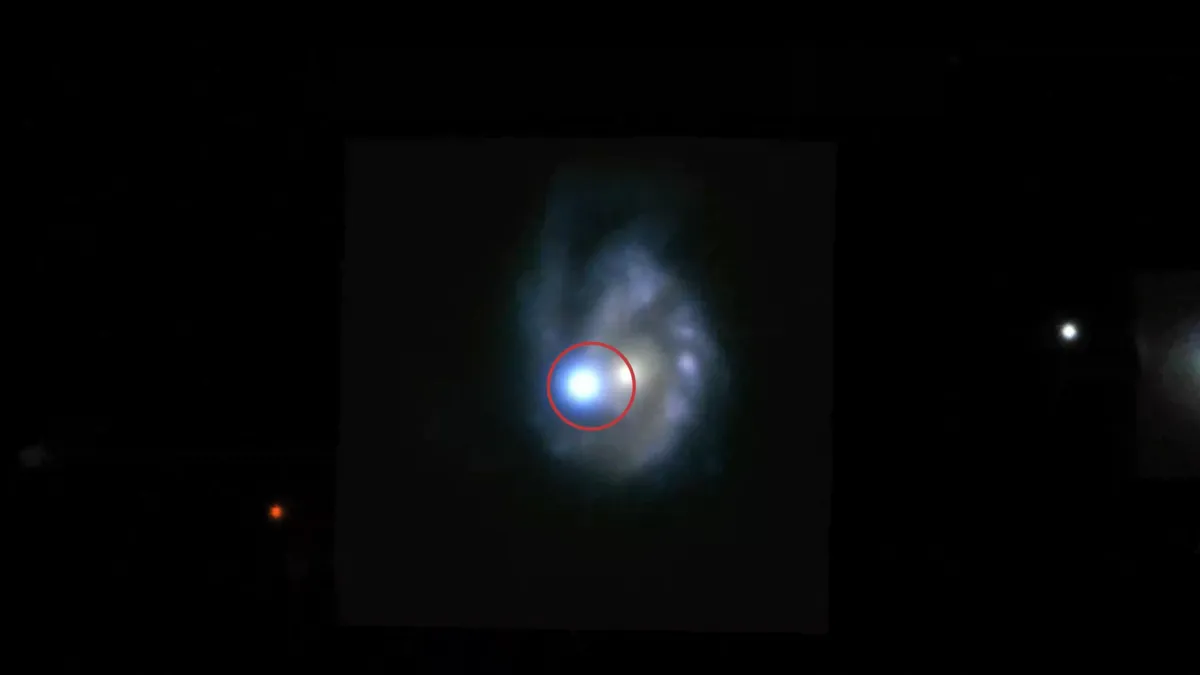
    A view of a spiral galaxy with a bright spot toward the left.

    The superluminous supernova SN 2017egm was discovered by the European Space Agency’s Gaia mission on May 23, 2017. The circle shows the supernova shining bright within the massive barred spiral galaxy NGC 3191. (Image credit: NASA’s Goddard Space Flight Center)

    A superbright supernova

    Over the last few decades, astronomers have observed around 400 core collapse supernovas, which, depending on the initial mass of the dying star involved, can also birth a black hole. Some of these stellar explosions are described as “superluminous” because they produce in excess of 10 times as much visible light as other core-collapse supernovas.

    In 2024, scientists revealed they had successfully used Fermi to spot gamma-rays, the most energetic form of light, emitted from a supercharged supernova designated SN 2017egm. This supernova erupted around 440 million light-years away in the galaxy NGC 3191. Though that distance is so vast it took gamma-rays from the event 440 million years to reach Earth and Fermi, it is still one of the closest core-collapse supernovas to Earth ever seen.

    “We searched for gamma rays from the six nearest superluminous supernovas seen during the first 16 years of Fermi’s mission,” Guillem Martí-Devesa, of the Institute of Space Sciences in Barcelona, Spain, said in the statement. “Only SN 2017egm shows evidence for gamma rays, confirming earlier hints that some supernovas can be as luminous in gamma rays as they are in visible light. This opens up a new window for studying these fascinating events.”
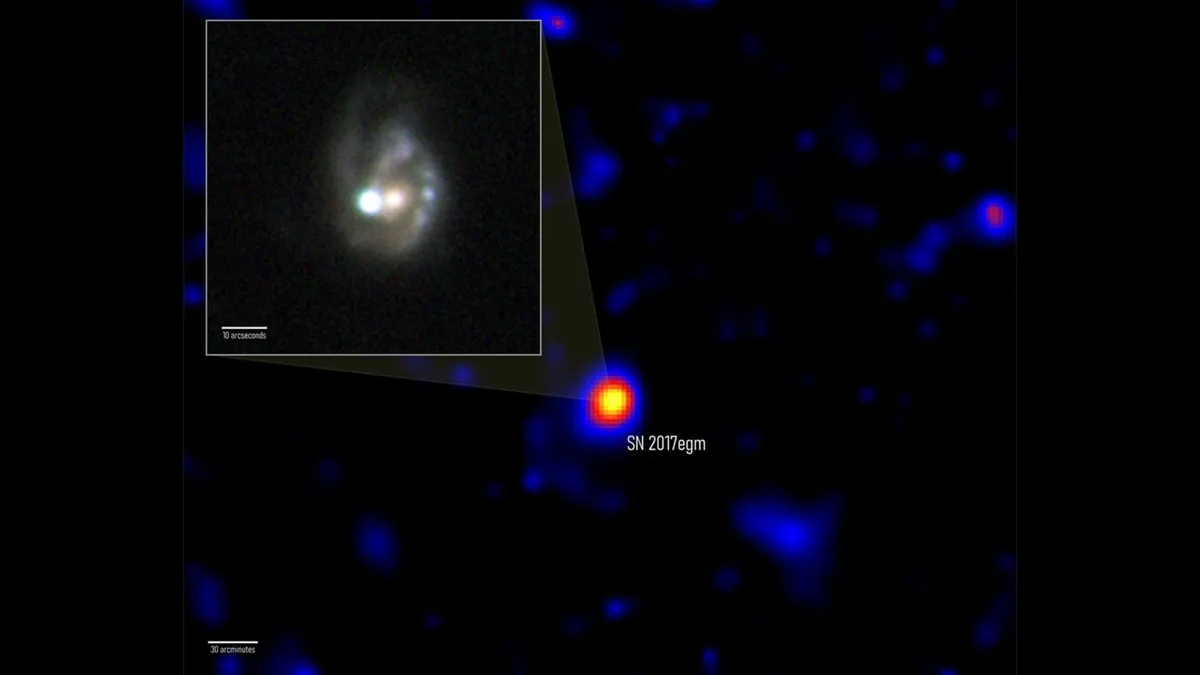
    Blue dots on a black background. There is an orange and yellow circle in the center bottom. An inset shows that this yellow and orange circle is in fact the supernova.

    Two views of SN 2017egm, in visible light (inset) and gamma rays (background). (Image credit: Background, NASA/DOE/Fermi LAT Collaboration and Acero et. al. 2026; inset, NOT+ALFSOC/Bose et al. 2020)

    Scientists are keen to discover what it is about superluminous supernovas that lets them pack such a powerful punch. One theory suggests this extra energy comes from the fact that these events birth a magnetar with magnetic fields 1,000 times stronger than those of “ordinary” neutron stars.

    Space

    This team observed the optical and gamma-ray radiation emitted by SN 2017egm and compared this data to theoretical models of the flow of light and particles from a newborn magnetar. The models specifically reproduced how said particles would interact with the expanding shell of material shrugged off by the supernova’s dying progenitor star. Of particular interest was a cloud of electrons and positrons in addition to their antimatter counterpart particles.

    Scientists believe those particles were thrown out by the rapidly spinning newborn magnetar and call the cloud a magnetar wind nebula. The magnetar wind nebula is believed to boost the production and absorption of gamma-rays. One of the processes that would allow it to do this is the annihilation of particles and the release of energy as gamma-rays that occurs when a matter particle and its antimatter counterpart meet. These gamma-rays strike the outer shell of supernova debris and are turned into lower-energy optical light, explaining why these superluminous supernovas are so bright in visible light.

    “About three months after the collapse, as the supernova debris expands and cools, the gamma rays can begin to leak out,” Acero said. “This magnetar model best reproduces the supernova’s luminosity and the arrival time of its gamma rays during the first months, but we see room for improvement at later times, when the visible light fades quite irregularly.”


    What to read next

    Acero and colleagues have a theory of what may be causing this gradual fade-out, suggesting it could be the result of debris ejected by the destroyed star hundreds of years prior to its supernova destruction falling back onto the magnetar.
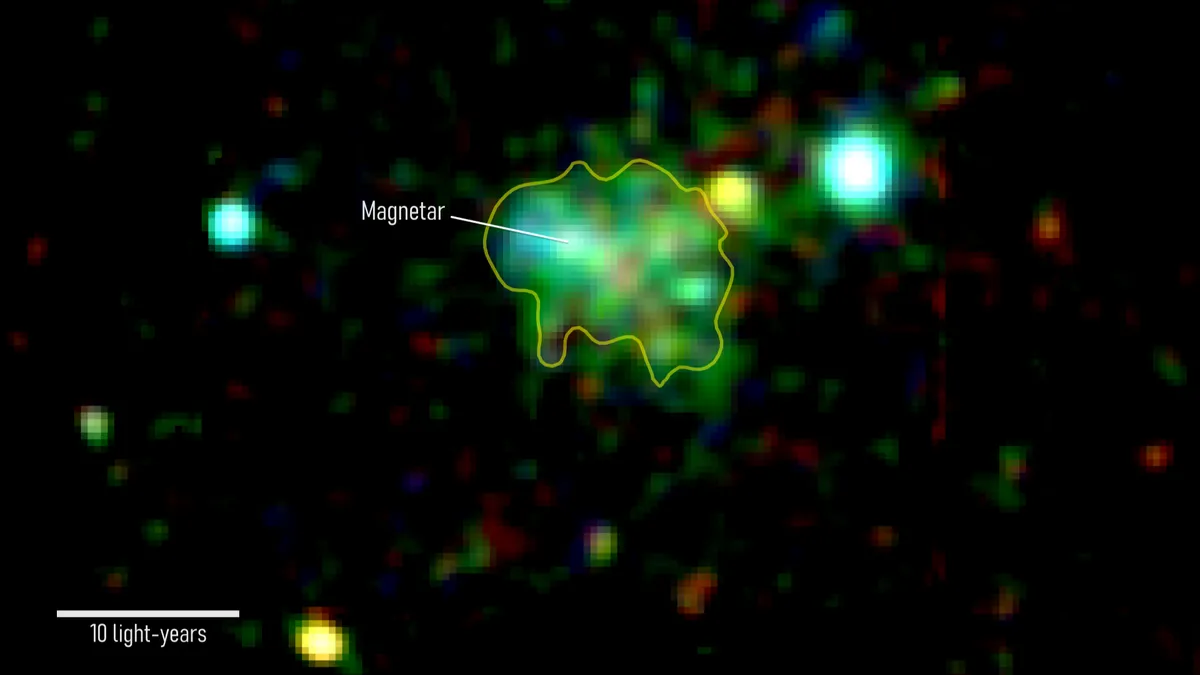
    Pixelated blobs in various sizes and colors emerge from a black background. At the center, a yellow outline encloses a large blob predominantly in green and blue-white. A thin white line extends from the brightest spot to a label at about 10 oclock that reads "Magnetar." A white scale bar at lower left indicates a width of 10 light-years, with corresponding text.

    The X-ray glow of Swift J1834.9-0846 at the heart of the W41 supernova remnant comes from the first magnetar wind nebula identified (outline). (Image credit: ESA/XMM-Newton and Younes et al. 2016)

    The team also had one eye on the future, assessing how efficient the new ground-based gamma-ray observatory, the Cerenkov Telescope Array Observatory, will be at spotting events like SN 2017egm. They found that in 50 hours of observing time, the telescope array, located at the Paranal Observatory and on the island of La Palma, Spain, should be able to spot similar cosmic blasts up to a distance of around 500 million light-years.

    That could help scientists finally understand these super-powerful supernovas.

    “The magnetar central engine mechanism discussed in this paper builds upon a lot of observational and theoretical advances in magnetars over the last 20 years,” team member Judy Racusin, at NASA’s Goddard Space Flight Center in Greenbelt, Maryland, said. “Observing gamma rays from supernovae will give us a new way to explore their inner workings.”

    The team’s results were published on Wednesday (May 20) in the journal Astronomy & Astrophysics.


    Source link

    Author

    • Admin

      NewsPublicly.com is News & Articles Platform that creating SEO-focused articles on travel, lifestyle, and digital trends.

    Admin
    • Website

    NewsPublicly.com is News & Articles Platform that creating SEO-focused articles on travel, lifestyle, and digital trends.

    Related Posts

    Scientists want to send a roly-poly robot filled with ‘dandelion drones’ to investigate hidden tunnels on Mars

    May 25, 2026

    15 sci-fi books you absolutely have to read before you die

    May 24, 2026

    The original (and best) ‘Transformers’ movie rolls back out into theaters for special 40th anniversary 4K screenings

    May 24, 2026
    Leave A Reply Cancel Reply

    Demo
    Top Posts

    “Inside Gemini Robotics 1.5: How Robots Learn to Reason & Act

    November 22, 202525 Views

    How US Tariffs Are Reshaping the Global Growth Landscape?

    November 21, 202518 Views

    Pakistani Journalist Laughing at Tejas Fighter Jet Crash at Dubai Airshow Sparks Massive Outrage Worldwide

    November 23, 202517 Views

    Vibe-Coding Boom: How Non-Coders Build Apps With AI Agents

    November 22, 202515 Views
    Don't Miss

    AI won’t replace you but someone using AI might

    May 25, 20261 Min Read0 Views

    Generative AI is transforming the workplace faster than ever, but new research from the University…

    RBI to examine role of quantum technology in strengthening financial sector

    May 25, 2026

    India bars piped natural gas customers from buying LPG cylinders, order shows

    May 25, 2026

    These underdogs are a big reason S&P 500 profit growth is the fastest in nearly 5 years

    May 25, 2026
    Stay In Touch
    • Facebook
    • Twitter
    • Instagram
    • YouTube
    • LinkedIn
    • WhatsApp

    Subscribe to Updates

    Get the latest creative news from SmartMag about art & design.

    Demo
    NEWSPUBLICLY
    Facebook X (Twitter) Instagram LinkedIn

    Home

    • About Us
    • Leadership
    • Advertise & Partner With Us
    • Pitch Your Story
    • Media Kit & Pricing
    • Career
    • FAQs

    Guidelines

    • Editorial & Submission
    • Partnership
    • Advertising & Sponsor
    • Intellectual Property Policy
    • Community & Comment
    • Security & Data Protection
    • Send Your Opinion

    Quick Links

    • Cookie Policy
    • Payment & Billing Terms
    • Refund & Cancellation
    • Copyright Policy
    • Complaint & Support
    • Sitemap
    • Contact Us

    Subscribe Us

    Get the latest news and updates!

    Copyright © 2026 Newspublicly (DIGITALIX COMMUNICATION). All Rights Reserved.
    • Privacy Policy
    • Terms of Use
    • Disclaimer