


Close Menu

    Subscribe to Updates

    Get the latest news information from worldwide businesses.

    What's Hot

    SpaceX just fired up its 33-engine Starship ‘V3’ Super Heavy rocket booster. When could it fly?

    May 13, 2026

    Sources: 76ers president Morey out; Nurse to stay

    May 13, 2026

    Tesla finally launches Supercharger virtual queue pilot after fights broke out

    May 13, 2026
    Facebook Instagram YouTube LinkedIn X (Twitter)
    Trending
    • SpaceX just fired up its 33-engine Starship ‘V3’ Super Heavy rocket booster. When could it fly?
    • Sources: 76ers president Morey out; Nurse to stay
    • Tesla finally launches Supercharger virtual queue pilot after fights broke out
    • Scientists discover a weak spot shared by polio and common cold viruses
    • Focal Coronary Disease Predicts Greater Benefit from PCI in Stable Angina: ORBITA-2 trial Analysis
    • Google’s ‘Create My Widget’ feature will let you vibe-code your own widgets
    • The breakthrough that makes robot faces feel less creepy
    • What LPG cylinder costs on 13 May: Domestic vs commercial rates in Delhi, Mumbai, Bengaluru
    Newspublicly
    • About Us
    • Advertise & Partner with us
    • Pitch Your Story
    • Contact Us
    Facebook Instagram LinkedIn X (Twitter)
    Subscribe
    • Home
    • World News
      • Asia
      • India
      • USA
      • UK & Europe
      • Middle East
    • Economy & Business
      • Global Economy
      • Corporate & Industry
      • Finance & Markets
      • Policy & Trade
    • Technology
      • Gadgets & Devices
      • Software & Apps
      • AI & Machine Learning
      • Robotics & Automation
    • Health & Medicine
      • Fitness & Nutrition
      • Research & Innovation
      • Disease & Treatment
      • Doctors, Clinics & Patient Care
    • Travel & Tourism
    • Automobile
      • Electric & Hybrid Vehicles
      • Auto Industry Insights
    • Sports
    • More
      • Education
      • Real Estate
      • Environment & Climate
      • Space & Astronomy
      • War & Conflicts
    Newspublicly
    Home»More»Space & Astronomy»Scientists found 10,000 possible exoplanets hiding in NASA data
    Space & Astronomy

    Scientists found 10,000 possible exoplanets hiding in NASA data

    Divya SharmaBy Divya SharmaMay 13, 2026No Comments4 Mins Read0 Views
    Share
    Facebook Twitter LinkedIn Copy Link WhatsApp


    Using NASA data and machine learning, scientists have found over 10,000 possible new planets in a single survey.

    In a new study, researchers used machine learning to perform a sweeping survey of data from NASA’s exoplanet-hunting Transiting Exoplanet Survey Satellite (TESS). As a result, they and uncovered exactly 10,091 candidate planets that had never been seen before. To clarify, when planets beyond our solar system (otherwise known as exoplanets) are first spotted, they are considered “candidates” until they can be confirmed as such with the right amount of evidence. Some of these candidates might not end up being planets after all — some could end up being other objects or even just “noise” in the data.

    To date, humanity has discovered over 6,200 confirmed exoplanets, or planets outside of our solar system, according to NASA’s Exoplanet Archive. But soon, thanks to all these new candidates, we could be adding a ton of worlds to the mix.


    You may like

    This major haul of exoplanet candidates, however, may beg the question: Why haven’t these thousands of planets been seen before? In fact, TESS has been operational since 2018, and has been continuing on its extended mission since 2020.

    Well, TESS operates by observing planets “transiting,” or passing in front of, their stars. In other words, when an exoplanet is orbiting its star, at some point it will cross the face of the star from TESS’ view. When this happens, the star appears to dim. TESS can measure that dimming, thereby revealing information about the planet passing in front of its star. Planets orbiting brighter stars are easier to spot because the transits are clearer.

    However, this new study pulled data from fainter stars.

    The survey actually looked at stars 16 times fainter than those typically targeted by TESS. Using machine learning, a type of artificial intelligence, the team surveyed over 83 million stars that were observed during TESS’ first year of observations. Of these many millions of faint stars TESS looked at, 10,091 appeared to have transiting, planet-like objects never seen before.
    Space

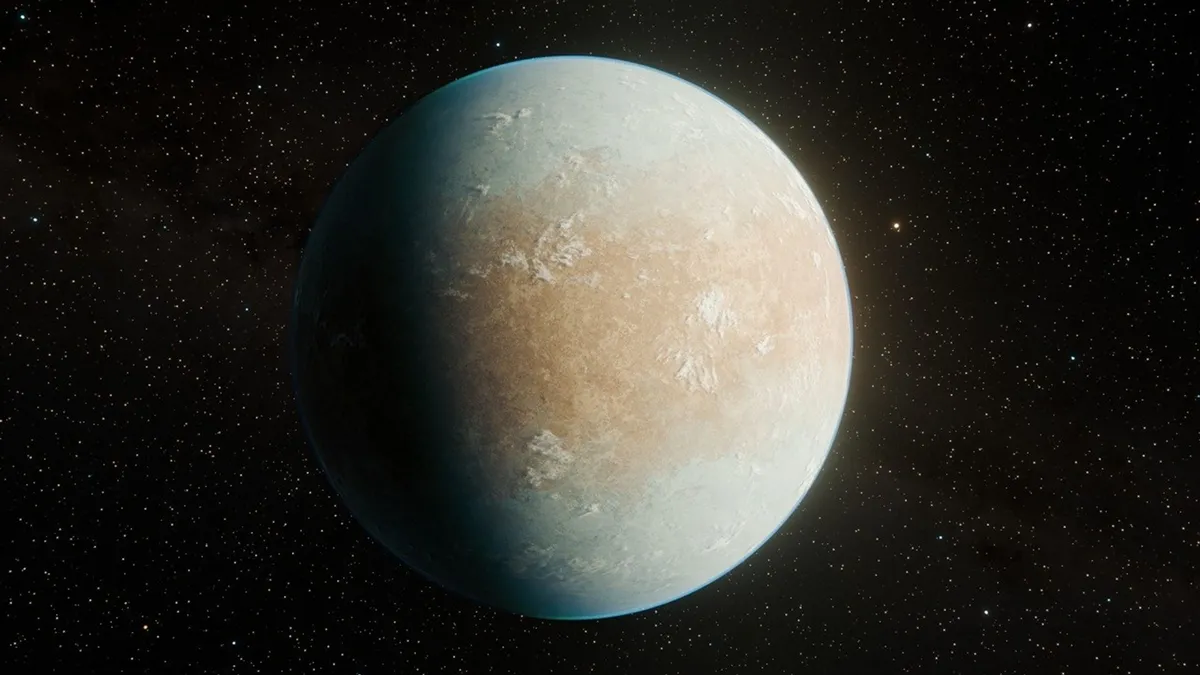
    A blue and brown exoplanet sits in the darkness of space, part of its left side covered by shadow

    An exoplanet drifts through the dark vastness of space. (Image credit: NASA/JPL–Caltech/Keith Miller (Caltech/IPAC).)

    Jackpot

    Of course, some of the 10,091 planet candidates might turn out to not be planets, so this research team wanted to start further testing to confirm these results. And in doing so, they were able to confirm one of the candidates: a planet called TIC 183374187 b. This world appears to be a hot Jupiter, a gas giant that orbits very close to its host star — which is why it’s so hot — and has a mass similar to Jupiter‘s.

    But besides confirming all the exoplanets spotted with this research, the team also intends to take things a step further. While this study used the first year of TESS data, the research team aims to continue with a follow-up study using TESS’ second year of data, lead author Joshua Roth, a graduate researcher at Princeton University, told IFLScience.

    This boom in exoplanet discovery comes just about 30 years since the first exoplanet to be confirmed, 51 Pegasi b, was found in 1995. With that first confirmation, scientists were able to definitively say what they had thought likely true for years — that planets exist around other stars outside of our solar system. Since then, NASA missions like TESS and Kepler have provided data that has grown the field tremendously.

    Looking to the future, in addition to incorporating techniques like machine learning as this team has done, NASA’s upcoming Nancy Grace Roman Space Telescope will continue to expand exoplanet science with its Coronagraph Instrument which will make direct observations of worlds beyond our cosmic neighborhood. Rather than increase the number of exoplanets discovered, this instrument will allow for more in-depth study of these worlds and their atmospheres. As of writing this article, that telescope is slated to launch no earlier than early September 2026.

    And even farther into the future, NASA aims to expand the field yet again with its Habitable Worlds Observatory, which is currently being built.

    This work was published April 28 in The Astrophysical Journal.


    Source link

    Divya Sharma
    • Website

    Divya Sharma is a content writer at NewsPublicly.com, creating SEO-focused articles on travel, lifestyle, and digital trends.

    Related Posts

    SpaceX just fired up its 33-engine Starship ‘V3’ Super Heavy rocket booster. When could it fly?

    May 13, 2026

    Learn the night sky without an app: May’s easiest star-hops for beginners

    May 13, 2026

    The charred hull of Artemis 2’s Orion photo of the day for May 8, 2026

    May 13, 2026
    Leave A Reply Cancel Reply

    Demo
    Top Posts

    “Inside Gemini Robotics 1.5: How Robots Learn to Reason & Act

    November 22, 202524 Views

    How US Tariffs Are Reshaping the Global Growth Landscape?

    November 21, 202518 Views

    Pakistani Journalist Laughing at Tejas Fighter Jet Crash at Dubai Airshow Sparks Massive Outrage Worldwide

    November 23, 202517 Views

    Vibe-Coding Boom: How Non-Coders Build Apps With AI Agents

    November 22, 202515 Views
    Don't Miss

    SpaceX just fired up its 33-engine Starship ‘V3’ Super Heavy rocket booster. When could it fly?

    May 13, 20263 Mins Read0 Views

    SpaceX’s Starship megarocket may indeed get off the ground next week.The company is apparently targeting…

    Sources: 76ers president Morey out; Nurse to stay

    May 13, 2026

    Tesla finally launches Supercharger virtual queue pilot after fights broke out

    May 13, 2026

    Scientists discover a weak spot shared by polio and common cold viruses

    May 13, 2026
    Stay In Touch
    • Facebook
    • Twitter
    • Instagram
    • YouTube
    • LinkedIn
    • WhatsApp

    Subscribe to Updates

    Get the latest creative news from SmartMag about art & design.

    Demo
    NEWSPUBLICLY
    Facebook X (Twitter) Instagram LinkedIn

    Home

    • About Us
    • Leadership & Certification
    • Advertise & Partner With Us
    • Pitch Your Story
    • Media Kit & Pricing
    • Career
    • FAQs

    Guidelines

    • Editorial & Submission
    • Partnership
    • Advertising & Sponsor
    • Intellectual Property Policy
    • Community & Comment
    • Security & Data Protection
    • Send Your Opinion

    Quick Links

    • Cookie Policy
    • Payment & Billing Terms
    • Refund & Cancellation
    • Copyright Policy
    • Complaint & Support
    • Sitemap
    • Contact Us

    Subscribe Us

    Get the latest news and updates!

    Copyright © 2026 Newspublicly (DIGITALIX COMMUNICATION). All Rights Reserved.
    • Privacy Policy
    • Terms of Use
    • Disclaimer