

After searching for 50 years, astronomers have finally discovered evidence of powerful winds blowing from Sagittarius A* (Sgr A*), the supermassive black hole at the heart of our galaxy. The discovery represents a deepening of our understanding of the physics at play both around supermassive black holes and at the heart of the Milky Way.
Scientists have long proposed that black holes produce energy as they consume matter that pushes material away from their vicinity, a process which has been dubbed “black hole winds.” That even applies to Sgr A*, which exists on a diet of gas and dust so meager For a human, the equivalent would be consuming one grain of rice every million years.
The problem is, scientists have been unable to collect evidence of black hole winds blowing through the heart of the Milky Way, resulting in a mystery that has persisted in astronomy for around half a century — that is, until now.
“Unless a black hole exists in a perfect vacuum, it must blow a wind somehow. And there is no perfect vacuum in the universe,” team co-leader and Northwestern University researcher Mark Gorski said in a statement. “With new observations, this is the first time we’ve had a clean enough view to see the wind’s imprint. We looked at the data and said, ‘There it is. There is the thing that everybody’s been looking for for 50 years.'”
Seeing black hole winds is far from a breeze
Scientists have been aware for some time that feeding black holes launch powerful outflows of material around them, including jets and winds. Winds are caused when matter falling to the black hole is accelerated to near light-speed, generating pressure that pushes infalling material away. That has been seen with ravenously feeding black holes before, but not the barely feeding Sgr A*. Its sparse consumption of material and the fact it is obscured by the plane of the Milky Way from our vantage point have made tracing this wind difficult.
Gorski’s Northwestern colleague and team co-leader Lena Murchikova pointed out that the scientists were the first to detect molecular gas very close to Sgr A* feeding the supermassive black hole. That makes Sgr A* reassuringly like other supermassive black holes.
“The wind is not powerful, and its direction probably wanders with time. It shows that our black hole is not unique, and our place in the universe is not unique,” Murchikova added. “To observe our own black hole, we have to look through the plane of our galaxy. That means we have to peer through gas, dust and ionized structures, and you can’t really see through all of that easily.”

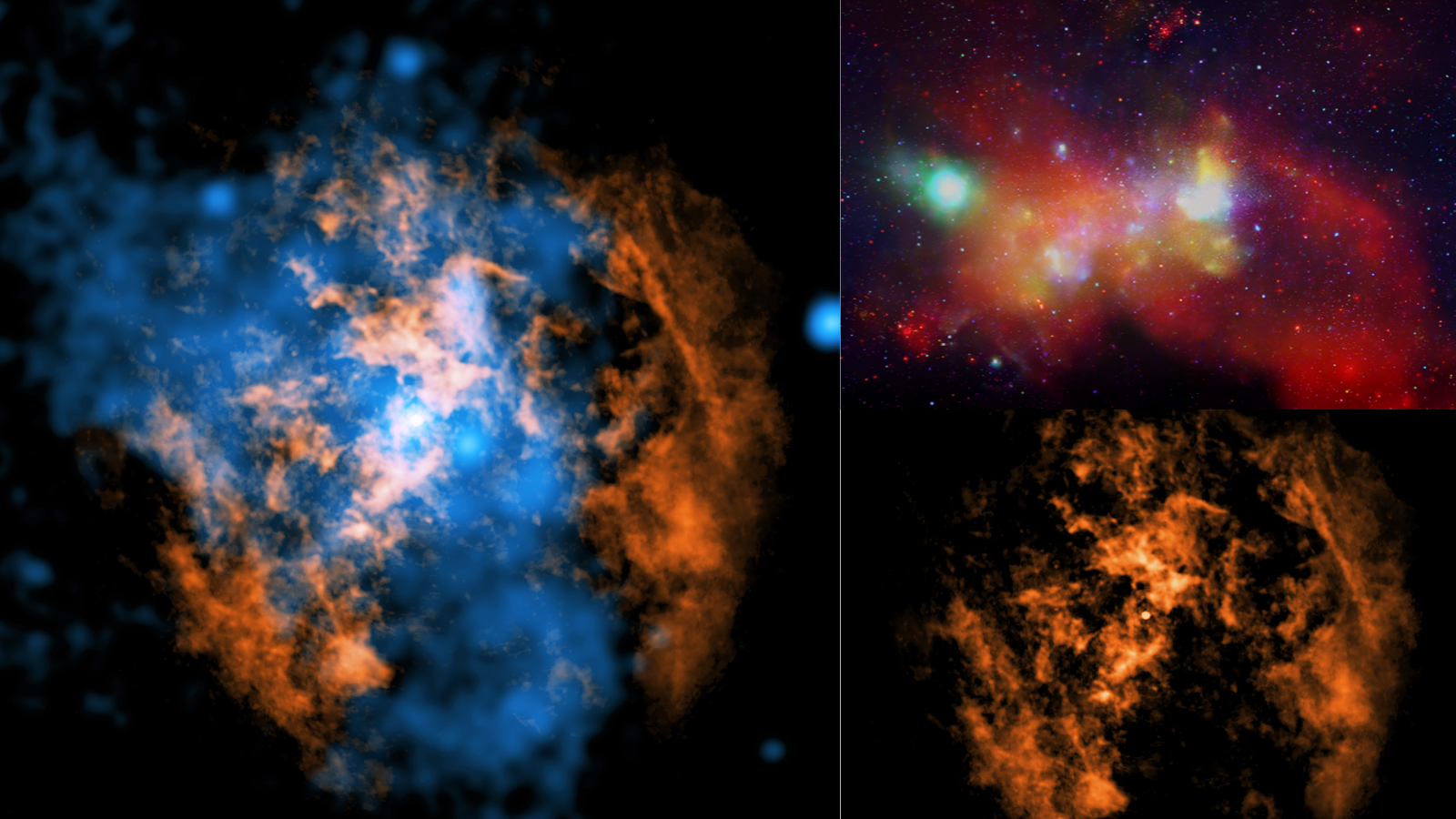
To tackle these difficulties, the team turned to five years of deep observations of the heart of the Milky Way collected by the Atacama Large Millimeter/Submillimeter Array (ALMA), 66 radio antennas located in northern Chile. This delivered the sharpest image yet of the cold molecular gas with around 3 light-years of Sgr A*.One aspect of these observations that stunned the scientists was a three-light-year-long, cone-shaped cavity in this cloud of cold gas. They reasoned that this cavity must have been cleared by hotter gas in a black hole wind sweeping through the region, either pushing the cold gas in front of it or heating the cold gas.
“If you blow hot material from the black hole, it’s not going to want to exist with the cold material,” Gorski said. “It’s either going to push the cold material out or heat it up. And, if it’s too hot, you will no longer see the cold gas.”
The region around Sgr A* is packed with stars — and stars also blow winds of material from them — but the team reasons that these stellar winds would not carry enough energy to carve out such a large cavity.
“It’s a huge absence of material. We calculated how much energy was needed to create this cavity. It is more than can be provided by the stars in that area,” Gorski explained. “Basically, there has to be input from the supermassive black hole. And, if you follow the shape of the cone, it’s pointed directly at the black hole.”
To double-check their results, the scientists turned to observations of the same region made by NASA’s Chandra X-ray space telescope.
“Exceptional claims require exceptional evidence,” Gorski said. “We wanted to make sure that we weren’t just looking at some sort of imaging artifact. Then, the X-ray image from Chandra just slotted in perfectly. The molecular features lined up.”
This backed up the results from ALMA by revealing X-ray emissions coming from the location of the cavity in the cold gas.
“When you find something that no one has seen before, the first thought that runs through your mind is not ‘Oh my god, we made a discovery,'” Murchikova said. “It’s ‘Oh my god, what’s wrong with my analysis?’ But when we overlaid our image with the X-ray image, it started to make sense.”
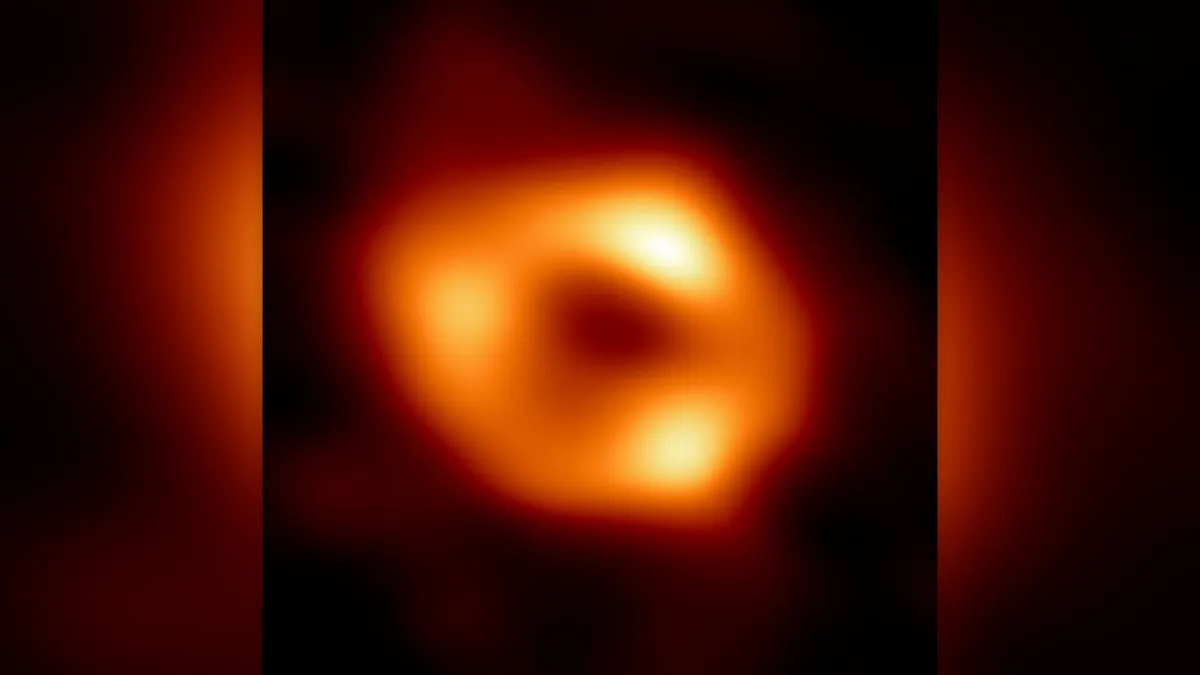
While the team’s results confirm that Sgr A* is extremely quiet compared to the supermassive black holes that sit in bright, turbulent regions of other galaxies called active galactic nuclei (AGN), this black hole wind is no slouch. In fact, the scientists think that it has been raging for around 20,000 years.
“The majority of other galaxies spend most of their lives in a state where they are not particularly active,” Murchikova said. “But we can only see them when they are in a fireworks stage. It is very attractive to study black holes when they are in the fireworks stage, but that’s not actually their dominant state. “Sgr A* finally gives us a window into the life of a black hole in this quiet state.”
The team’s research was published on Thursday (June 4) in The Astrophysical Journal Letters.