

-Priyadarshi Dutta, Bappaditya Mukhopadhyay

A quick look at the growth of Data Analytics and Product Manager roles in India throws up some interesting statistics. According to Grand View Horizon’s analysis, India’s data analytics market generated revenue of $4,234 million in 2025. The report projects that the Indian analytics market will grow at a compound annual growth rate (CAGR) of 36.1% between 2026 and 2033. AccioJob, meanwhile, estimates a CAGR of 27.46% for the market between 2025 and 2033.
Likewise, an article in the Institute of Product Leadership quoted 25% year-on-year growth in 2025 in product-related roles. As per Analytics India Magazine, GCCs saw a 42% rise in 2025 in Product Management roles. While different studies might have used different methodologies, there is a clear trend that shows increasing demand for both these roles.
It will be appropriate to first understand what these two roles entail.
Let us take the example of a Fintech company which lends unsecured personal loans. The company needs to build an app which the potential customers (also called applicants) will use to apply for a loan. To build the app, the entire user journey needs to be figured out, which includes aspects such as what information to collect from the applicant, KYC, capturing consent, transparent disclosure about the product and its features, a friendly user interface and design.
The Technical Product Manager is often in charge of defining and owning this overall user journey in the app while balancing inputs from multiple stakeholders such as Business, Technology, Risk Management and Data Analytics, Compliance, Customer Care, among other things.
Conducting competitor user journey studies, observing user friction points and figuring out solutions to address them, deciding what features should be built and in what order, ensuring relevant teams provide their respective inputs in the app development in a timely, and working closely with the technology team to ensure timelines are met along with appropriate User Acceptance Testing (UAT) are examples of the work done by the Technical Product Manager.
Story continues below this ad
One such input comes from the Data Analytics team. It is important to capture the right level of information about an applicant so that their ability to repay a loan, or creditworthiness, can be appropriately assessed along with fraud checks. Deciding what information should be captured to evaluate an applicant’s creditworthiness, based on which the organisation determines whether to approve a loan and, if so, how much to offer, usually falls within the scope of the Data Analytics team. This specific process is called underwriting.
A Data Analyst conducts various trend analyses, estimates the probability of loan default — that is, the likelihood of a borrower failing to repay the loan — and identifies variables that are strongly correlated with default tendencies to establish underwriting criteria. Data Analysts may also build automated dashboards, monitor portfolio performance across different segments and design pilot initiatives.
However, a Data Analyst cannot directly implement all these requirements in an app. They need to work with the Technical Product Manager, who acts as a bridge between the core technology team and specialist functions such as Risk and Analytics. The Technical Product Manager considers these inputs, along with requirements from other functions, before deciding how the app should be built.
Similarly, in an online e-commerce app, analysing consumer behaviour to determine which bundled offers should be shown to which customers is typically the role of a Data Analyst. Ensuring that the app functions effectively and meets customer requirements, while bringing together inputs from Business, Analytics, Technology and other teams, is the responsibility of the Technical Product Manager.
Story continues below this ad
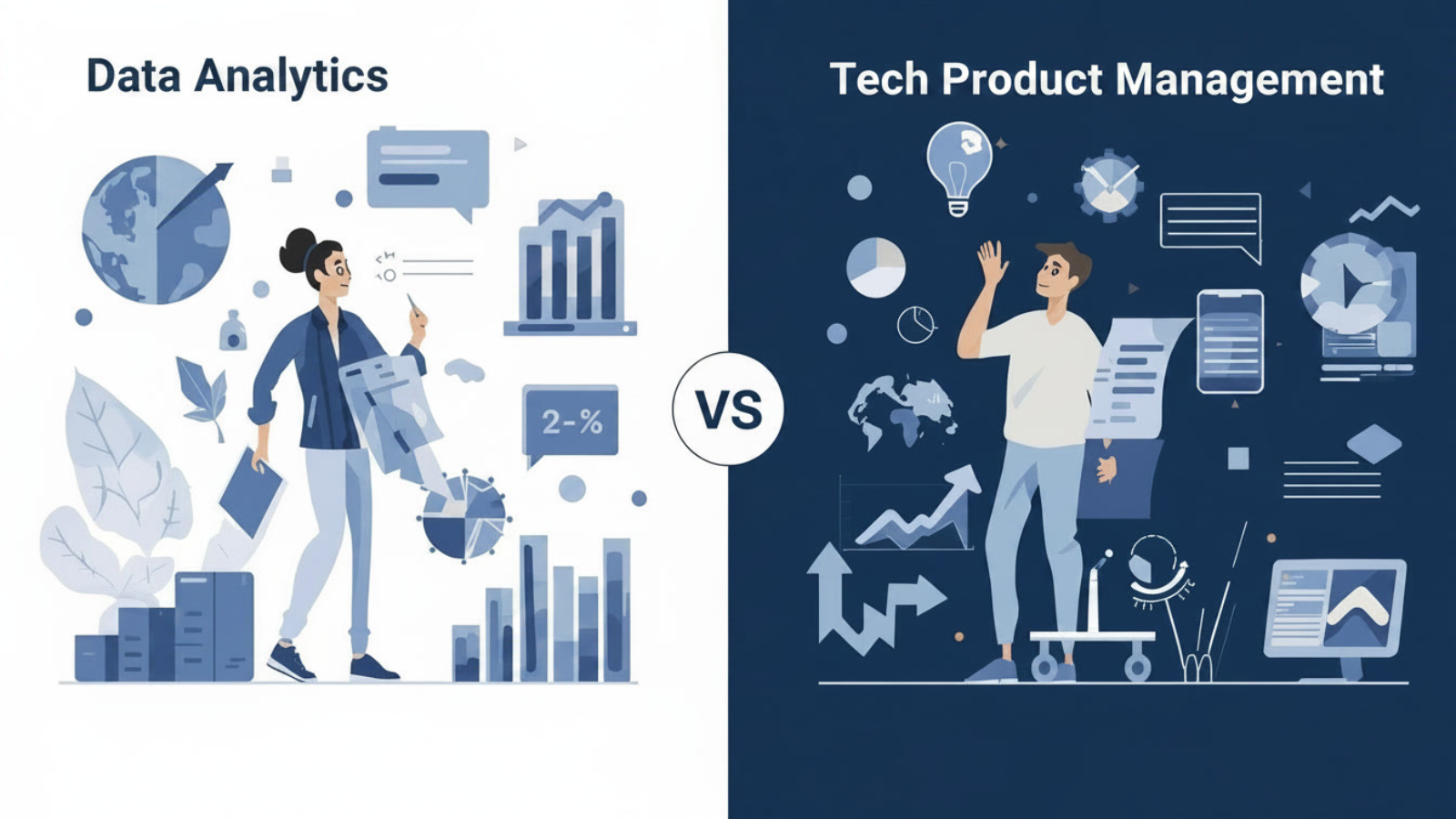
It should be clear by now that these roles are largely complementary. The Technical Product Manager is an orchestrator, while the Data Analyst is a specialist. Both work together to build successful products. However, while both roles are technical, their requirements are domain-specific — BFSI (including fintech and regtech), retail, e-commerce, healthcare, manufacturing and logistics, among others.
Which role to choose?
The choice depends largely on two factors: an individual’s interest in numbers and their ability to connect the dots.
Those who are intrigued by pattern recognition, interested in statistics and machine-learning algorithms, and enjoy deriving insights from data may find greater comfort in a Data Analyst role. On the other hand, those who enjoy defining products, understanding customer needs, collaborating with multiple stakeholders, making trade-offs between competing business requirements and driving execution may be better suited to a Technical Product Manager role.
The second factor — the ability to connect the dots — is increasingly important. Professionals can no longer view problems solely through a narrow, domain-specific lens; they need to draw insights across domains. In BFSI, for example, professionals need to understand both risk and revenue.
Story continues below this ad
The exact expectations from these roles vary across organisations. Today, many companies expect Technical Product Managers to have a good understanding of APIs, cloud infrastructure and Agile Scrum delivery, along with strong stakeholder-management skills, an understanding of customer experience, and the ability to think about product design and drive innovation.
Data Analysts, meanwhile, are expected to have a sound understanding of basic statistics, programming languages, predominantly Python — although AI has made coding significantly easier — and data-visualisation tools such as Power BI or Tableau. They also need an interest in learning ever-evolving machine-learning algorithms.
In a rapidly evolving world, continuous learning is critical to staying relevant. The motivation to learn comes naturally when one pursues a career closely aligned with their interests. We believe this is more AI-proof than simply acquiring skills that happen to be in demand at a particular point in time.
The authors are professors of analytics at Great Lakes Institute of Management, Gurgaon