

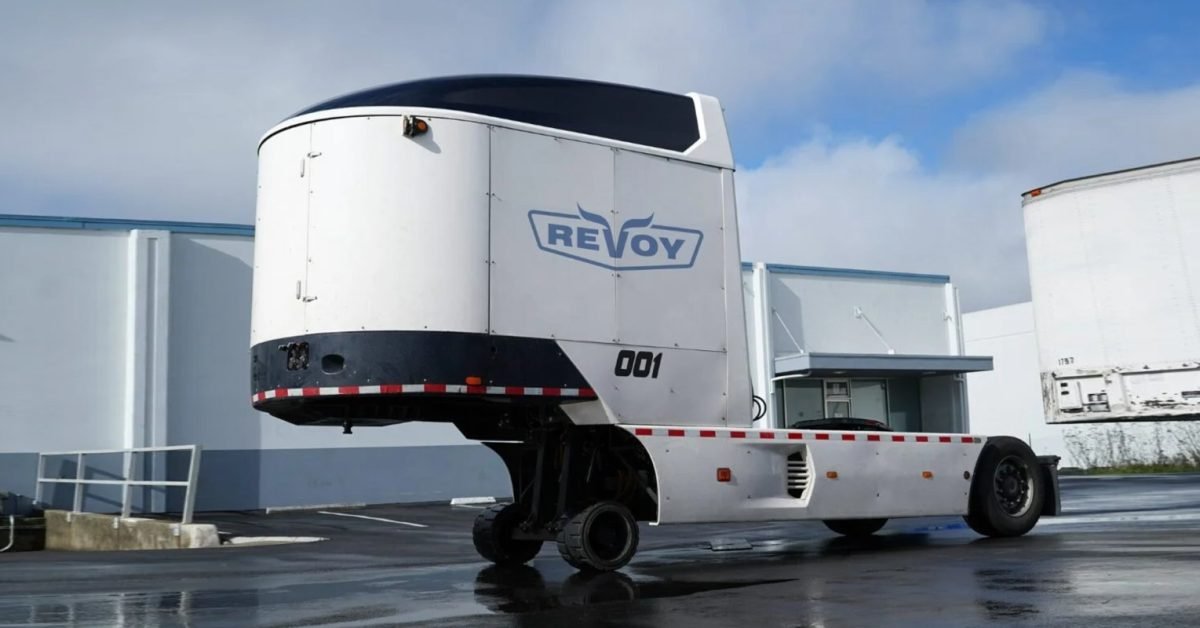
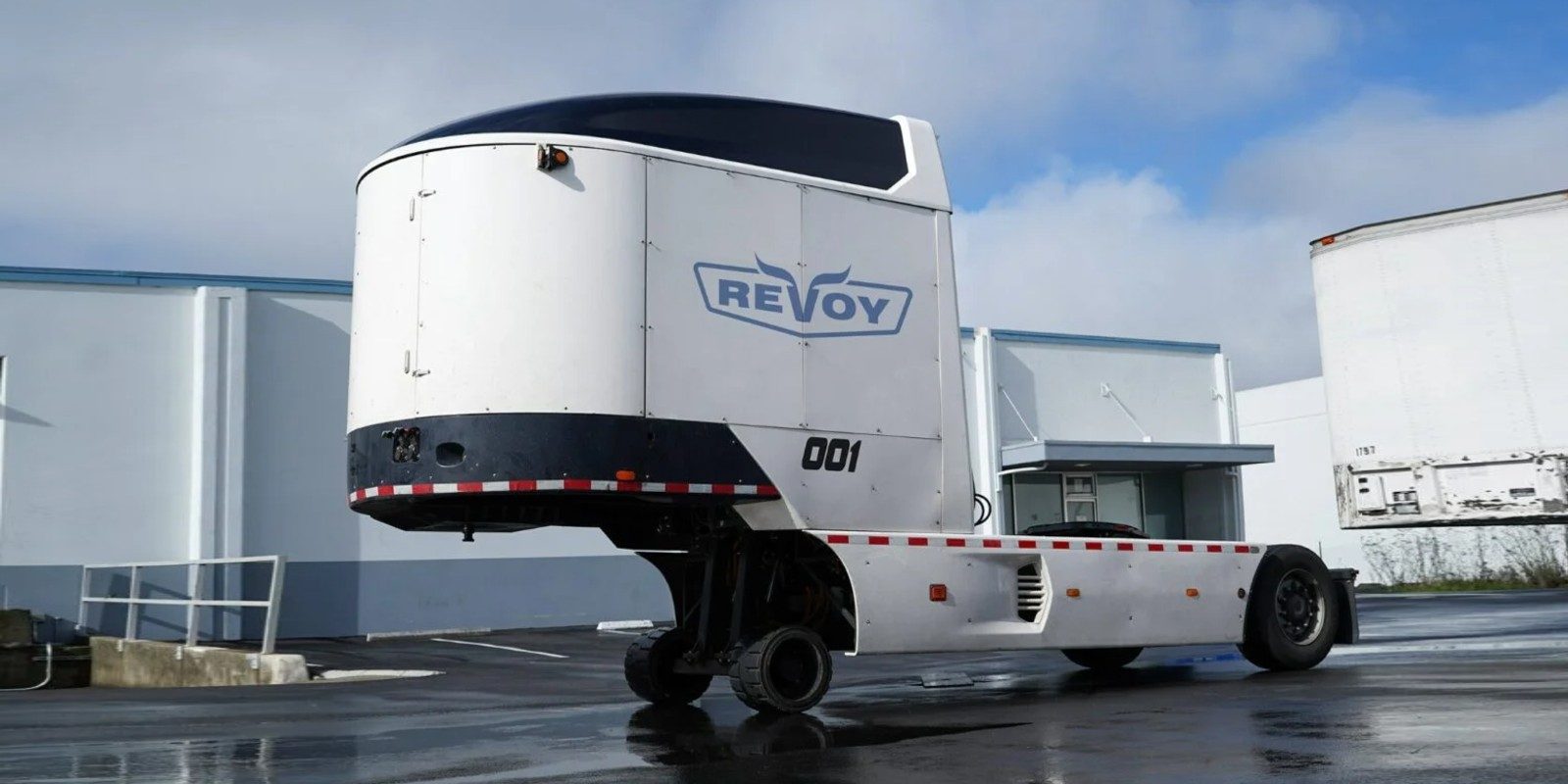
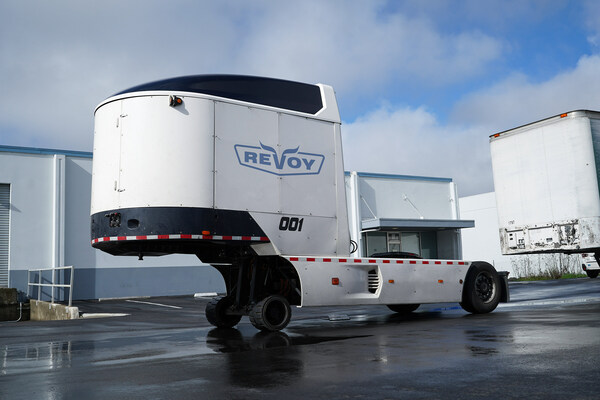
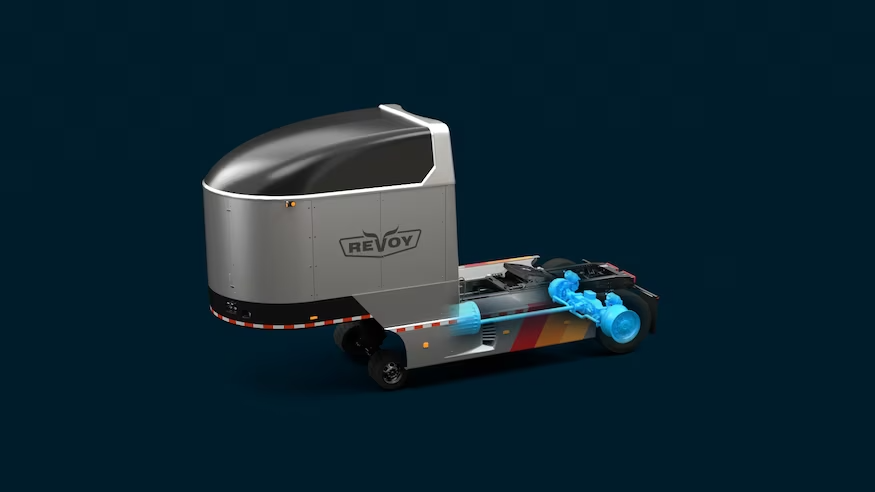
By packing batteries and an electric drive axle into a tandem trailer that fits between a conventional semi truck and trailer, Revoy EV promises to “electrify” trucking and cut a fleet’s fuel bill in half. Now, after years of development, the concept is taking some real steps towards production. In fact, it’s taking 27 million of them!
Dealroom is reporting that the San Francisco-based trucking startup raised $27 million in a Series A funding led by Standard Capital, with Doerr Capital, Time Ventures, Y Combinator, and Leap Ventures participating. The money is being earmarked to towards the development of cheaper, “second-generation” hybrid trailer dolly with a smaller battery but similar fuel economy gains.
And, given the questions raised about the GCWR implications of the dolly in the first place, I’d argue that that’s exactly the right move for Revoy.
The timing of the raise matters, too. The company just completed a year-long proof of concept pilot with Ryder Systems, and plans to deploy four more along a 200-mile route in the PNW by the end of this year. “Dozens” more are set to be in operation, “by the end of 2027.”
You can read more about Revoy EV’s concept in this article from 2024, following the trailer dolly’s regulatory approval from the National Highway Traffic Safety Administration (NHTSA) back in 2023, below, then let us know what you think of the concept in the comments.
Revoy EV promises to electrify diesel semis in minutes
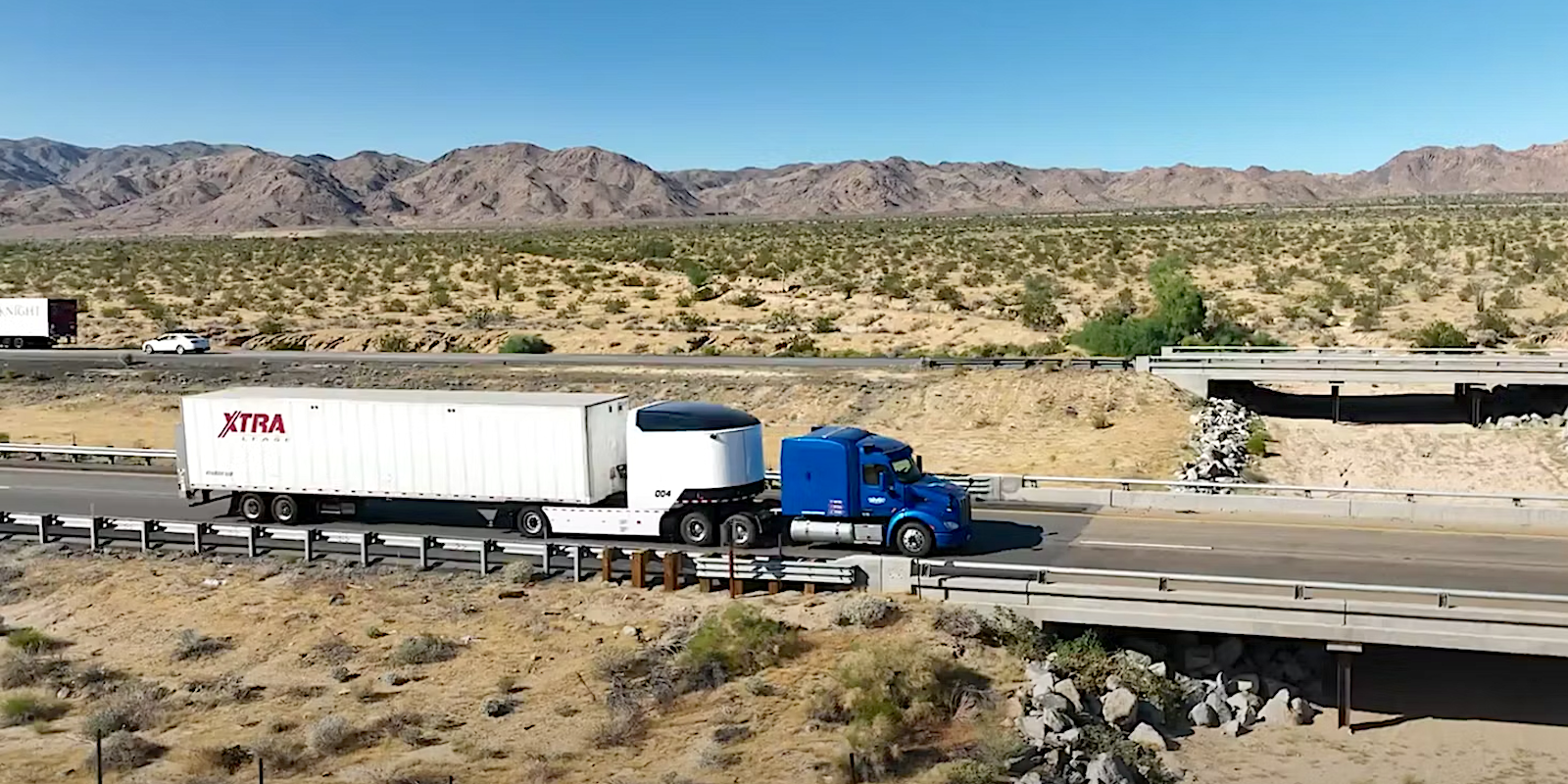
The Revoy EV concept is deceptively simple. A tractor’s 5th wheel pairs up with the Revoy’s hitch. Then the trailer that the semi is set to haul attaches to the Revoy’s 5th wheel. Some AI embedded in the Revoy’s electronic control units does some number-crunching and the three-part truck, trailer, trailer combo then hauls off down the road, with the Revoy’s high-torque e-axle providing most of the power to accelerate the load and diesel power where it’s most efficient: on the highway.
The best part, according to Revoy? Truckers can add the Revoy EV trailer to their rigs with no up-front costs.
“We offer a really different and much better and easier path for fleets to go electric,” offers Revoy EV’s founder, Ian Rust. “We offer a service, (zero money up front for the unit, then) customers pay us by the mile. It’s really more of a fuel product. We charge them for the diesel we save them, altogether with the residual diesel, and our fees that are all inclusive.”
The Revoy EV has a range of about 250 miles, which comparable to the 2nd generation Volvo VNR Electric and the Freightliner eCascadia models. “On a 250-mile run, a truck getting 7 mpg might burn 35 gallons of diesel, which we’ll say costs $4/gallon or $140,” writes Alex Lockie, from the Commercial Carrier Journal. “The Revoy EV would cut that in half, approximately, and bill the fleet for a cut of the difference.”
Revoy EV hybrid semi trailer
Revoy is launching with two “swap stations” already up and running in Texas and Arkansas, where drivers can pull into the station, be greeted by a Revoy attendant, then swap out their spent battery “in about five minutes or so,” according to the press release. Rust adds that Revoy has stations planned for California and Oregon as well.
Electrek’s Take
Where do we start? On the one hand, the Revoy EV is very much not vaporware. This is a thoroughly conceived, well-engineered, and seemingly well-funded effort to bring someone’s big idea to life. On the other hand, the concept itself seems deeply flawed.
The first major problem with the Revoy EV is its weight. The electrified trailer weighs in at about 22,000 pounds, according to the company – around 2,000 pounds lighter than the previously mentioned Volvo VNR Electric and as much as 6,000 pounds more than a Freightliner eCascadia. National rules say that without a special permit, a semi-truck and the trailer it is hauling can’t collectively weigh more than 80,000 pounds in total. Worse, the Revoy doesn’t fit into any special legal loopholes that can help make that mass go away (because the Revoy isn’t a ZEV, it doesn’t even get the extra 2,000 lb. GVWR allowance a BEV gets). That means adding a Revoy trailer to your rig effectively negates your ability to haul 22,000 lbs. of the stuff that, you know, you’re actually being paid to haul.
Add in the potential safety risks and generically “weird” handling characteristics presented by adding an extra few articulations into the mix and the Revoy starts to look even more like a liability.
Still, the Revoy guys aren’t dumb – and a number of knowledgeable industry people have jumped in to defend Rust’s concept. “In high-value freight at least,” offers Lockie, “the trend has been toward the extreme majority of loads cubing out before they ever weigh out.”
Rust, to his credit, at least acknowledges the problems. “The key is when we encounter those trailers that can’t afford the weight (of the Revoy EV), we wave them on,” he says. “We looked at the data … two thirds of loads can accommodate the extra weight.”
With so many commercial fleets complaining that the 2000 lb. EV adjustment isn’t enough, I (for one) question Rust’s confidence. Still, I’m just one guy – and you, dear readers? You’re smart. Head on down to the comments and let me know what you think of the Revoy EV, and whether or not you think it’ll be a staple of trucking’s future.

If you’re considering going solar, it’s always a good idea to get quotes from a few installers. To make sure you find a trusted, reliable solar installer near you that offers competitive pricing, check out EnergySage, a free service that makes it easy for you to go solar. It has hundreds of pre-vetted solar installers competing for your business, ensuring you get high-quality solutions and save 20-30% compared to going it alone. Plus, it’s free to use, and you won’t get sales calls until you select an installer and share your phone number with them.
Your personalized solar quotes are easy to compare online and you’ll get access to unbiased Energy Advisors to help you every step of the way. Get started here.


FTC: We use income earning auto affiliate links. More.