

4 min readNew DelhiUpdated: Aug 2, 2026 07:33 AM IST
Central India’s key tiger corridor between the Satpura and Melghat tiger reserves stands to be fragmented because in-principle wildlife clearance for a third railway line between Jujharpur and Chichonda in Madhya Pradesh has been recommended by the Standing Committee of the National Board for Wildlife (SC-NBWL).
The clearance is subject to the condition that mitigation structures — such as overpasses for safe passage of wildlife across the rail alignment — suggested by the Central Railway are reviewed and finalised based on proper scientific study and engineering designs, according to the minutes of the SC-NBWL’s July 9 meeting.

The proposed railway line will pass through two notified tiger corridors, and an eco-sensitive zone in the Satpura-Melghat landscape, according to official documents. The Satpura tiger reserve is in Madhya Pradesh while the Melghat tiger reserve is in Maharashtra.
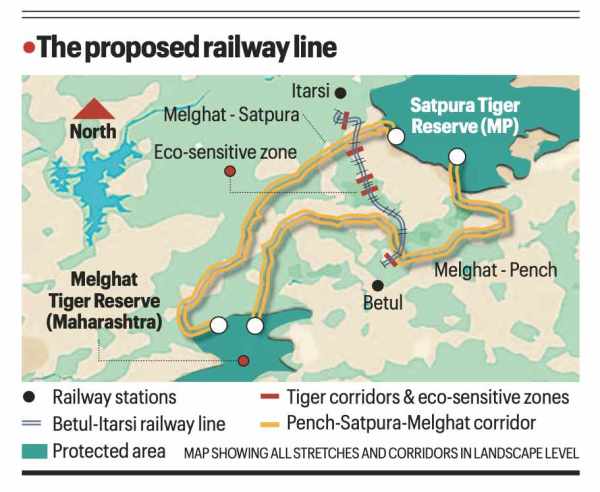 The proposed railway line will pass through two notified tiger corridors, and an eco-sensitive zone in the Satpura-Melghat landscape
Tiger corridors provide safe pathways for many wildlife species including tigers, leopards, herbivores, sloth bears, helping the animals disperse to newer landscape and aiding genetic flow of wildlife.
A committee that inspected the alignment sites noted in its report to the SC-NBWL that the forest stretch and corridors are a lifeline for the Satpura-Pench-Melghat landscape, and hence the project should be seen in the context of current and future perspectives.
The 160.6-km stretch between Jujharpur (Betul district) and Chichonda (Narmadapuram district), forms part of a longer 290-km third and fourth railway line on the busy Itarsi-Nagpur route, proposed by the Central Railway, Mumbai headquarters. The alignment passes through forest areas, two notified tiger corridors and an eco-sensitive zone.
The project requires use of 206.09 hectares of land – 74.69 hectares of forest land and 131.4 hectares of non-forest land – falling in the notified tiger corridor.
Story continues below this ad
The proposal was earlier considered by the SC-NBWL at its 88th meeting on January 19. A final decision, though, was deferred as a site inspection was deemed necessary.
The site inspection was carried out by officials from the Railways, Union Environment Ministry, a scientist from the Wildlife Institute of India, and an official from the National Tiger Conservation Authority.
The site inspection committee’s report stated that the Central Railway had proposed 34 wildlife overpasses along the rail line alignment. However, they were largely based on inputs from frontline forest staff, wildlife mortality records, rather than a detailed scientific study.
The SC-NBWL’s July 9 meeting minutes also noted that detailed engineering designs of these structures were yet to be finalised. “It was further observed that a comprehensive scientific assessment of the likely impacts of the project and the appropriate landscape-level mitigation measures had not been completed at the time of inspection. The State Forest Research Institute, Jabalpur, had been entrusted with the study, and its report was awaited,” the minutes noted.
Story continues below this ad
Given the lack of a comprehensive study, the site inspection committee said that optimal, landscape-level mitigation measures were required, particularly considering that the Itarsi-Nagpur line expansion includes construction of a third as well as possibly a fourth line.
The Chief Wildlife Warden of Madhya Pradesh informed the wildlife board panel that the state forest research institute had submitted a detailed report on mitigation measures and it was under consideration, and assured it would form the basis for overpass designs.
The SC-NBWL also directed that upon receipt and examination of the scientific study and other relevant data, the site inspection committee shall revisit the project area and submit definitive recommendations regarding the location, dimensions, design and connectivity of the wildlife mitigation structures.