

The story so far:
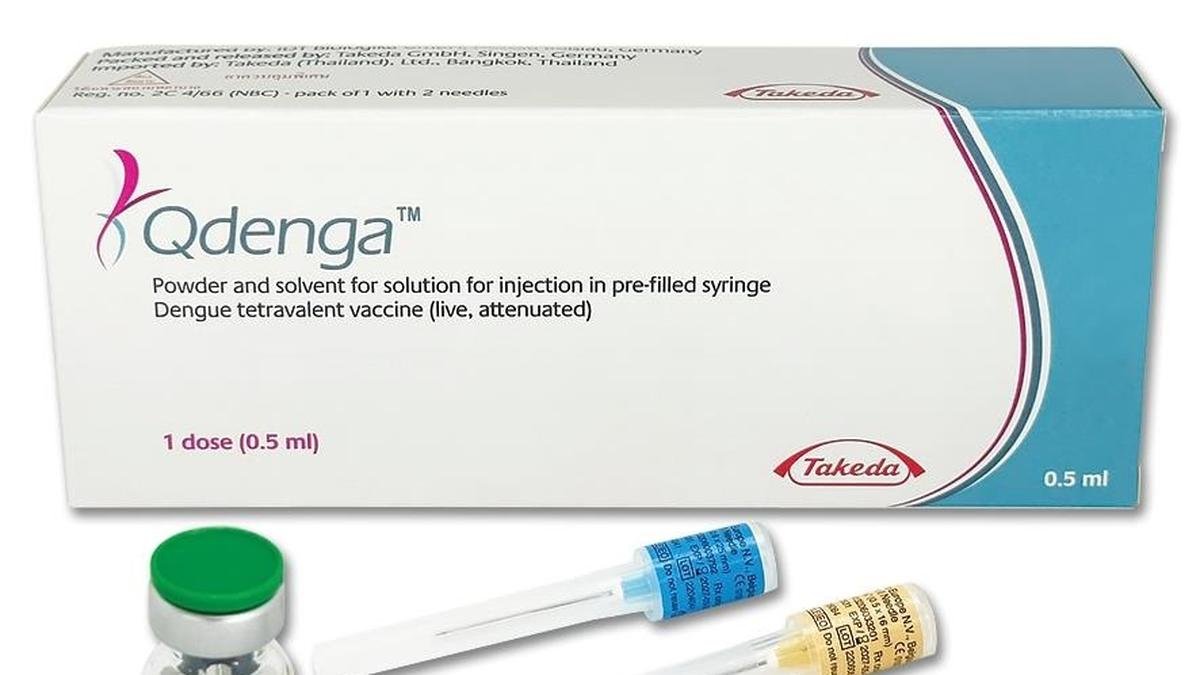
QDENGA, a vaccine for dengue manufactured by Takeda Biopharmaceuticals, a multinational pharmaceutical company headquartered in Japan, has received market authorisation from the Drug Controller General of India (DCGI). This makes it the first dengue vaccine to be approved for use in the country. The vaccine can be used in individuals aged 4 to 60, and is given in two doses, three months apart. It is designed to protect against all four dengue serotypes (variations of the virus). The company has still not announced an official price of the vaccine for India.
Why is this significant?
About half of the world’s population is now at risk of dengue, with an estimated 100–400 million infections occurring each year, according to the World Health Organization. India, which accounts for about one-third of the global burden, is one of five nations that are are among the 30 most highly endemic countries in the world when it comes to dengue.
According to the National Centre for Vector Borne Diseases Control portal, last year, a total of 1,21,824 dengue cases were reported with 121 deaths. In 2023 and 2024, the case load was well over 2 lakh. Even these numbers, however, may be an underestimate. The actual number of dengue cases may remain underreported, researchers have noted, as many dengue infections are either asymptomatic or present mild symptoms and the illness is sometimes wrongly diagnosed as another condition.
Dengue places a huge burden, both medically and economically, on the country. A 2019 paper in the Journal of Infection and Public Health noted that the overall cost of dengue in 2016 was about US$5.71 billion with 14.3% due to fatal cases and 85.7% to non-fatal cases. With the disease burden having increased substantially over the past few decades, these costs are only rising.
How does QDENGA work?
QDENGA is a live attenuated vaccine, which means it contains weakened versions of dengue virus serotypes 1, 2, 3 and 4. These weakened versions cannot cause the disease itself, but can teach the immune system to identify the foreign virus and make antibodies against it. When a person is then later exposed to the actual virus, the immune system recognises it, and can neutralise it.
According to the company, the vaccine can be administered irrespective of whether an individual has had a previous dengue infection and does not require pre-vaccination screening.
What is its efficacy?
India’s approval is based on Takeda’s global clinical development programme comprising 19 Phase I, II and III clinical trials involving more than 28,000 participants in dengue-endemic and non-endemic regions. The company states that the vaccine demonstrated an efficacy of 80.2% against virologically confirmed dengue 12 months after the second dose and 90.4% efficacy against dengue-related hospitalisation at 18 months.
Follow-up data at 4.5 years showed 84.1% efficacy against dengue-related hospitalisation, while seven-year follow-up demonstrated sustained protection against dengue disease and dengue-related hospitalisation across all four serotypes, according to the company.
QDENGA has been approved for use in 43 countries so far.
Will it work in India?
So far, India has relied largely on vector-control measures, since dengue is a mosquito-borne illness. These measures continue to remain essential, but the vaccine represents a crucial, significant shift in strategy.
Vipin M. Vashishtha, former national convener, Indian Academy of Paediatrics’ Committee on Immunisation, however, writing for The Hindu earlier this year, noted that while QDENGA performs very well against the DENV-2 serotype, since it was developed on the DENV-2 backbone, and reasonably well against DENV-1, its effectiveness against DENV-3 and DENV-4 appears to be lower — particularly in individuals who have not previously been infected with dengue. In essence, he says the vaccine is likely to reduce the severity of illness rather than prevent infection altogether. As a result, dengue outbreaks will not disappear and public health measures such as vector control will remain indispensable.
The Ministry of Health has also noted that while this marks an important milestone in India’s public health response to dengue, it is expected to complement ongoing vector control, surveillance, early diagnosis and case management measures being implemented under the National Vector Borne Disease Control Programme.
What are the other vaccines in the pipeline?
Vaccines for dengue have been challenging to make, as generally, immunity against one strain of the virus does not protect against another.
In India, Panacea Biotec has begun final Phase III trials of its vaccine, DengiAll. More than 10,000 volunteers across the country are enrolled in the study, overseen by the Indian Council of Medical Research, with the vaccine on track for rollout as early as next year if the trial results are favourable, as per media reports. DengiAll is a single-dose vaccine also designed to provide protection across all four serotypes.
In Brazil, the dengue vaccination campaign, using the world’s first single-dose dengue vaccine, Butantan-DV, developed by Brazil’s Butantan Institute, was suspended last month, following two suspicious deaths. More than half a million people have received doses of the vaccine this year in Brazil.
In the United States, Dengvaxia, made by Sanofi-Pasteur was available to prevent dengue in children aged 9–16 years, with laboratory-confirmed previous dengue virus infection. In May this year, according to a note issued in by the U.S. Centers for Disease Control and Prevention, the company has said it is discontinuing the vaccine citing a lack of demand in the global market.
Are dengue cases going to increase?
With rapid urbanisation, increasing heat, changing rainfall patterns, migration and the effects of climate change, the burden of dengue has already risen globally. In 2023, WHO graded dengue as a Grade 3 emergency after outbreaks increased in several countries. Unplanned urbanization and climatic factors such as heat waves and high temperatures have increased the intensity, frequency, duration and distribution of dengue in recent years. Lack of sustained surveillance and control interventions as well as staff are some of the other challenges, according to the WHO.
Published – July 21, 2026 03:08 pm IST