

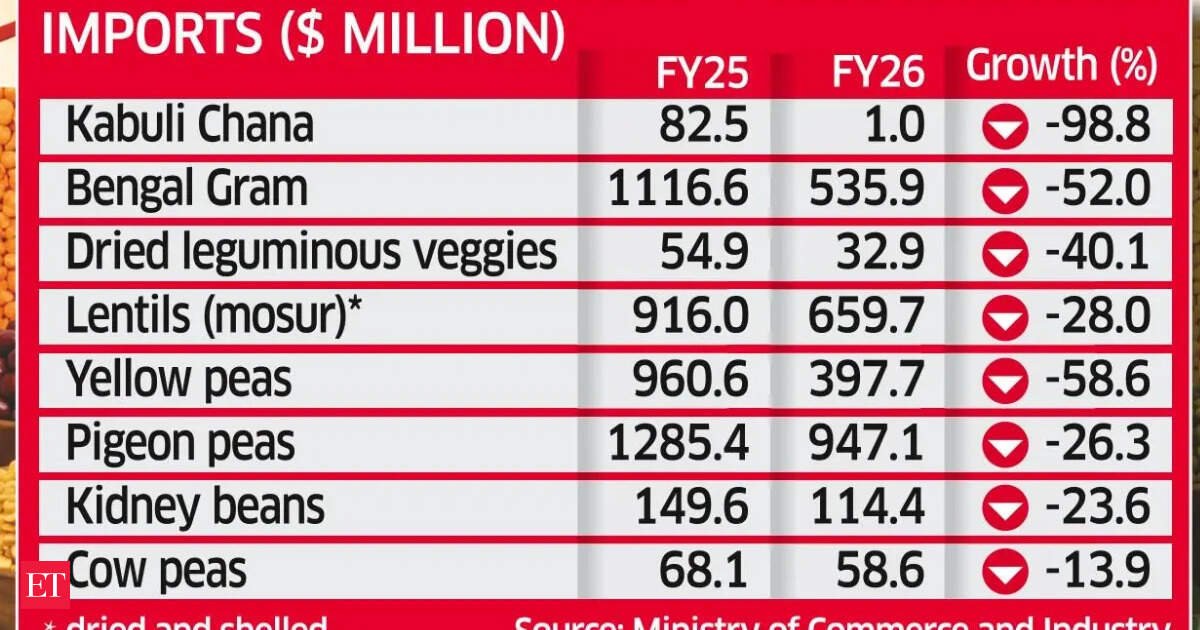
Imports of Kabuli Chana fell nearly 99% to about $970,000 from $82.53 million in FY25, while Bengal gram reported a 52% decline to $535.9 million, influenced by a 25% drop in its global price compared to the year before.
India imports about 18-20% of its annual consumption of pulses such as tur, urad, lentils, yellow peas, and Bengal gram from Canada, Russia, Brazil, Myanmar, and Africa.
Also Read: India needs income-centric agri policies, greater Centre-state coordination: EAC-PM chairman
“The domestic production of many pulses such as moong, urad, masoor, chana, and chickpeas has been robust, a key factor for our lower import bill,” said an official.

Imports of other dried leguminous vegetables fell to $32.9 million in FY26 from $54.9 million in FY25, while lentils or masoor-dried and shelled-declined to $659.7 million from $916 million. Yellow peas imports dropped to $397.7 million from $960.6 million.
In contrast, Kabuli chana exports rose 18.1% to $212.2 million in FY26 from $179.7 million in FY25. Exports of other dried leguminous vegetables also more than doubled to $23 million from $9.7 million.Also Read: Farmers should be ‘businessmen’ who respond to market demand, not just grow rice and wheat: NITI Aayog’s Ashok Lahiri
Madan Sabnavis, chief economist at Bank of Baroda, attributed the drop in imports to higher domestic output. “Production of these crops was good last year, reducing the need for imports and creating room for exports,” he said.
India’s total pulses production increased to 27.4 million tonnes in FY26, according to the third advance estimates, from nearly 25.7 mt in FY25. Rabi pulses production rose to 16.9 mt from 15.2 mt in the same period.
Sabnavis however cautioned that imports could rebound if domestic output weakens due to developing El Nino conditions. “Going ahead, production could be lower, which would lead to an increase in imports,” he said.
While the cost of imports has fallen 30-40% in the current fiscal year due to higher global output, and resultant lower prices, domestic policies such as assured buy back at minimum support price and a mission for Aatmanirbharta or self-sufficiency in pulses, which includes expanding the area under cultivation in non-traditional regions, are the other factors supporting lower imports.
“Pulses production in India has been good till the last harvest which has also helped us to increase our exports to other countries, especially China, where Indian green moong is finding favour,” said Ajay Goyal, joint secretary, Tamil Nadu Pulses Importers and Exporters Association. “A 40-50% decline in global pulses prices has also helped in maintaining prices in the domestic market.”
Industry watchers said import restrictions on green moong and import duty on kabuli chana also helped contain imports.