

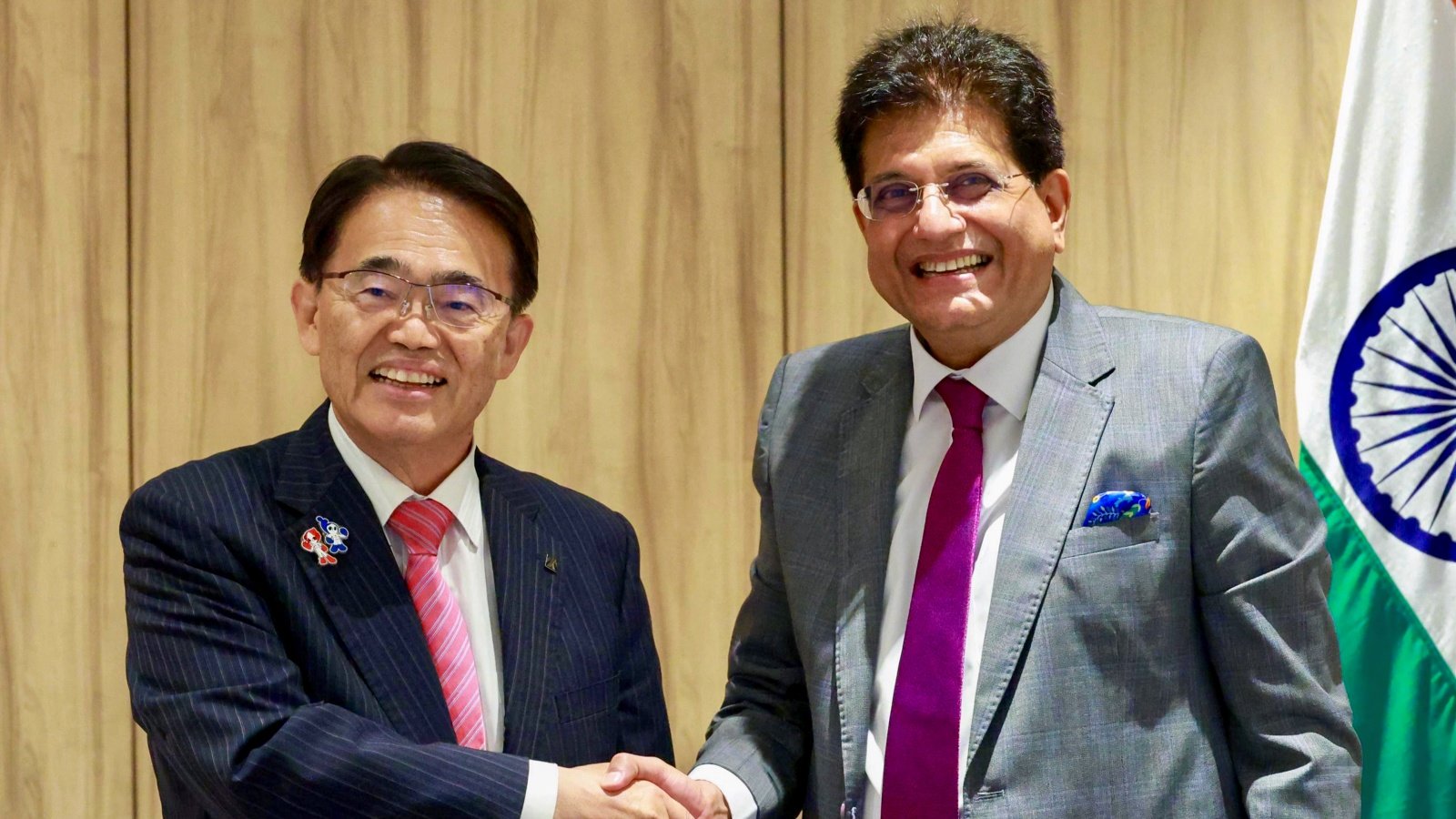
New Delhi is not only seeking higher investments from Japan but is keen to deepen its economic partnership with Tokyo. In an interview to The Indian Express, Commerce and Industry Minister Piyush Goyal said after his four-day visit to Tokyo, Nagoya and Osaka, he hoped that the pace of investment will pick up further. To increase its presence in Japan, he said India must strive to become its global sourcing partner, and that businesses need to be more outward-looking. Edited excerpts:
It took us so many years to get them to the table to talk. As of now, even terms of reference have not been discussed. We have just done a macro level opening.

But we will enter the Japanese market for our goods and bring them more and more to India so that they naturally start making India their global source partner. Whether they export to Japan or export anywhere else in the world, I don’t mind as long as jobs come to India and import substitution ends in India.
In all the FTAs we have put some unique element, and we have negotiated from a position of strength. Like we have done with the European Free Trade Association (EFTA) that includes Iceland, Liechtenstein, Norway, and Switzerland and they have committed $100 billion investment. If they don’t bring, then I can claw back concessions.Similarly, New Zealand has committed $20 billion investment.
What is the progress on investment promises of $70 billion by Japan?
It was announced last year, and in 10 months it has already reached $10 billion. After this visit, it will pick up further. They are looking for projects. I met the chairman of a large textile retailer here and he said that he wants to come to India in a big way. “India is my only horizon,” he said. They have 1,000 stores in China and 4,000 stores worldwide. As they come, the quality consciousness will improve and even exports will improve as these companies do international sourcing (from various geographies) and we have to see if on a net basis exports are more or the imports are more.
Has there been any discussion with Japan on job creation?
We have discussed with companies across sectors including shipping, chemicals, hi-tech and different types of service sectors and they will train around 3 lakh Indian youths in Japan.
You have made references to China in your address, including a comment that seemed to be a reference to Jack Ma. What is your view on China?
It was on a lighter note. We support enterprises, entrepreneurs. We protect them, we protect technology, we protect data. I have never said that they should move their investments from China. India on its own should be an attractive destination. See, they want to diversify their supply chains but for that India is not the only place, they can go anywhere. We have to make India an attractive case on its own merit and not just because it’s China plus one.
Story continues below this ad
Are there opportunities that India sees vis-a-vis Japan-China ties?
What is happening between them and another country is not something for us to interfere in. We are focussing on our own strengths. Automobiles have become a strength area; so are textile, footwear, leather, precision engineering, aerospace and defence. We have done well on mobile phones and so we are moving forward on areas where our strength lies.
We have to stand on our own feet and become an international player. We have done FTA covering 38 countries (all rich countries) and we have opened up two-thirds of global trade for India.
What are some of the challenges that Japanese firms are pointing out, which are hindering investment?
They have indicated they are having challenges, particularly at the local body level and in some states also. But it’s a mixed bag. Some of them have had such wonderful experiences. They come and share that your government has transformed investments in India.
Everybody has some thoughts and suggestions that you may amend this to make it easier. We take this feedback very seriously. In one of my meetings with regard to the semiconductor industry, we took a decision quickly and I have already instructed lawyers, and instructed my ministry to prepare a framework.
Story continues below this ad
Can you elaborate on the case ?
Tokyo Electron is a semiconductor company that is planning to come to India. They raised concerns with me over BIS certification. They need over 13,000 parts. As they source it from all around the world, it would be a herculean task to get BIS certification for each of them. They make high quality semiconductors so they can take care of that themselves.
On that basis, for specific industries, which are hi-tech industries, we said we will make a new rule or a new regulation. They want to create a new rule or recognition by which we can give either a company-wide exemption or exemption to make semiconductors.
In another case, somebody wanted approval for SEZ in Dholera. I talked to Mr Harsh Sanghvi about it. He said he was waiting for a large group to certify as to what is the ecosystem, how much land they want and he would immediately apply for SEZ approval and my ministry will immediately process it. So we ourselves are excited and want companies to come with any issues they face so that we can resolve them.
You spoke about the $100 billion EFTA investment commitment. What are your expectations from there?
We are still working on which specific areas. Pharmaceutical is one major area that they are working on, where they think that clinical trials and innovation in India can be done in a big way and large amounts can be invested.
Story continues below this ad
They also are very keen to shift their high precision and middle SMEs to India. They don’t have labour there as it’s too expensive. At best, what they will produce, they will use locally because they can afford high prices. So they are all looking for Indian partnerships. Now, the Indians have to go and make connections and partnerships, bring technology.
You said Indian businesses are complacent. Can you elaborate?
I am doing it all the time. I am talking to Indian businesses, telling them to be more outward looking, go and explore the world. Hon’ble Prime Minister has directed all our missions to focus on technology, trade and tourism.
I mean geopolitics has now become economics geopolitics or economic diplomacy. Earlier our embassies used to stay away from businesses, now they are changing that. We are saying we will market our business companies, not one particular company. We are encouraging Indian industry and we are willing to stand by Indian industry. We have to stand up for our investors.
India, US ties have recently shown some stability. The first set of Section 301 tariffs have not been extremely harsh like they were last year. Some companies are also getting back their tariffs refunds and RBI on Monday said that India is better prepared to handle Section 301 tariffs. Is the year-long negotiations yielding fruits?
Section 301 is a mechanism that they have found to try and put duties on everybody in the world because the earlier tariffs got struck down by the (U.S.) Supreme Court. So they are now attempting different ways to put tariffs. Our deal is kind of done, we have to now formalise it. We have to make sure that our tariff is lower than our competition, which is an assurance the U.S. has given us. So Indonesia, Vietnam, all these countries are our neighbours and competitors, they have to make sure that we get a lower rate than them, which is a part of our agreement. After all, what is a free trade agreement? It’s a preference you have over your competition.
Story continues below this ad
In the USA, we just want to make sure we get a better rate than the competition, then we can sign the deal.
But are things better with the US?
It was never bad, it was just a small phase when the oil duty was imposed. Otherwise we have a very strong partnership. Trade is just one element, they are the largest investors. We have strategic defence tie-up, we have technology tie-up, we have a critical minerals tie-up. We are members of Pax Silica, members of Quad, and a lot of our interests align in WTO. So, America is very important and special.
We learn that India is looking to partner with countries to jointly explore opportunities in Africa.
Yes, we are having very active discussions. The concept is that India has manpower, skill and scale and the UAE has financial power. Together, if we go and invest in a third country, we can become a force multiplier. The UAE on its own cannot do it, because who will set up the infrastructure? Who will run the factories there? India has a requirement of capital to support this. The UAE has a lot of relationships in Africa, other countries, which gives them confidence when they are investing. We also have very good relations, but we need the capital. So together, we complement each other and can go to third countries, both for services, for infrastructure projects, and for setting up factories.
With Japan, is India looking at securing rare earth and critical minerals?
We have been talking to them, and there is already a serious dialogue with them for jointly developing technologies or exchange and transfer of technology to help us become self-reliant in rare earth and critical minerals.
Story continues below this ad
The correspondent is in Tokyo at the invitation of FICCI