

Octopuses have long been known for their remarkable intelligence. One famous example was Inky, the octopus that escaped from New Zealand’s National Aquarium in 2016 by squeezing through a drainpipe and making its way back to the ocean.
Now, researchers at Dartmouth have uncovered another impressive ability. A new study published in Current Biology found that octopuses can learn to use mirrors to locate food hidden from direct view, demonstrating sophisticated spatial thinking.
“Our findings are the first to demonstrate that invertebrates can use mirrors to understand their environment to find prey,” says lead author Mary Kieseler, Guarini ’25, who conducted the research as a PhD student in the Department of Psychological and Brain Sciences at Dartmouth and is now a postdoc at Switzerland’s University of Fribourg. “It’s a skill that previously has only been documented in vertebrates, such as in some mammals and some birds.”
Octopuses Learn to Use Mirrors
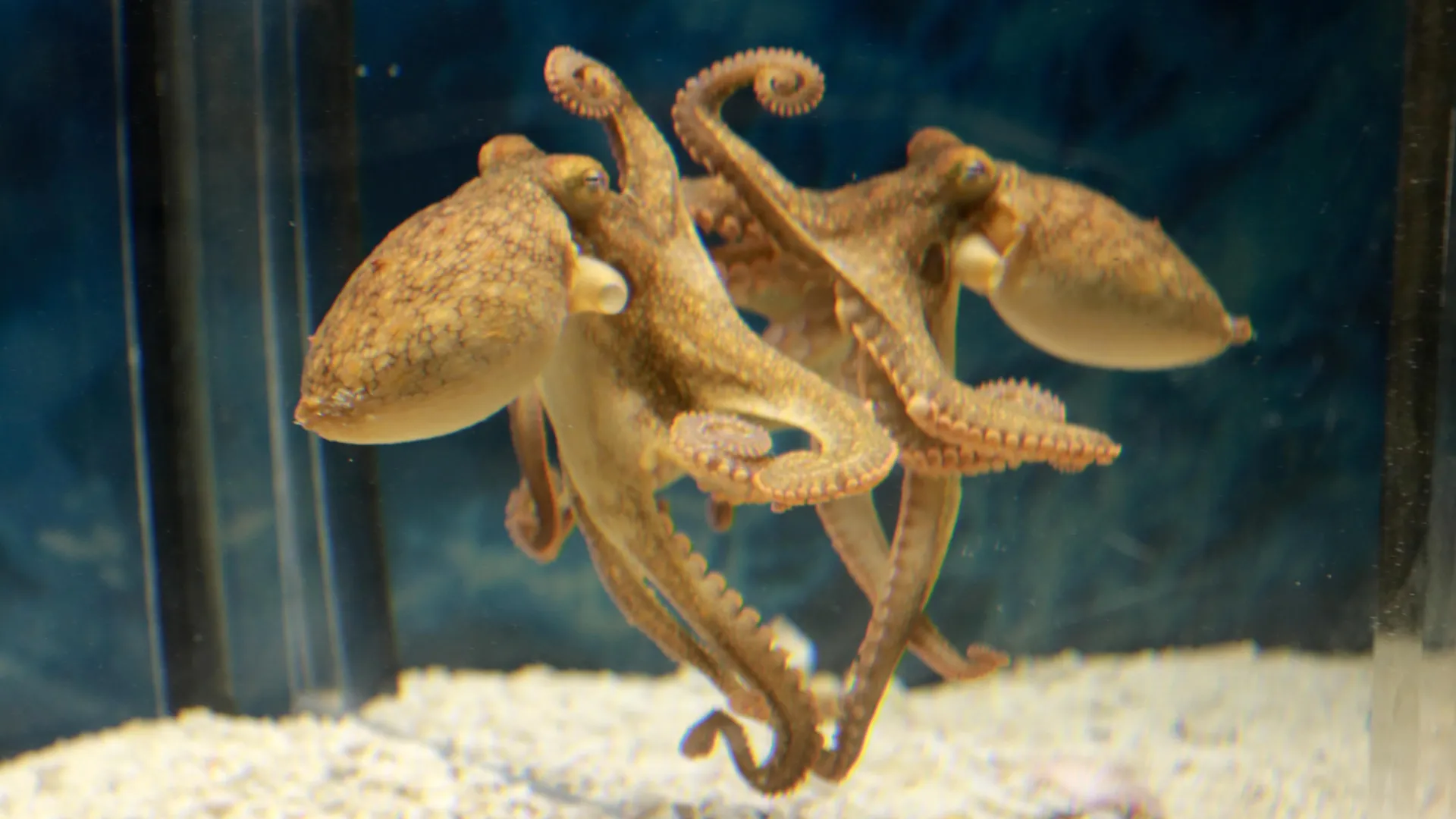
The research team worked with three California two-spot octopuses (Octopus bimaculoides) housed in Dartmouth’s Octopus Lab.
Their goal was to determine whether the animals could learn to use a mirror to identify the location of a food source that was out of sight. Instead of attacking the reflected image, the octopuses needed to figure out where the stimulus was actually located and move toward it.
The animals were first given time to become familiar with a mirror placed in their habitat. Next, researchers trained them to understand the relationship between a reflection and the real world. During this phase, a live crab was placed inside a glass jar positioned so the octopus could see it only through the mirror. To reach the crab, the animal had to turn 90 degrees and move around a corner.
“We don’t enter the world knowing how to use a mirror but learn how to use a mirror,” says senior author and cognitive neuroscientist Peter Tse, a professor of psychological and brain sciences at Dartmouth. Just as new drivers learn to use a rearview mirror to track other vehicles, “Octopuses can also learn how to use a mirror to infer where things are in the world.”
Testing Spatial Cognition
Octopuses possess chemoreceptors that allow them to smell and taste through touch, which could have affected the results if real prey had been used during testing. To avoid that issue, the researchers relied on a virtual crab image instead.
For the experiment, each octopus was placed inside a start box that was open at the front and top. A mirror was positioned directly in front of the animal. The virtual crab image appeared behind the octopus, either on its left or right side, but was visible only through the mirror.
To earn a reward, the octopus had to recognize where the image was actually located and move toward that position. Instead of approaching the mirror itself, the animals turned around and headed toward the correct side, where they received a live crab reward. Some octopuses even climbed over the side of the box to reach the location of the projected image rather than swimming around it.
The animals chose the correct side about 73% of the time.
Researchers tracked a point between the octopus’s eyes on the mantle, the part of the body comparable to a head, using overhead observations. They also measured the routes the animals took while seeking the reward. Although the octopuses did not always choose the shortest path, they became faster at reaching the correct location as the trials progressed.
Clues About the Evolution of Intelligence
According to the researchers, the findings may offer new insights into how intelligence evolves.
“Octopuses are among the most evolutionarily distant animals from humans, as our last common ancestor was a worm that lived 350 to 500 million years ago,” says Kieseler. “Given that such a remote organism has independently evolved the means to use a mirror as a tool to process spatial cognition suggests that the underlying cognitive processes might be subject to convergent evolution, where different species evolve similar neural solutions to the same challenge.”
The environments where octopuses live, including coral reefs and the seafloor, are often highly complex and filled with obstacles.
“Octopuses are like cats: they will sneak up on their prey and pounce, and they want to do so as fast as possible, so that they don’t become preyed upon,” Tse says.
Researchers believe this kind of hunting strategy may benefit from an internal understanding of the surrounding environment.
“Hunters are very effective when they have a mental map of their territory, so that they know where they are in relation to their environments,” says Tse. “Our work suggests that octopuses might also have internal maps, an internal representation of space.”
The team emphasizes that more research will be needed to determine whether octopuses truly maintain such mental maps. Even so, the study adds another remarkable skill to the growing list of abilities that make octopuses some of the most fascinating animals in the ocean.