

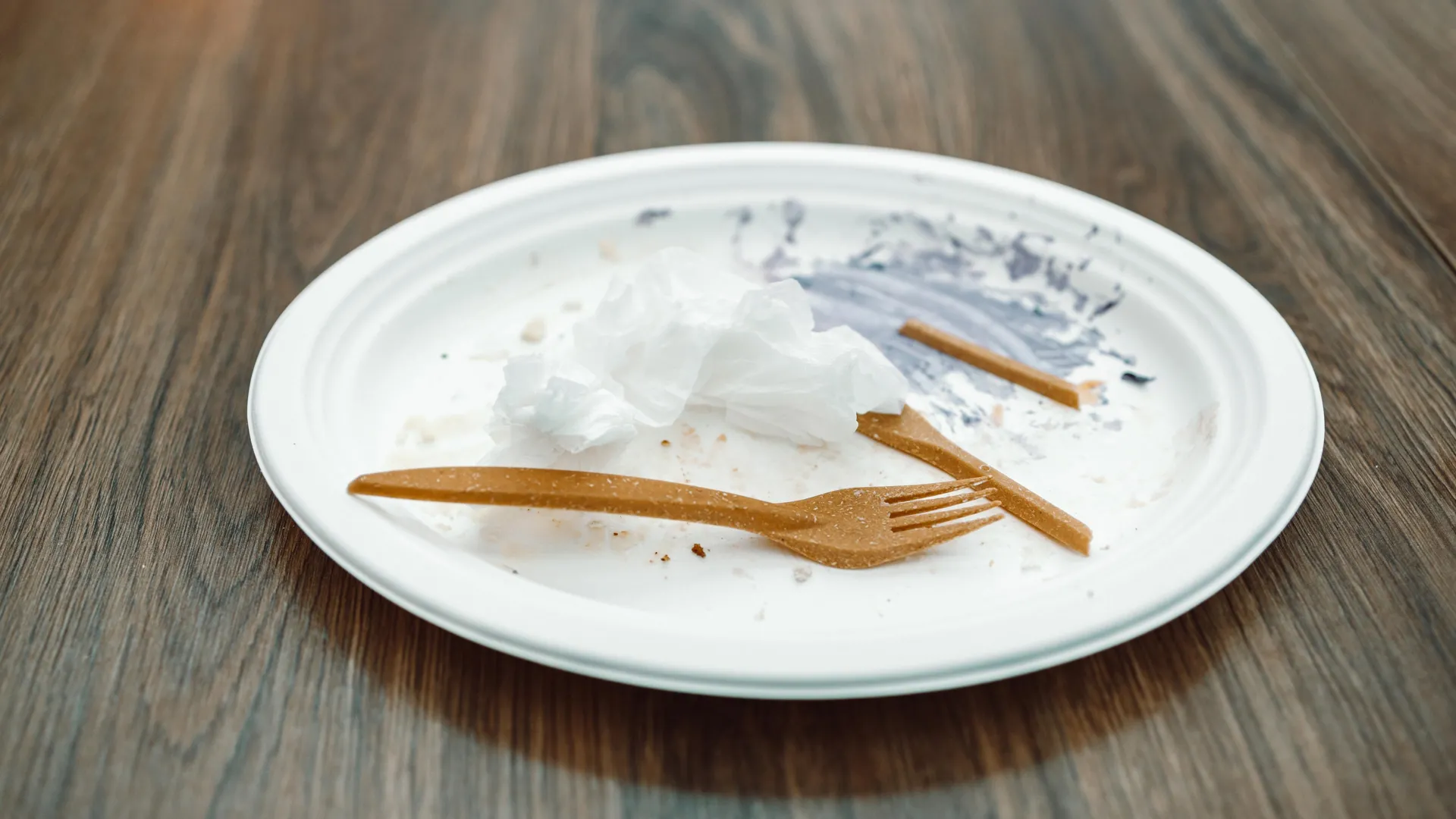
Many plastic items are used for only a few minutes or hours, but the material can remain in the environment for decades or even centuries. Researchers are now exploring a different approach: plastics designed to break themselves down when activated.
Known as living plastics, these materials contain dormant microbes capable of degrading the surrounding polymer. In a study published in ACS Applied Polymer Materials, scientists developed a version that fully decomposed in six days without producing microplastics.
Zhuojun Dai, a corresponding author on the paper, explains that “the realization that traditional plastics persist for centuries, while many applications, like packaging, are short-lived, led us to ask: Could we build degradation directly into the material’s life cycle?”
Turning Microbes Into a Built-In Disposal System
Some microorganisms naturally produce enzymes that cut long polymer chains into smaller fragments. Since plastics are made from polymers, researchers have been investigating whether these enzymes, or the microbes that produce them, can be embedded directly into plastic materials.
“By embedding these microbes, plastics could effectively ‘come alive’ and self-destruct on command, turning durability from a problem into a programmable feature,” explains Dai.
Earlier living plastic designs often depended on a single enzyme, which limited how efficiently the material could be broken down. To improve the process, Dai, Jin Geng, Dianpeng Qi and colleagues engineered Bacillus subtilis to produce two polymer-degrading enzymes that work together.
The first enzyme cuts the long polymer chains at random points, reducing them into shorter sections. The second then works from the ends of those fragments, breaking them down further into their individual monomer building blocks.
Complete Breakdown in Six Days
The researchers combined dormant B. subtilis spores with polycaprolactone (a polymer common in 3D printing and some surgical sutures). Keeping the bacteria in spore form protected them until the team was ready to begin the degradation process.
The finished living plastic had mechanical properties similar to ordinary polycaprolactone films. It remained strong and functional under normal conditions, suggesting that adding the spores did not significantly weaken the material.
To activate the bacteria, the team added a nutrient broth heated to 122 degrees Fahrenheit (50 degrees Celsius). The spores became active and began producing the two enzymes. Within six days, the plastic had been completely reduced to its basic building blocks.
Because the enzymes worked in sequence, the material did not simply crumble into smaller plastic fragments. The process was efficient enough to prevent microplastics from forming during decomposition.
A Wearable Device That Disappears
To demonstrate a possible real-world use, the researchers made a wearable plastic electrode from the living material. The device worked as intended and then fully degraded within two weeks after activation.
The result suggests that living plastics could eventually be used in products that need to remain durable for a limited time but should not persist after they are discarded.
Expanding the Technology to Other Plastics
The team now hopes to develop a method that activates the bacterial spores in water, where a significant share of plastic pollution accumulates.
Although the experiments focused on a single polymer, the researchers believe the same general strategy could be adapted for other materials, including plastics widely used in disposable products.
The authors acknowledge funding from the National Key Research and Development Program of China, the Shenzhen Medical Research Fund, the National Natural Science Foundation of China, the Guangdong Natural Science Funds for Distinguished Young Scholars, and the Shenzhen Science and Technology Program.