

Close Menu

    Subscribe to Updates

    Get the latest news information from worldwide businesses.

    What's Hot

    ‘Chelsea Jane Doe’ identified as Pennsylvania teen 26 years after murder

    June 7, 2026

    How to get Martyr of the First Edict free Passive point

    June 7, 2026

    What are the benefits of suji for diabetics?

    June 7, 2026
    Facebook Instagram YouTube LinkedIn X (Twitter)
    Trending
    • ‘Chelsea Jane Doe’ identified as Pennsylvania teen 26 years after murder
    • How to get Martyr of the First Edict free Passive point
    • What are the benefits of suji for diabetics?
    • Health Bulletin 06/June/2026
    • India’s electric scooter boom: Mass market adoption spreads beyond metros
    • PM reiterates need to ‘add more momentum’ to reforms at EAC meet | India News
    • After NEET-UG 2026 leak, NTA wants question setters to not know which exam they’re setting papers for | Education News
    • 5 major statements by Ajit Agarkar over India’s T20I squad selection
    Newspublicly
    • About Us
    • Advertise & Partner with us
    • Pitch Your Story
    • Contact Us
    Facebook Instagram LinkedIn X (Twitter)
    Subscribe
    • Home
    • World News
      • Asia
      • India
      • USA
      • UK & Europe
      • Middle East
    • Economy & Business
      • Global Economy
      • Corporate & Industry
      • Finance & Markets
      • Policy & Trade
    • Technology
      • Gadgets & Devices
      • Software & Apps
      • AI & Machine Learning
      • Robotics & Automation
    • Health & Medicine
      • Fitness & Nutrition
      • Research & Innovation
      • Disease & Treatment
      • Doctors, Clinics & Patient Care
    • Travel & Tourism
    • Automobile
      • Electric & Hybrid Vehicles
      • Auto Industry Insights
    • Sports
    • More
      • Education
      • Real Estate
      • Environment & Climate
      • Space & Astronomy
      • War & Conflicts
    Newspublicly
    Home»Health & Medicine»Research & Innovation»New light-powered chip could accelerate AI and quantum computing
    Research & Innovation

    New light-powered chip could accelerate AI and quantum computing

    AdminBy AdminJune 2, 2026No Comments4 Mins Read0 Views
    Share
    Facebook Twitter LinkedIn Copy Link WhatsApp


    Scientists at Monash University have created a tiny new circuit that can generate, direct, and read information carried by light, all within a single chip.

    The advance marks a significant milestone for a growing area of research known as “valleytronics,” which could help drive future breakthroughs in faster computing, lower energy consumption, and quantum technologies.

    Developed by researchers from the Monash School of Physics and Astronomy, the new device combines advanced nanotechnology with cutting-edge materials to solve a challenge that has limited the field for years.

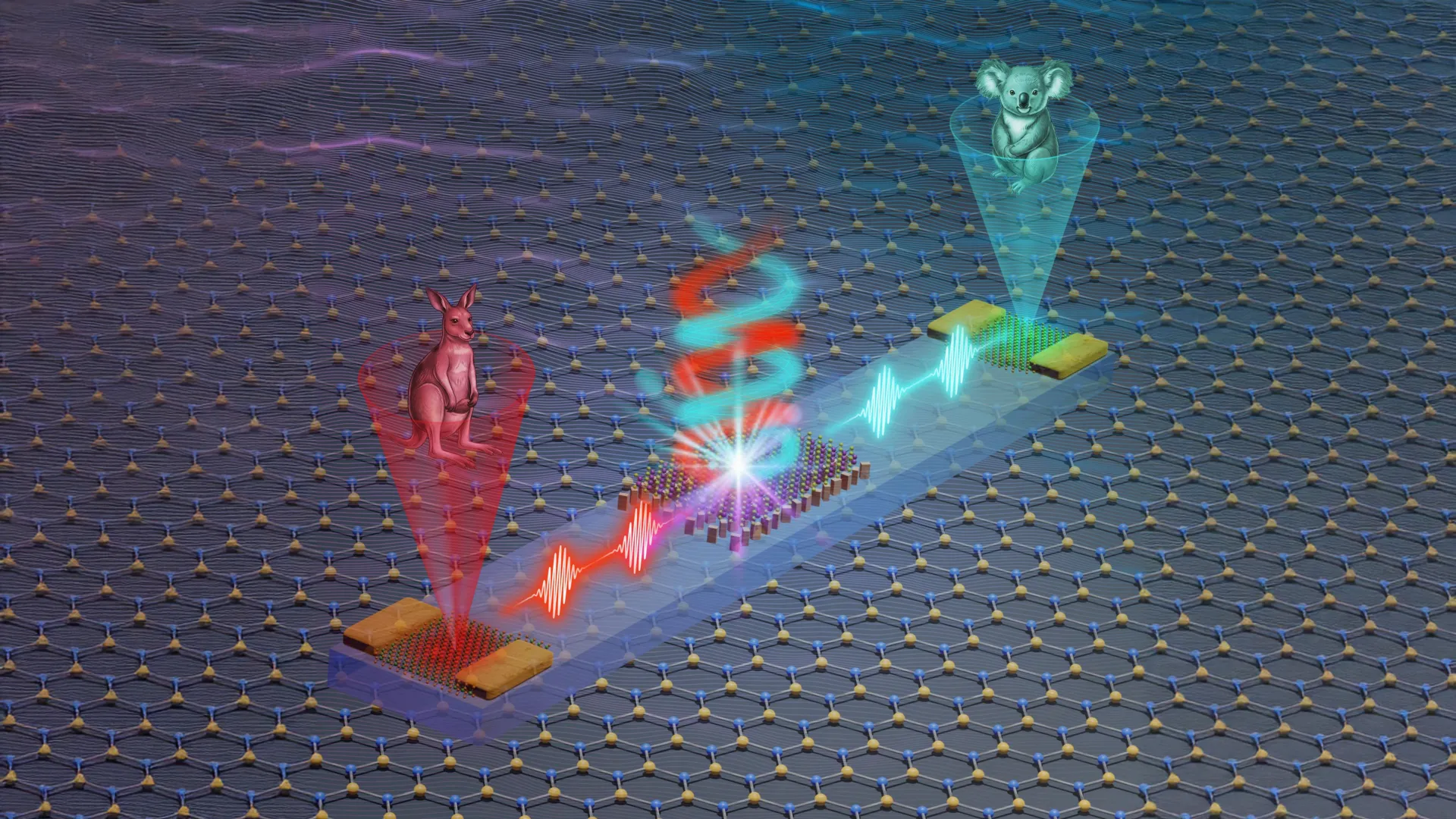
    For the first time, the team has built a fully integrated chip capable of producing specialized light signals, steering them along specific paths, and converting them into electrical signals within the same compact system.

    These signals store information using a quantum property called the “valley degree of freedom.” Scientists believe this unique characteristic could provide entirely new ways to encode, transmit, and process data.

    Integrated Valleytronics Chip Solves Long-Standing Challenge

    Lead author Dr. Chi Li, whose team’s findings were published in Nature Photonics, said the achievement addresses a major obstacle in valleytronics research.

    “Until now, we could generate or detect these signals, but not do everything in one integrated device,” Dr. Li said.

    “What we’ve built is a complete on-chip system that can create, route and read this information with very high precision.”

    The device relies on ultra-thin materials that are only a few atoms thick. These materials are paired with specially engineered nanostructures designed to precisely control light at extremely small scales.

    Dr. Kaijian Xing, co-first author of the study and a Research Fellow at Monash University, explained that the team developed a practical way to combine these components.

    “We employ a straightforward stacking approach to integrate ultra-thin materials with metasurfaces, overcoming the technical challenges of direct material growth on photonic structures, and enabling further advances in valleytronics,” Dr. Xing said.

    Room-Temperature Photonic Technology

    One of the technology’s most important advantages is that it operates at room temperature. Many quantum systems require extremely cold environments, making them more difficult and expensive to use in real-world applications.

    Senior author Dr. Haoran Ren, ARC Future Fellow and leader of the Monash NanoMeta Group, said the work could pave the way for a new generation of compact photonic devices that are both programmable and highly efficient.

    According to Dr. Ren, the technology could support faster computing systems, reduce energy consumption, and enable new methods for secure communications and advanced data processing.

    “This is a significant step toward scalable, chip-based technologies that use light instead of electricity to process information,” Dr. Ren said.

    “Photonic devices use light to achieve massive bandwidths, ultra-fast data transmission speeds, and lower energy consumption, so what we have achieved has strong potential for applications in quantum computing, advanced imaging, and next-generation optical communication systems.”

    Processing Multiple Streams of Information

    To demonstrate the chip’s capabilities, the researchers successfully encoded and processed two separate images at the same time. The experiment showed that the device can manage multiple streams of information simultaneously, an important feature for future computing technologies.

    Professor Stefan A. Maier, Head of the School of Physics and Astronomy and Nanophotonics Laboratory at Monash University, said the development helps bridge the divide between fundamental scientific discoveries and practical technologies.

    “This is an important step toward fully integrated valleytronic systems,” said Professor Maier. “By combining light and quantum materials on a chip, we can access new ways of encoding and processing information.”

    The international project brought together researchers from Australia, China, Singapore, Germany, and Japan, combining expertise in nanophotonics, two-dimensional materials, and optoelectronics.

    The Monash University team included Dr. Chi Li, Dr. Kaijian Xing, Professor Michael S. Fuhrer, Professor Stefan A. Maier, and Dr. Haoran Ren. Additional contributions came from the Singapore University of Technology and Design, LMU Munich, and the University of Technology Sydney.


    Source link

    Author

    • Admin

      NewsPublicly.com is News & Articles Platform that creating SEO-focused articles on travel, lifestyle, and digital trends.

    Admin
    • Website

    NewsPublicly.com is News & Articles Platform that creating SEO-focused articles on travel, lifestyle, and digital trends.

    Related Posts

    NASA just proved spacecraft can switch between multiple satellite networks

    June 6, 2026

    A tiny atomic shift gives scientists powerful control over metals

    June 6, 2026

    Scientists sound the alarm as dangerous amoebas spread globally

    June 6, 2026
    Leave A Reply Cancel Reply

    Demo
    Top Posts

    The Blue Moon rises on May 30— Where and when to see the second full moon of the month

    May 30, 202640 Views

    New SOCOM rifle allows barrel swapping and cartridge changes

    June 1, 202632 Views

    “Inside Gemini Robotics 1.5: How Robots Learn to Reason & Act

    November 22, 202525 Views

    525 pounds of cocaine seized after Nebraska K9 alerts troopers on I-80

    May 28, 202624 Views
    Don't Miss

    ‘Chelsea Jane Doe’ identified as Pennsylvania teen 26 years after murder

    June 7, 20263 Mins Read0 Views

    NEWYou can now listen to Fox News articles! Authorities have identified a Pennsylvania teenager nearly…

    How to get Martyr of the First Edict free Passive point

    June 7, 2026

    What are the benefits of suji for diabetics?

    June 7, 2026

    Health Bulletin 06/June/2026

    June 7, 2026
    Stay In Touch
    • Facebook
    • Twitter
    • Instagram
    • YouTube
    • LinkedIn
    • WhatsApp

    Subscribe to Updates

    Get the latest creative news from SmartMag about art & design.

    Demo
    NEWSPUBLICLY
    Facebook X (Twitter) Instagram LinkedIn

    Home

    • About Us
    • Leadership
    • Advertise & Partner With Us
    • Pitch Your Story
    • Media Kit & Pricing
    • Career
    • FAQs

    Guidelines

    • Editorial & Submission
    • Partnership
    • Advertising & Sponsor
    • Intellectual Property Policy
    • Community & Comment
    • Security & Data Protection
    • Send Your Opinion

    Quick Links

    • Cookie Policy
    • Payment & Billing Terms
    • Refund & Cancellation
    • Copyright Policy
    • Complaint & Support
    • Sitemap
    • Contact Us

    Subscribe Us

    Get the latest news and updates!

    Copyright © 2026 Newspublicly (DIGITALIX COMMUNICATION). All Rights Reserved.
    • Privacy Policy
    • Terms of Use
    • Disclaimer