

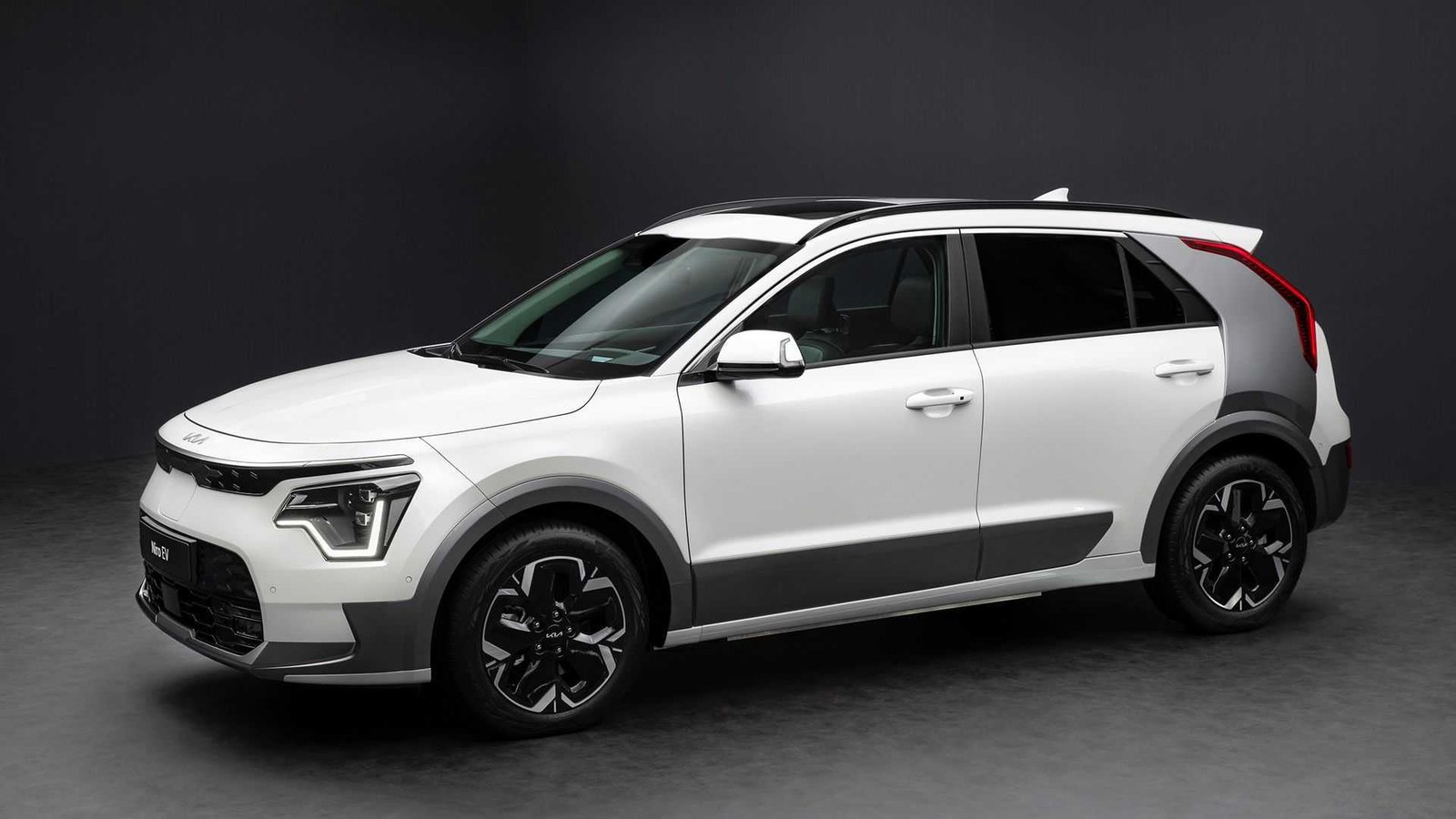
- Nearly 10,000 battery tests found that two EVs retained more than 97% of their capacity after 62,000 miles.
- The top three performers were all Korean EVs, led by the Kia e-Niro.
- Even the lowest-ranked model in the top 20 still retained more than 91% battery health.
Battery degradation is one of the big unknowns when buying an electric car, and it’s especially important if you’re looking to buy used. Mileage tells you something, and it correlates with capacity loss. But the odometer alone can’t tell you how well—or poorly—an EV has aged.
Two seemingly identical EV batteries with similar mileage can age very differently depending on how and where they are used, charging habits, and what car they’re installed in. That is what makes studies like this one from Sweden’s Carla, a used car marketplace, particularly useful. It compiled 9,954 EV battery health tests it conducted between 2022 and 2026 to see which models retain the most capacity after years of use and 100,000 kilometers, or around 62,000 miles, on the odometer.
Here are the results:
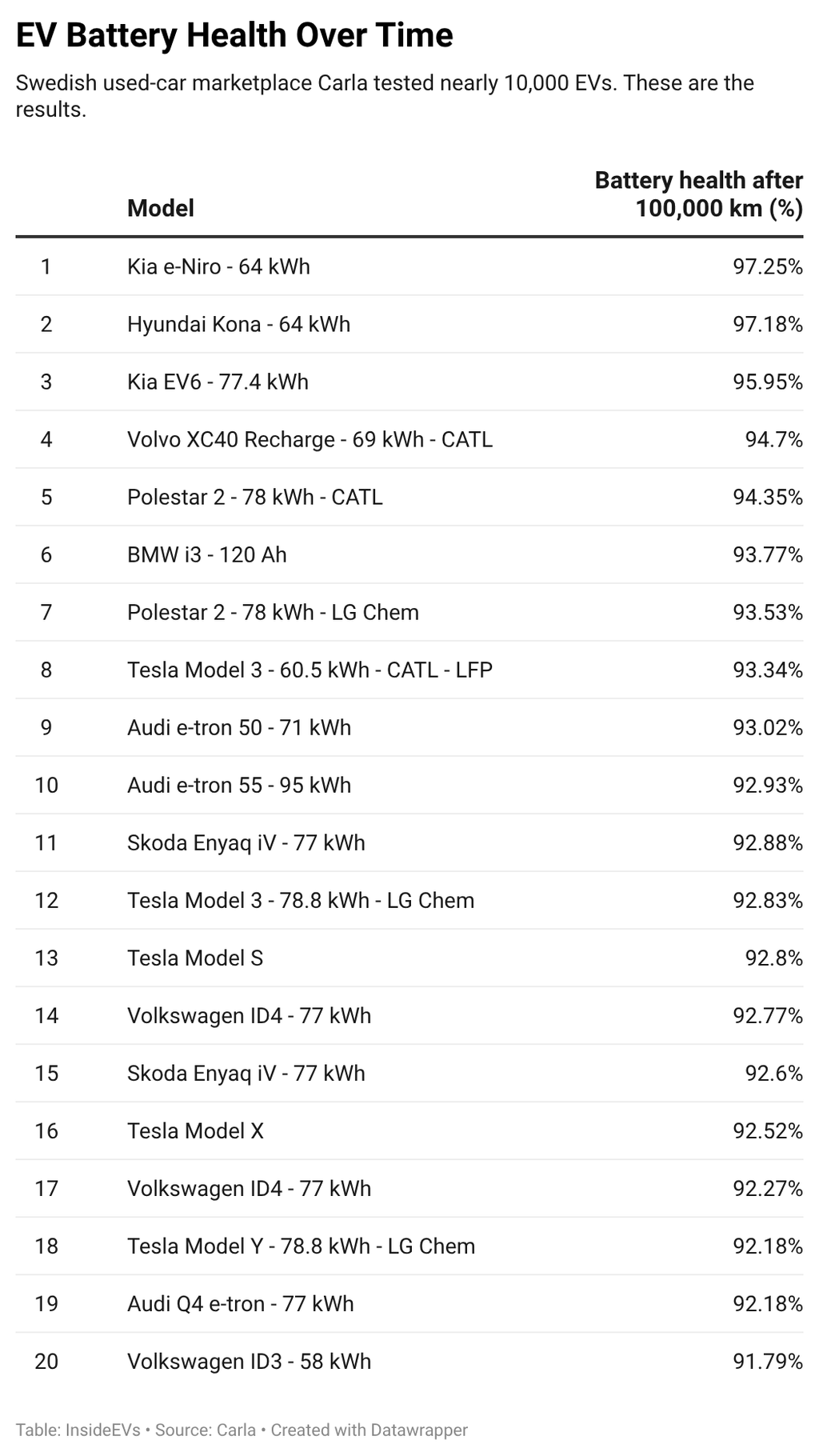
Photo by: InsideEVs
Carla found that several popular EVs still have battery health ratings of 95% or higher, and the top performers were notable.
The top three EVs all came from Korea. The overall winner was the Kia e-Niro (known as the Niro Electric in the U.S.), whose 64-kilowatt-hour battery pack, on average, retained 97.25% of its initial capacity, followed by the mechanically related Hyundai Kona E with 97.18%. That’s less than 3% degradation, and it’s a remarkably good result.
Then came another Kia, the EV6, which features a 77.4 kWh battery and recorded a 95.95% result. It was followed by the Volvo XC40 Recharge, whose battery pack with CATL cells still had 94.70% left, marginally better than the Polestar 2 with battery cells from the same supplier, which had an average of 94.35%. Next on the list was the BMW i3 with the larger 42.2 kWh battery, introduced in 2019, which ranked sixth in the test at 93.77%.
The e-Niro and Kona EV are older EVs, and you would think newer EVs would fare even better due to improving battery technology. One explanation could be that both Korean EVs are comparatively gentle on their batteries.
Their liquid-cooled packs charge at less than 80 kW, below what many newer EVs can handle, and this lower charging rate should help reduce the heat and current that are associated with accelerated cell aging. At the same time, the third-place vehicle, the 800-volt EV6, charges three times as quickly as the others and came very close to matching their low degradation. Sweden’s cooler climate may have helped, though it should have helped all cars equally.
It’s also worth noting that Hyundai replaced entire battery packs in tens of thousands of early Kona EVs after faulty LG Energy Solution cells were linked to fires. It’s not clear whether cars with replacement packs were excluded, but a large number of replacement packs out there could tilt the results in the Kona’s favor. The closely related e-Niro had battery cells from another supplier and was not part of the recall that affected around 82,000 Kona EVs globally.
So what else can we learn from this research? Degradation among the top 20 vehicles tested by Carla was less than 10%. The last-place finisher, the Volkswagen ID.3, still had an average battery health of 91.79% after 100,000 kilometers on the road.
This Swedish analysis reinforces what lots of recent research around battery degradation has pointed to. While battery degradation is real, it is typically gradual and not the catastrophic, fall-off-a-cliff capacity loss many may fear after hearing Nissan Leaf capacity loss horror stories. This dataset is another strong indication that current EV batteries can retain the vast majority of their original capacity well beyond 62,000 miles.