

Close Menu

    Subscribe to Updates

    Get the latest news information from worldwide businesses.

    What's Hot

    New drug for chronic heart failure tested in early study: Lancet

    June 28, 2026

    Big Four rethink partnership as AI changes the game

    June 28, 2026

    Oil prices rise, stock futures inch higher as U.S. and Iran trade more airstrikes

    June 28, 2026
    Facebook Instagram YouTube LinkedIn X (Twitter)
    Trending
    • New drug for chronic heart failure tested in early study: Lancet
    • Big Four rethink partnership as AI changes the game
    • Oil prices rise, stock futures inch higher as U.S. and Iran trade more airstrikes
    • Putin admits Ukrainian strikes driving Russian fuel shortages | Vladimir Putin
    • During PM Modi’s visit, India & Seychelles ink pact for extradition, 8 others | India News
    • After Manchester United confirmed serious injury to star at FIFA World Cup, journalist reveals club’s plans for the summer window
    • Antimicrobial photodynamic therapy Shows Promise in Preventing Osteoradionecrosis of Jaw: Study
    • China’s Z.ai claims it can match Mythos on cybersecurity
    Newspublicly
    • About Us
    • Advertise & Partner with us
    • Pitch Your Story
    • Contact Us
    Facebook Instagram LinkedIn X (Twitter)
    Subscribe
    • Home
    • World News
      • Asia
      • India
      • USA
      • UK & Europe
      • Middle East
    • Economy & Business
      • Global Economy
      • Corporate & Industry
      • Finance & Markets
      • Policy & Trade
    • Technology
      • Gadgets & Devices
      • Software & Apps
      • AI & Machine Learning
      • Robotics & Automation
    • Health & Medicine
      • Fitness & Nutrition
      • Research & Innovation
      • Disease & Treatment
      • Doctors, Clinics & Patient Care
    • Travel & Tourism
    • Automobile
      • Electric & Hybrid Vehicles
      • Auto Industry Insights
    • Sports
    • More
      • Education
      • Real Estate
      • Environment & Climate
      • Space & Astronomy
      • War & Conflicts
    Newspublicly
    Home»More»Space & Astronomy»My quiet obsession with satellites — and how they’re ruining everything
    Space & Astronomy

    My quiet obsession with satellites — and how they’re ruining everything

    AdminBy AdminJune 12, 2026No Comments5 Mins Read0 Views
    Share
    Facebook Twitter LinkedIn Copy Link WhatsApp


    Did you ever see an Iridium flare? For two decades until 2019, these communication satellites would become dazzlingly bright for a second or so in the night sky. I used to see them by accident before discovering that some websites and apps could forecast precisely when and where they would occur. I got so obsessed with Iridium flares that I would build my stargazing sessions around them. Eventually, I started trying to take night sky images just as they flared. Why? In a long exposure, the flare produced a diamond-shaped light. It was beautiful. I carried on doing the same for the International Space Station (ISS), capturing it racing across the night sky, again to a tight pre-determined schedule.

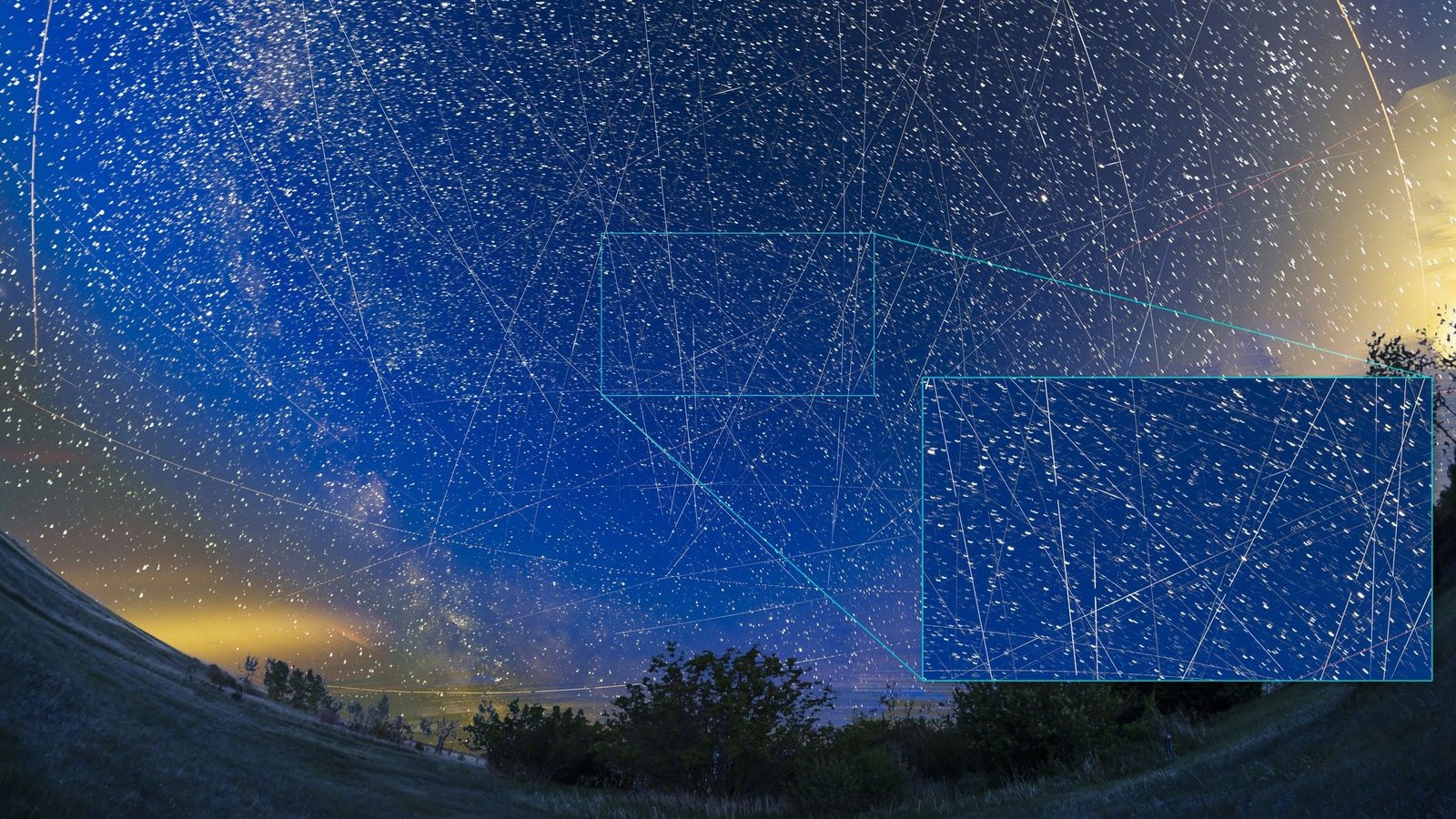
    Then SpaceX came along. After launching the non-flaring replacements for Iridium in May 2019, SpaceX began launching its Starlink satellites into low Earth orbit. There were complaints about their brightness from astrophotographers, who saw their streaks in long exposure photos, but for stargazers, they were initially a delight. Each time SpaceX launched a batch of satellites into orbit on a Falcon 9 rocket, a string of moving lights could be seen in the night sky. It got called a “train” by some because it resembled a freight train racing through the sky. To me, it looked like an alien invasion. During COVID-19, glimpsing Starlink trains was something new to do (I spent hours on Heavens Above). Now it’s something to actively avoid.

    About 11,000 Starlinks later, that seems naive. Sure, there are now 12 million people worldwide who use Starlink internet access. I hope most of them are in previously off-grid communities in Africa, which was said to be one of Starlink’s major selling points.

    Look up soon after sunset, and Starlinks and other satellites are everywhere. As primarily a naked-eye stargazer and binocular astronomer, it doesn’t particularly bother me, but for astrophotographers and both visual and radio astronomers, the mega-constellation era is a tragedy. Being photobombed by satellite streaks in images is a big problem, but so is radio interference in low Earth orbit. Astrophotographers can stack images and use software to remove trails (as if post-processing wasn’t already time-consuming enough), but for astronomers, mega-constellations can hugely affect spectroscopic data and wide-field surveys, such as the Rubin Observatory.

    a bright streak of light against a background of stars.

    An Iridium flare, which ceased in 2019. (Image credit: Jamie Carter)

    Within a few years, there’s likely to be about 40,000 Starlinks, but with Amazon and other companies preparing rival mega-constellations, a phase of hyper-expansion is about to begin. It’s going to get a lot, lot worse. As with Iridium satellites, mega-constellations of satellites will eventually de-orbit, burn up and disappear from the night sky, though probably not en masse in our lifetimes.


    You may like

    When to see satellites

    The best time to fully appreciate just how dominant satellites are becoming in the night sky is during summer in the twilight hour immediately following sunset or before sunrise. At this time of year, the sun may have dipped below your horizon, but it’s not far below, so its light still shines on satellites far above you.

    By the middle of the night, the sun is farther below the horizon. Satellites therefore pass through Earth’s deep shadow and don’t get lit by the sun, making them more or less invisible.

    Space

    Stargazer’s corner: June 12-18, 2026

    night sky graphic showing the moon shining close to the beehive cluster

    See a waxing crescent close to Venus and the Beehive Cluster on June 17. (Image credit: Stellarium)

    Here comes a beautiful week for being outside looking west as twilight unfolds after sunset. That’s because the moon reaches its new phase on Sunday, June 14, which means dark skies (albeit during short nights in the Northern Hemisphere’s mid-latitudes) and a crescent moon after sunset. On June 15, you’ll see a young waxing crescent with Venus, Jupiter and Mercury, with the latter as high as it gets. On June 17, the crescent passes close to Venus and the Beehive Cluster. These moments are short-lived, but they reward those willing to step outside at just the right time.

    Constellation of the week: Lyra

    night sky graphic showing the constellation Lyra

    The constellation Lyra. (Image credit: E. Slawik/NOIRLab/NSF/AURA/M. Zamani)

    Lyra is small (and said to resemble a harp), but it commands attention because of Vega, one of the brightest stars in the night sky. About 25 light-years away, it’s one of the most studied stars and serves as a standard yardstick to measure the apparent magnitude (brightness) of other stars. It’s also the brightest in the famous Summer Triangle asterism, now obvious in the east after dark.

    In the cult movie Contact (1997), astronomers discover an extraterrestrial signal emanating from Vega. In reality, a recent image from the Hubble Space Telescope of a 100-billion-mile-wide disk of dust around Vega revealed no directly visible large planets.

    My latest stargazing obsession: the ISS

    a long white streak across a star studded sky.

    The International Space Station crosses the night sky. (Image credit: Jamie Carter)

    At this time of year, true darkness is in short supply, especially at mid-northern latitudes. But twilight has its own advantages. Every 90 minutes or so, the International Space Station buzzes around Earth, but as Earth revolves beneath it, it appears to take a different trajectory. Using NASA’s Spot The Station app (and many other stargazing apps), it’s possible to see the dates and exact times of passes over your location over the next week or two. The app also has an augmented reality mode that lets you point your phone at the night sky to see where the ISS will appear in the west. When you see it, it will cross the sky and disappear into Earth’s shadow to the east, taking between one and six minutes. Since the ISS is always brightest during twilight and the Milky Way becomes visible as twilight ends, it’s a narrow window, but it is sometimes possible to image both together. If you’re patient, seeing the ISS can add an extra dimension to stargazing.


    Source link

    Author

    • Admin

      NewsPublicly.com is News & Articles Platform that creating SEO-focused articles on travel, lifestyle, and digital trends.

    Admin
    • Website

    NewsPublicly.com is News & Articles Platform that creating SEO-focused articles on travel, lifestyle, and digital trends.

    Related Posts

    SpaceX sends 24 Starlink satellites into Earth orbit on Falcon 9 launch from California

    June 28, 2026

    ‘Superman Returns’ at 20: Is it a sequel? Is it a reboot? Two decades on, we’re still not sure

    June 28, 2026

    Japanese probe set for super-close flyby on July 5: ‘We’re going to discover another beast to put in the zoo of asteroids’

    June 28, 2026
    Leave A Reply Cancel Reply

    Demo
    Top Posts

    The Blue Moon rises on May 30— Where and when to see the second full moon of the month

    May 30, 202640 Views

    New SOCOM rifle allows barrel swapping and cartridge changes

    June 1, 202633 Views

    “Inside Gemini Robotics 1.5: How Robots Learn to Reason & Act

    November 22, 202525 Views

    525 pounds of cocaine seized after Nebraska K9 alerts troopers on I-80

    May 28, 202624 Views
    Don't Miss

    New drug for chronic heart failure tested in early study: Lancet

    June 28, 20261 Min Read0 Views

    New drug for chronic heart failure tested in early study: Lancet We use cookies for…

    Big Four rethink partnership as AI changes the game

    June 28, 2026

    Oil prices rise, stock futures inch higher as U.S. and Iran trade more airstrikes

    June 28, 2026

    Putin admits Ukrainian strikes driving Russian fuel shortages | Vladimir Putin

    June 28, 2026
    Stay In Touch
    • Facebook
    • Twitter
    • Instagram
    • YouTube
    • LinkedIn
    • WhatsApp

    Subscribe to Updates

    Get the latest creative news from SmartMag about art & design.

    Demo
    NEWSPUBLICLY
    Facebook X (Twitter) Instagram LinkedIn

    Home

    • About Us
    • Leadership
    • Advertise & Partner With Us
    • Pitch Your Story
    • Media Kit & Pricing
    • Career
    • FAQs

    Guidelines

    • Editorial & Submission
    • Partnership
    • Advertising & Sponsor
    • Intellectual Property Policy
    • Community & Comment
    • Security & Data Protection
    • Send Your Opinion

    Quick Links

    • Cookie Policy
    • Payment & Billing Terms
    • Refund & Cancellation
    • Copyright Policy
    • Complaint & Support
    • Sitemap
    • Contact Us

    Subscribe Us

    Get the latest news and updates!

    Copyright © 2026 Newspublicly (DIGITALIX COMMUNICATION). All Rights Reserved.
    • Privacy Policy
    • Terms of Use
    • Disclaimer