

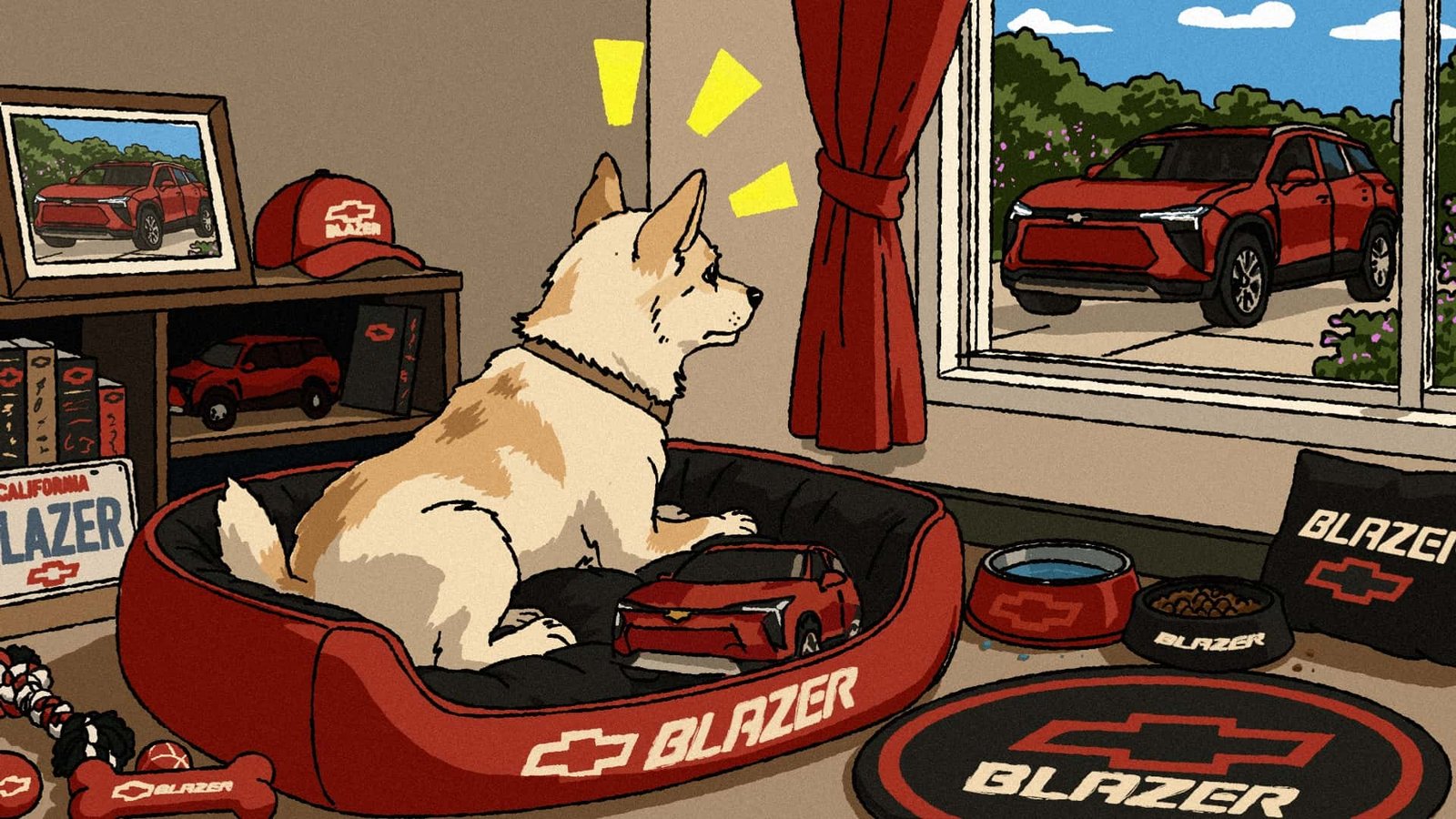
I can see his pointy little ears poking through the living room window by the time I roll up. Before I can see the house, before he even sleepily raises himself from his dog bed, my boy Kickflip knows I’m coming. And it’s all thanks to the space-ship hum of my Chevy Blazer EV.
I’m sure you’ve heard it, or something similar, when a neighbor’s hybrid or EV drives by. Since 2016, the feds have required all EVs and hybrids to emit a pedestrian warning noise when traveling below 30 km/h (18.6 mph), ensuring that your local vision-impaired jogger isn’t surprised by a 5,000-pound car moving in complete silence. Above that speed, the tire roar of the car is loud enough to alert you on your own, the thinking goes.

Flip in his favorite car on Earth.
Photo by: Mack Hogan/InsideEVs
Each brand uses a slightly different approach, with Tesla’s warning sound being the most cartoonish and space-ship-like to my ears, and some sounding closer to the unsexy, platonic ideal warning sound: pink noise. Yet most stick to the same basic approach, adopting the soundtrack of an idling hoverboard or a vacuum cleaner from the year 3,000. Listen to a Hyundai or a Toyota or a Honda or a Chevy drive by on electric power alone, and you’d be hard-pressed to hear the difference.
But you’re using human ears. For Flip, with his super-powered and super-cute ears, the job is easier. It’s not news that dogs can separate out specific vehicle noises; my friend’s St. Bernard mix knows when his owner’s Lexus LC500 is coming around the bend, as the car makes a particular V-8 thrum that’s hard to miss. Yet even Clifford’s super-size ears likely couldn’t tell the difference between the boring four-cylinder in your Mazda CX-5 and the even-more-boring four-cylinder in your neighbor’s Hyundai Tucson. In the EV world, though, the notes come through clearer. And the result is that my dog has become a bona fide Chevy EV enthusiast.
14
Source: InsideEVs
When he hears my Blazer EV round the corner, pull a 3-point turn in the neighbor’s driveway, and slow to a stop, it’s a signal that the best thing possible is about to happen: His best friend is coming home. Cue the wagging tail, the perching on the couch to see out the window, and the excited run to the door. Most of his life is between these walls and around these blocks; to unlock anything better, he needs me home, with all of the parmesan cheese and dog-park visits that entails.
But there’s another thing you need to know about dogs: They are extremely bad at generalizing. In my efforts to train my high-energy, year-and-a-half-old Husky mutt, I have learned this the hard way. Just because they know what “heel” means in the back yard doesn’t mean they’ll understand it on the walk. So while Flip knows that the approach of a Blazer EV means “dad’s home,” it’s a far more baffling experience when we hear the sound together on a walk.
All Chevy EVs, and most EVs from the greater General Motors family, make the same pedestrian-alert sound. It’s even the same on the badge-engineered Honda Prologue. And because I live in coastal Southern California, you can’t walk too far without hearing an Equinox EV or a Prologue bopping about.
When that happens, without fail, Flip snaps to attention, fixes his eyes on the emitting offender, and stares at it with the intensity of a film major watching Inception while stoned. This is sometimes paired with tail-wagging, excited pulling, or over-the-shoulder looks at me in excitement. “Dad’s coming home,” his little peanut brain thinks, as he sits two feet from me.

This is basically how Flip reacts when a Honda Prologue drives by.
Photo by: Mack Hogan/InsideEVs
I tried to apply human reasoning to him, as any dog owner’s core hobby is projecting the depth of human emotion onto a being whose highest purpose appears to be finding peanut butter. My fiancé occasionally takes my car places, so maybe he thinks it means she’s about to join us. But it happens even if we’re both together.
It’s pure conditioning. If Pavlov had driven a Blazer EV, he’d have had no use for the bell. Purely by rocking up to the experiment, he’d have the dog salivating all the same. There’s a simple stimulus-response going on here, where Flip knows that the sound means exciting things, but the abstraction doesn’t seem to go further than that.
It certainly helps that the Blazer is also what takes Flip to all of his favorite places, like Sunset Cliffs and Dog Beach.
Photo by: Mack Hogan/InsideEVs
The good news is that—despite the language barrier—I’ve managed to turn my best bud into a certified EV enthusiast. He can identify a Chevy Blazer EV’s approach long before even the most eagle-eyed and bat-eared enthusiast, and he commits his entire focus to it as long as it’s around. He can only half-walk when one is nearby, committed as he is to keeping his head locked on it and his ears perked up. He’s obsessed.
What makes it all the better is the total indifference he has to all other car noises. My fiancé’s Ford Escape has a 2.5-liter four-cylinder, altogether too anonymous in its aural signature to garner any rise. And while Hyundais and Teslas and Toyotas sing their own songs, he can instantly tell that they’re not what he’s looking for. He’s a Chevy man, through and through.
The only downside is that I’m afraid I may break his heart. When my Blazer EV lease return ends, I don’t know what I’ll get next. But I can’t imagine looking in his giant eyes and explaining that, I’m sorry, son, but it’s not a Chevy EV this time. Part of that is because of the aforementioned language barrier—he’s not quite conversational in English, and I don’t think he’d get it. But part of it is that young ones are impressionable; you don’t want to quash their enthusiasm.
I suspect, however, that his love of the low-pitched hum of a Blazer or Equinox will live on long after my lease. Just like when we see one together, he doesn’t have to know what the sound means. All he knows is that he loves it.
Contact the author: Mack.Hogan@insideevs.com.