

Close Menu

    Subscribe to Updates

    Get the latest news information from worldwide businesses.

    What's Hot

    What’s next for SpaceX’s Starship V3 megarocket after its historic debut flight?

    May 28, 2026

    How Utility Companies and States Shaped America’s Clean Energy Transition

    May 28, 2026

    19 year-old Macklin Celebrini opens up about captaining Sidney Crosby, other Canadian veterans in 2026 IIHF World Championship

    May 28, 2026
    Facebook Instagram YouTube LinkedIn X (Twitter)
    Trending
    • What’s next for SpaceX’s Starship V3 megarocket after its historic debut flight?
    • How Utility Companies and States Shaped America’s Clean Energy Transition
    • 19 year-old Macklin Celebrini opens up about captaining Sidney Crosby, other Canadian veterans in 2026 IIHF World Championship
    • Lightship’s Self-Propelled Trailer Looks Like A Jobsite Game Changer—And An EV Range Saver
    • Tesla’s own AI trainers don’t trust ‘Full Self-Driving’ or its safety stats, Reuters finds
    • Signs your body may be low on iron
    • Healthcare professionals cannot be presumed guilty- Doctors’ body urges authorities to reconsider SRN hospital medicos suspension
    • Xiaomi 17T Pro arrives with the company’s biggest battery yet
    Newspublicly
    • About Us
    • Advertise & Partner with us
    • Pitch Your Story
    • Contact Us
    Facebook Instagram LinkedIn X (Twitter)
    Subscribe
    • Home
    • World News
      • Asia
      • India
      • USA
      • UK & Europe
      • Middle East
    • Economy & Business
      • Global Economy
      • Corporate & Industry
      • Finance & Markets
      • Policy & Trade
    • Technology
      • Gadgets & Devices
      • Software & Apps
      • AI & Machine Learning
      • Robotics & Automation
    • Health & Medicine
      • Fitness & Nutrition
      • Research & Innovation
      • Disease & Treatment
      • Doctors, Clinics & Patient Care
    • Travel & Tourism
    • Automobile
      • Electric & Hybrid Vehicles
      • Auto Industry Insights
    • Sports
    • More
      • Education
      • Real Estate
      • Environment & Climate
      • Space & Astronomy
      • War & Conflicts
    Newspublicly
    Home»More»Space & Astronomy»Most powerful ‘ghost particle’ ever may have come from a cosmic particle accelerator fed by a black hole
    Space & Astronomy

    Most powerful ‘ghost particle’ ever may have come from a cosmic particle accelerator fed by a black hole

    AdminBy AdminMay 28, 2026No Comments5 Mins Read0 Views
    Share
    Facebook Twitter LinkedIn Copy Link WhatsApp


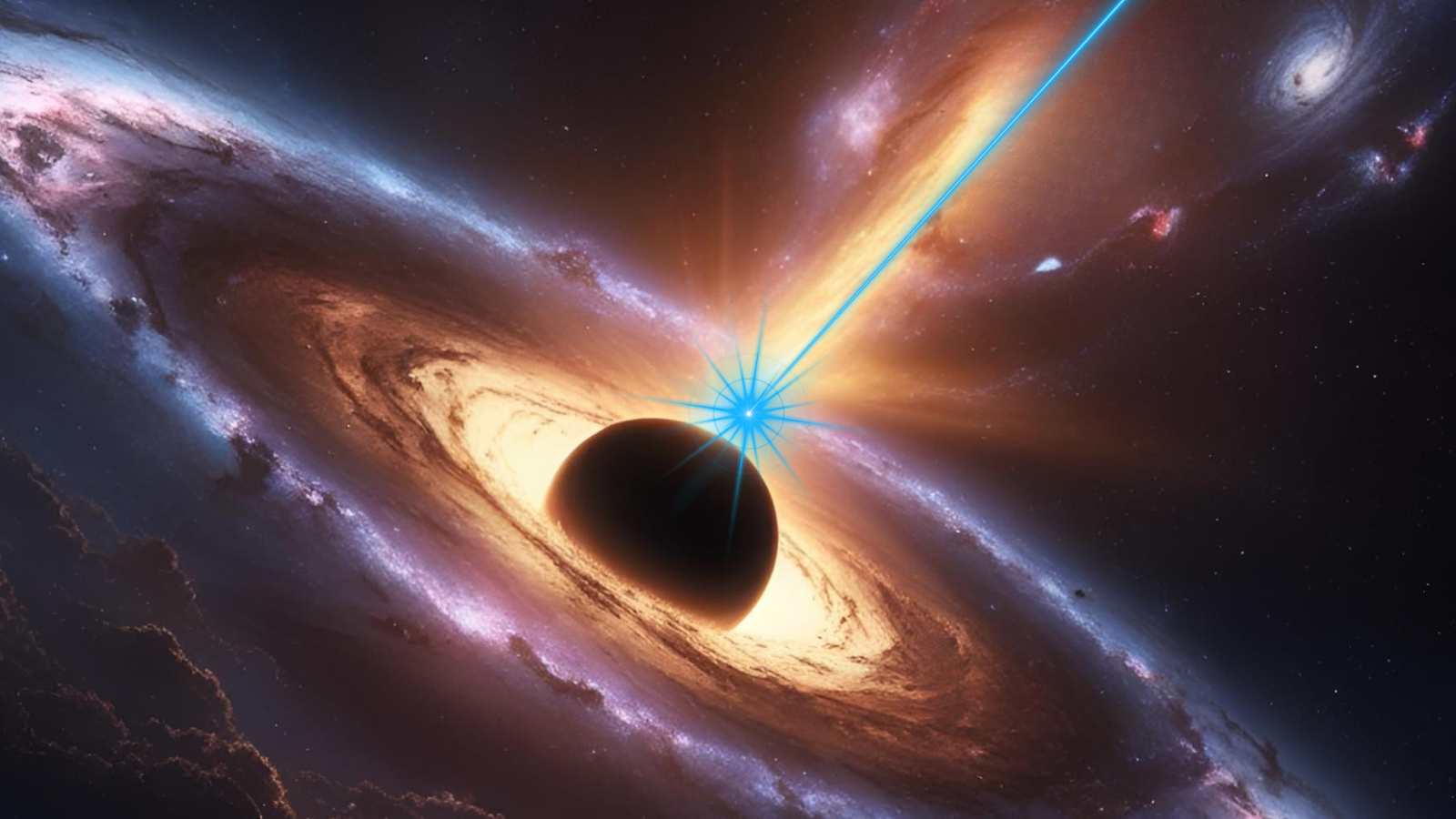
    Scientists have discovered an ultra-powerful “ghost particle” or neutrino, which struck Earth and was detected in the Mediterranean Sea in 2023, may have been blasted at Earth by blazars powered by a feasting black hole engine.

    Blazars are a type of quasar, the regions at the hearts of galaxies that host feeding supermassive black holes and discharge powerful jets of radiation. Blazars are different from “ordinary” quasars because their orientation means that the energy, particles, and jets of plasma they blast out are pointed directly at Earth.

    The neutrino was 30 times more energetic than carried with it 30 times the energy of the previous most energetic neutrino ever detected. It arrived at Earth on Feb. 13, 2023, traveling at nearly the speed of light, and was spotted via the detection of a single muon (a subatomic particle) by the Kilometer Cubic Neutrino Telescope (KM3NeT), located 11,300 feet (3,450 meters) beneath the waves of the Mediterranean Sea. Blazars were initially suggested as the source of the particle, but this team of scientists took it upon themselves to confirm a specific class of these supermassive black hole-powered events as a possible origin.


    You may like

    “There are several possible explanations for the origin of this particle,” team member Meriem Bendahman, from the KM3NeT collaboration, said in a statement. “For example, it has been proposed that such neutrinos are generated when ultra-high-energy cosmic rays interact with the cosmic microwave background radiation (CMB), the residual light from the early universe. But there is also the possibility that the neutrino originates from a diffuse flux produced by a population of extreme accelerators, such as blazars.”

    A high-energy ‘ghost’

    Neutrinos get their nickname of “ghost particles” from the fact that they have no electric charge and are virtually massless, meaning they pass through matter with little to no interaction. In fact, as you just read that sentence, around 100 trillion neutrinos passed through your body at nearly the speed of light. That makes detecting neutrinos incredibly difficult, even when like this one, they carry an energy of 220 million billion electron volts.

    For context, that is 30,000 times the energy that Earth’s largest particle accelerator, the Large Hadron Collider (LHC), is capable of achieving. In fact, to accelerate a particle to such energies, the LHC would have to be expanded from its current length of 17 miles (27 kilometers) to around 25,000 miles (40,000 kilometers), the entire circumference of the Earth.

    Little wonder scientists are eager to understand where this particle came from and how it was boosted to such high energies.

    Space

    An infographic compares the energy of this particle to that of a ping pong ball on Earth

    An infographic compares the energy of this particle to that of a ping pong ball on Earth (Image credit: Robert Lea (created with Canva))

    The team began sorting through possible origins for this high-energy neutrino particle by acting like cosmic forensic detectives, classifying the detection of the particle as a crime scene and hunting for potential clues that point toward a culprit.

    One of the first clues discovered by the researchers was the absence of an electromagnetic radiation signal in radio, optical, X-ray, or gamma rays from the same region of space that the neutrino appeared to have originated from. That is something that they would expect to see if the particle had been launched by a single explosive event like a stellar flare or a supernova.

    “This does not completely rule out the possibility of a point-like source, but it leads us to consider that our neutrino may come from a diffuse background — that is, from a flux of neutrinos including contributions from many sources,” Bendahman said.

    Sources like a population of black hole-powered blazars.

    Bendahman simulated a population of blazars, taking into account observations of their characteristics such as magnetic field strength and the range of radiation they emit. Their simulations allowed them to vary two important parameters: the energy carried by protons compared to electrons (called “baryonic loading”) and how that energy is distributed across the protons; and how likely particles are to reach ultra-high energies. This second parameter determines how many neutrinos can be created, the neutrino flux (the intensity of a stream), and how many gamma-rays are created.


    What to read next

    The model developed by the researchers also had to account for the lack of detection of neutrinos of similar high energies by KM3NeT, still under construction off the coast of Sicily, and by other facilities such as the IceCube Neutrino Observatory located in Antarctica. That meant any event that created such a high-energy neutrino must be relatively rare.

    Additionally, as neutrino creation is accompanied by gamma-ray emission, the model had to ensure that in creating high-energy neutrinos, blazars didn’t generate enough gamma-ray radiation to exceed the extragalactic gamma-ray background measured by the Fermi space telescope.

    In this artist's illustration, a blazar is accelerating protons that produce pions, which produce neutrinos and gamma-rays.

    An illustration shows a blazar accelerating protons that produce pions, which produce neutrinos and gamma-rays. (Image credit: IceCube/NASA)

    “We modelled a realistic population of blazars with physically motivated parameters, and we found that this population of blazars could explain the origin of this ultra-high-energy event, while also being consistent with the constraints that we have regarding the gamma-ray and neutrino observations,” Bendahman said.

    While the team’s findings do indeed show that a population of blazars could be responsible for this high-energy neutrino, the case is far from closed.

    “We need more observational data,” Bendahman said. “We have never observed such a high-energy neutrino before, and if it turns out to come from cosmic accelerators like blazars, it would give us new insight into how these objects can emit particles at energies beyond what we previously expected.”

    The team’s research was published in the Journal of Cosmology and Astroparticle Physics (JCAP).


    Source link

    Author

    • Admin

      NewsPublicly.com is News & Articles Platform that creating SEO-focused articles on travel, lifestyle, and digital trends.

    Admin
    • Website

    NewsPublicly.com is News & Articles Platform that creating SEO-focused articles on travel, lifestyle, and digital trends.

    Related Posts

    What’s next for SpaceX’s Starship V3 megarocket after its historic debut flight?

    May 28, 2026

    Save 87% off and get a $30 Amazon voucher FREE with Surfshark

    May 28, 2026

    Where did Mercury get its water ice? Maybe from a slow asteroid impact in a single Mercurian day

    May 28, 2026
    Leave A Reply Cancel Reply

    Demo
    Top Posts

    “Inside Gemini Robotics 1.5: How Robots Learn to Reason & Act

    November 22, 202525 Views

    How US Tariffs Are Reshaping the Global Growth Landscape?

    November 21, 202518 Views

    Pakistani Journalist Laughing at Tejas Fighter Jet Crash at Dubai Airshow Sparks Massive Outrage Worldwide

    November 23, 202517 Views

    Vibe-Coding Boom: How Non-Coders Build Apps With AI Agents

    November 22, 202515 Views
    Don't Miss

    What’s next for SpaceX’s Starship V3 megarocket after its historic debut flight?

    May 28, 20267 Mins Read0 Views

    SpaceX’s next-gen Starship megarocket finally got off the ground last week.On May 22, SpaceX’s first…

    How Utility Companies and States Shaped America’s Clean Energy Transition

    May 28, 2026

    19 year-old Macklin Celebrini opens up about captaining Sidney Crosby, other Canadian veterans in 2026 IIHF World Championship

    May 28, 2026

    Lightship’s Self-Propelled Trailer Looks Like A Jobsite Game Changer—And An EV Range Saver

    May 28, 2026
    Stay In Touch
    • Facebook
    • Twitter
    • Instagram
    • YouTube
    • LinkedIn
    • WhatsApp

    Subscribe to Updates

    Get the latest creative news from SmartMag about art & design.

    Demo
    NEWSPUBLICLY
    Facebook X (Twitter) Instagram LinkedIn

    Home

    • About Us
    • Leadership
    • Advertise & Partner With Us
    • Pitch Your Story
    • Media Kit & Pricing
    • Career
    • FAQs

    Guidelines

    • Editorial & Submission
    • Partnership
    • Advertising & Sponsor
    • Intellectual Property Policy
    • Community & Comment
    • Security & Data Protection
    • Send Your Opinion

    Quick Links

    • Cookie Policy
    • Payment & Billing Terms
    • Refund & Cancellation
    • Copyright Policy
    • Complaint & Support
    • Sitemap
    • Contact Us

    Subscribe Us

    Get the latest news and updates!

    Copyright © 2026 Newspublicly (DIGITALIX COMMUNICATION). All Rights Reserved.
    • Privacy Policy
    • Terms of Use
    • Disclaimer