

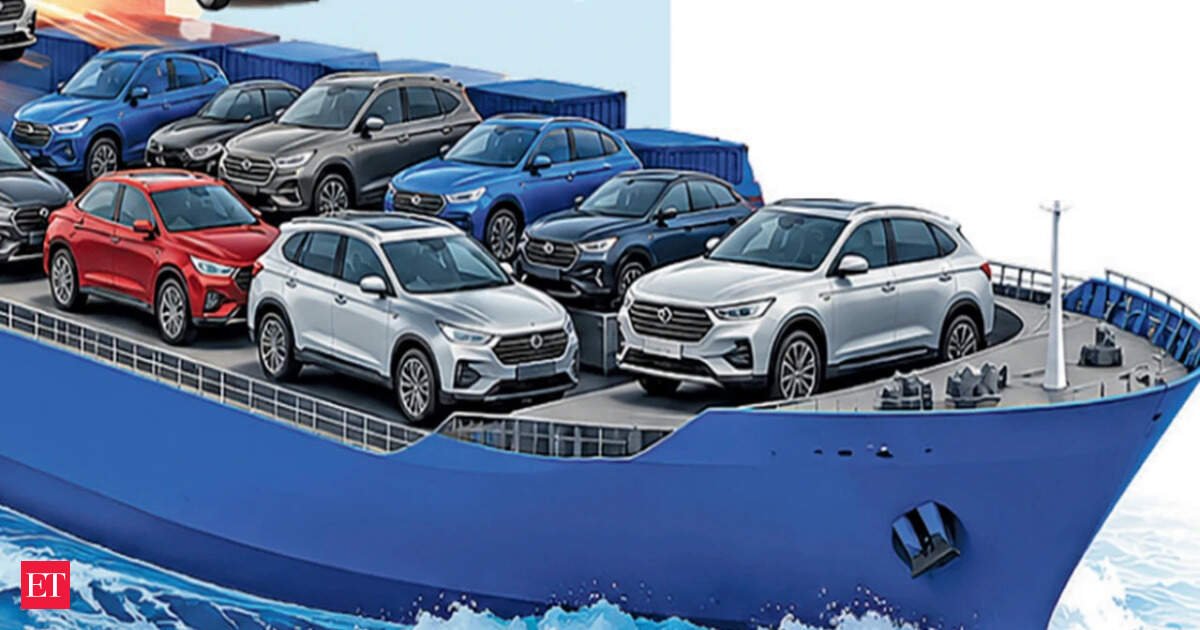
Exports rose to 15,641 units in the three months ended June, from 1,122 units a year earlier, showed industry data. This accounted for more than half of the 28,652 units exported last fiscal year.
While the initial boom is largely driven by Maruti Suzuki‘s flagship e-Vitara, which emerged as India’s third-most exported car last quarter, the robust export demand is driving Indian carmakers’ broader global growth ambitions.
Sensing a structural shift in the international market, Tata Motors and Mahindra & Mahindra are aggressively mobilising plans to scale up electric vehicle shipments to right-hand drive markets worldwide.
The country’s largest carmaker, Maruti Suzuki entered 20 new markets, mostly in Europe, last quarter with the e-Vitara. The Suzuki Motor Corp unit shipped 15,210 electric cars to 47 countries during the period. The UK was the largest export destination, followed by South Africa.

E-VITARA AT NO. 3 AMONG TOP EXPORTS IN APRIL-JUNE

Launches to Capitalise on Demand
Given the burgeoning demand at home and overseas, Maruti Suzuki plans to introduce four more EVs by 2030. “Maruti Suzuki exports more cars from India than the rest of 17 car manufacturers put together,” said Rahul Bharti, senior executive officer, Maruti Suzuki. “We exported close to 125,000 cars in Q1 to about 120 markets…We have already exported more than 40,000 units of the e-Vitara in less than a year of commencing shipments.”
Bharti said India-made vehicles are well-received in developed markets such as Europe and Japan on the strength of their quality and technology. Maruti Suzuki has added 20 export destinations in the previous quarter, mostly in Europe, he said.
Tata Motors Passenger Vehicles, which recently started EV exports to neighbouring countries in South Asia, is actively looking to accelerate the exports growth momentum.
“They want to expand electric vehicle exports to additional markets in Asia, Africa, Asia, Europe and the Pacific over the next few years,” said a senior industry executive aware of the company’s plans, requesting anonymity. “Right now, demand is very high in the domestic market. But with new investments coming in towards capacity expansion, the company wants to increase its footprint overseas.”
Tata Motors Passenger Vehicles recently announced plans to invest up to ₹40,000 crore over the next five years to augment annual capacity to 1.3 million vehicles by FY31, from about 900,000 units currently.
The company has also finalised plans to expand its EV portfolio to 10 nameplates from six during the same period.
Tata Motors is looking at introducing premium electric cars based on the Avinya platform in Europe in the next 2-3 years, said people familiar with the matter.
The automaker is closely working with its British luxury car unit Jaguar Land Rover on vehicle engineering and software development to meet customer needs in advanced automobile markets.
The UK is expected to be one of Tata Motors’ first new car export destinations. The company has begun preparations for entering the market, that includes vehicle certification, compliance with local regulations, and establishing distribution and after-sales operations.
Mahindra & Mahindra (M&M) too has started work on specific variants of the BE 6 and XEV 9e SUVs for the UK, to tap into opportunities under the India-UK Comprehensive Economic and Trade Agreement (CETA).
“For exports, we would want to take our EVs out, and we’ve said that we look at right-hander markets in the world first, and there are two or three of them that we are evaluating,” Rajesh Jejurikar, executive director and CEO, auto and farm sectors at M&M, said recently.
“If we succeed there, which we hope we will…then we will look at left-hand drive, western world markets, western European markets as well, but we have always said we’ll do it in a phased manner and learn along the way, and not open up many markets at the same time,” he added.