

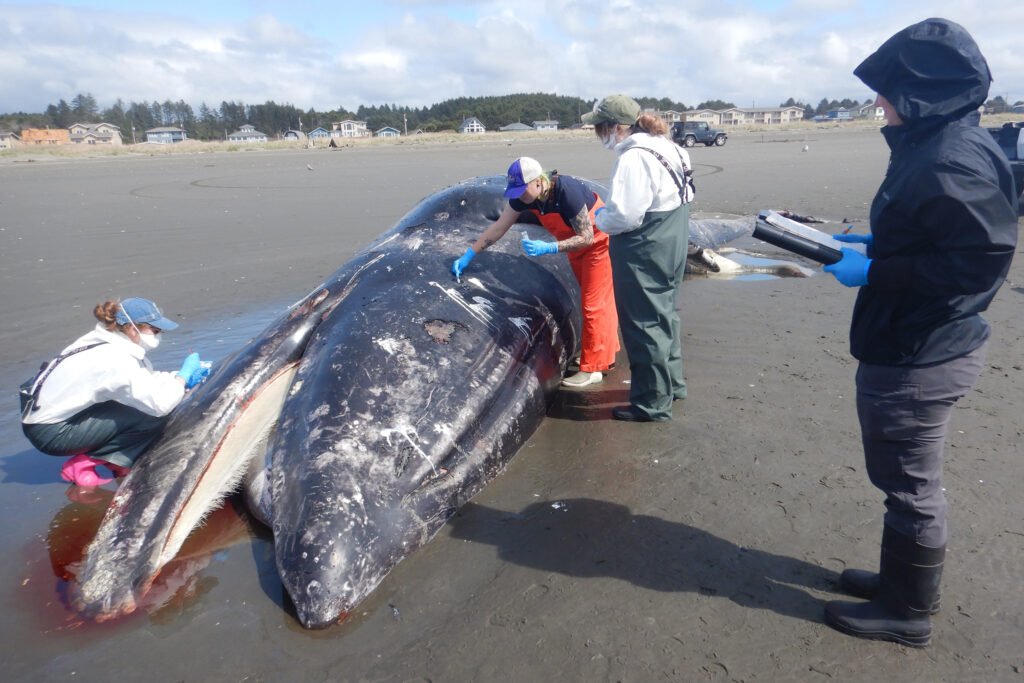
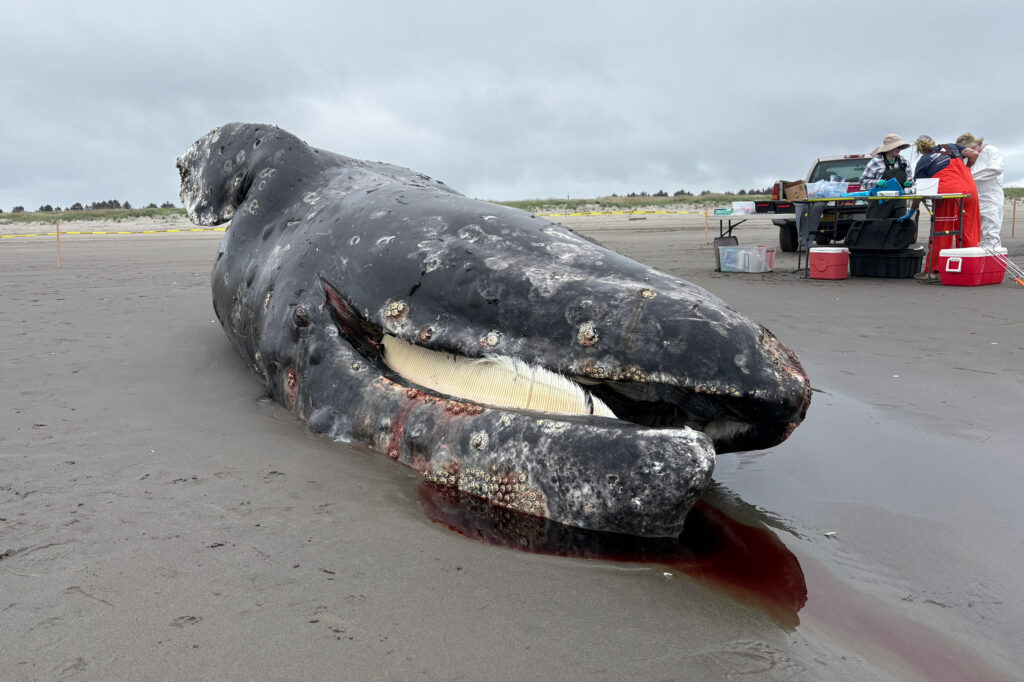
SEATTLE—Exceptionally skinny gray whales—enfeebled by starvation and mangled by blunt-force trauma—are washing up this spring along the coast of Washington state in numbers that alarm marine-mammal scientists.
Twenty-two carcasses have been found so far this spring, many of them battered by collisions with boats. Dead and dying on beaches, in harbors and up narrow rivers, they are grim evidence of what researchers say is a population and fertility collapse among gray whales that has been worsening for seven years and is driven by climate change in the rapidly warming Arctic.
A surge in malnutrition-related mortality has cut the eastern North Pacific population of gray whales in half, to about 13,000 last year from about 27,000 in 2016, while reducing calf births by 95 percent, according to counts by the National Oceanic and Atmospheric Administration. This whale stock is one of the most studied in the world, and scientists say the current population nosedive has lasted longer than previous cycles of decline monitored over the past 60 years.
“The population is in serious trouble, and this is not part of a normal cycle,” said John Calambokidis, a senior research biologist and co-founder of the Cascadia Research Collective in Washington state. He has been studying gray whales for 40 years. “What is so alarming is that desperate animals are dying at a really high rate and not having calves.”
From San Francisco Bay to the Oregon coast to Washington’s Puget Sound, the die-off has occurred all along the gray whale’s annual West Coast migration route. It’s a 10,000 to 14,000-mile round trip—the longest migration of any mammal—between the warm waters off Mexico’s Baja Peninsula, where gray whales give birth and nurse calves, and the Arctic, where they normally feast all summer on ocean-bottom crustaceans.
It’s in those traditional ocean-floor dining areas in the Bering and Chukchi seas where climate change appears to be triggering mass starvation among a whale stock that had, until recently, recovered nicely from the depredations of commercial whaling. (A genetically distinct and far less numerous stock of western North Pacific gray whales feeds off Sakhalin Island, Russia, and has long been classified as endangered.)
“These gray whales are evolution-specialized to feed on prey in those sea-floor sediments,” said Joshua D. Stewart, an assistant professor at Oregon State University’s Marine Mammal Institute. He’s the lead author of a 2023 research article in Science that links the decline of gray whales to climate change in the Arctic.
“The problem is that the quality of the prey that gray whales are finding in the sediment is declining,” Stewart said. “The fattest and most nutritious of the shrimp-like crustaceans that the whales eat are no longer as fat. A lot of things in those waters are changing all at once because of warming trends.”
Stewart and other researchers believe that a primary factor in the declining nutritional value of sea-floor prey is the early retreat of sea ice—triggered by climate change. Rapid melting substantially reduces the quantity of seasonal algae that grows under the ice. Those algae sink to the ocean floor as ice melts. If abundant, as they were before the Arctic began to warm, they provide crucial nutrients to the creatures that gray whales eat.
“The prey base is extremely sensitive to the warming Arctic and does not seem to be recovering,” said Stewart. “There is no reason to think this is not a response to climate change.”
Scientists say warmer water on the sea floor, together with stronger currents associated with climate change, are also making crustaceans in the sediment less viable as food for gray whales.
Data gathered by federal marine mammal experts supports these conclusions. But scientists at NOAA Fisheries—where major staff reductions have been ordered by the Trump administration—are reluctant to speak publicly about gray whale population collapse. It could require them to mention climate change, which Trump has called a scam.
When the Arctic feeding season ends, gray whales usually spend the next six to eight months fasting—as they migrate south. Mature gray whales are about 42 to 49 feet long, the length of a school bus. When well nourished, they weigh about 45 tons, roughly equivalent to six adult African elephants.
This story is funded by readers like you.
Our nonprofit newsroom provides award-winning climate coverage free of charge and advertising. We rely on donations from readers like you to keep going. Please donate now to support our work.
Powered by the blubber they can pack on, they swim 5,000 to 6,000 miles to sheltered lagoons off the Baja Peninsula, where they winter together and where females give birth and nurse their calves. Then, in the early spring, still relying on reserves of blubber, they start back toward the Arctic.
“They need to build up all the fat reserves they can,” said Stewart.
In the past seven years, as climate change increasingly deprives them of nutritious prey, many gray whales haven’t been able to get fat enough to endure their long trek or to participate in the energy-sapping business of breeding, gestating, giving birth and nursing calves. The annual number of calves has plunged in this period from 1,600 to 85, according to a NOAA count.
“If you put all this together, it is painting a really grim picture,” said Calambokidis, at Cascadia Research in Olympia.
He said this year’s pace of gray whale strandings in Washington is faster than in any previous year, adding that “since the population of these whales is substantially reduced, the proportion of death is already much greater than before.”
Even when severe malnutrition doesn’t kill gray whales outright, it drastically alters their behavior and diminishes their survival skills, Calambokidis said.
“You have levels of debilitation that are affecting their sense of navigation, their ability to avoid ship strikes, and they are more likely to get tangled up in fishing nets,” he said.
Increasing numbers of starving gray whales, he said, are “prioritizing feeding over going south to their birth waters.”
Some south-bound swimmers are turning left into Puget Sound, where they often try to use high tides to access prey in the intertidal zone around Whidbey and Camano islands.
About six gray whales, known as Sounders, have been making a success of this detour for decades. In recent years—as malnutrition has worsened—more and more stragglers have wandered into Puget Sound and attempted to join the Sounders.
A few find food, manage to avoid shipping lanes, and stay through spring, giving up on the long swim to Mexico.
Many others die.
About This Story
Perhaps you noticed: This story, like all the news we publish, is free to read. That’s because Inside Climate News is a 501c3 nonprofit organization. We do not charge a subscription fee, lock our news behind a paywall, or clutter our website with ads. We make our news on climate and the environment freely available to you and anyone who wants it.
That’s not all. We also share our news for free with scores of other media organizations around the country. Many of them can’t afford to do environmental journalism of their own. We’ve built bureaus from coast to coast to report local stories, collaborate with local newsrooms and co-publish articles so that this vital work is shared as widely as possible.
Two of us launched ICN in 2007. Six years later we earned a Pulitzer Prize for National Reporting, and now we run the oldest and largest dedicated climate newsroom in the nation. We tell the story in all its complexity. We hold polluters accountable. We expose environmental injustice. We debunk misinformation. We scrutinize solutions and inspire action.
Donations from readers like you fund every aspect of what we do. If you don’t already, will you support our ongoing work, our reporting on the biggest crisis facing our planet, and help us reach even more readers in more places?
Please take a moment to make a tax-deductible donation. Every one of them makes a difference.
Thank you,

Contributor
Blaine Harden, who writes about the Pacific Northwest for ICN, is the author of six books and was a longtime foreign correspondent for the Washington Post in Africa, Eastern Europe and Northeast Asia, as well as a national correspondent for the New York Times. Born in Moses Lake, Washington, he’s the son of a welder who worked on Grand Coulee Dam and the Hanford nuclear site. Two of Blaine’s books focus on the history of the Pacific Northwest, three are about North Korea, and one is about Africa. He lives in Seattle. His website is Blaineharden.com