

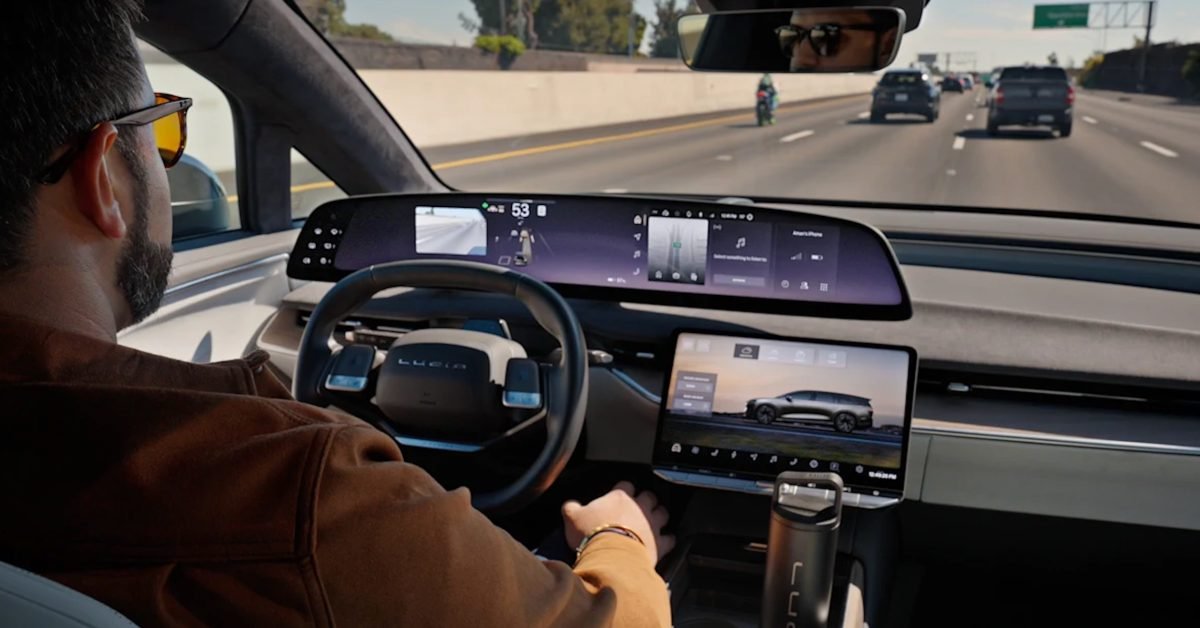
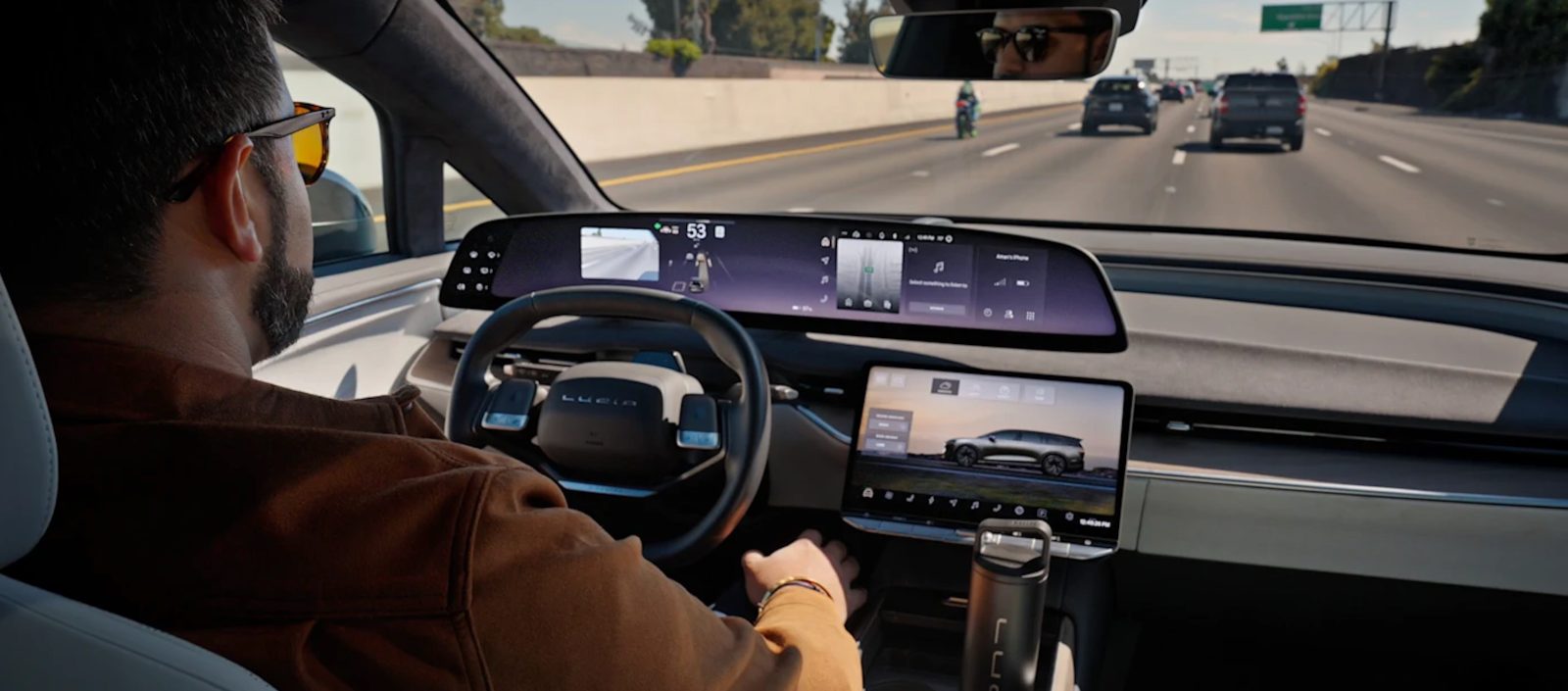
Lucid Group (NASDAQ: LCID) announced it has begun rolling out an over-the-air software update that brings hands-free highway driving to the Gravity SUV in North America.
Lucid first promised hands-free driving for its vehicles well over a year ago, but the feature’s actual rollout has been notoriously slow. The Gravity update arrives at a critical time for the EV startup, which is dealing with shareholder lawsuits, a new CEO, and a stock trading near all-time lows.
What’s in the update
The new Hands-Free Drive Assist feature handles steering, acceleration, and braking on compatible divided highways. It requires the DreamDrive 2 Pro package, a $6,750 option that includes LiDAR and a full sensor suite.
The system also includes Hands-Free Lane Change, which lets drivers initiate lane changes via the turn signal, and an Automatic Lane Change function that can independently execute passing maneuvers to overtake slower traffic. That last feature is notable — not all competing systems offer unprompted passing at launch.
Beyond the hands-free driving headline, the update packs several other upgrades. Adaptive Driving Beam maintains high beams while dynamically masking the section that would blind oncoming drivers. The Gravity’s navigation system now integrates Google Maps point-of-interest information, including reviews, photos, and business details.
There are also two features for the EV charging nerds. Advanced Preconditioning View displays the battery’s temperature relative to its optimal charging window, and Predictive Charging Power shows the expected peak DC fast-charging rate based on the vehicle’s current state and battery temperature. These are genuinely useful for road-tripping — knowing your projected charging speed before you pull into a station eliminates a common pain point.
How it compares to the competition
The Gravity’s hands-free system competes directly with GM’s Super Cruise, Ford’s BlueCruise, and Rivian’s Universal Hands-Free feature. Each takes a different approach to pricing.
Lucid charges a one-time $6,750 for DreamDrive 2 Pro, which is expensive upfront but includes LiDAR hardware and no ongoing subscription fees. Rivian’s Autonomy+ package costs $2,500 as a one-time purchase or $49.99 per month after a 60-day trial. GM and Ford have generally included their systems as standard or as part of trim-level packages.
Tesla’s Autopilot offers basic lane-centering and adaptive cruise at no extra cost, but its “Full Self-Driving” package — which includes lane changes and city street driving — cost $100 a month. Lucid’s system allows actual hands-free driving on supported highways with driver-monitoring cameras ensuring attention, which puts it in the same category as Super Cruise rather than Tesla’s system.
Lucid needs software wins right now
The timing of this update matters. Lucid is navigating a turbulent stretch. The company is aiming to build 25,000 to 27,000 vehicles in 2026, a significant ramp from last year, but its Gravity deliveries were disrupted for 29 days in Q1 due to a second-row seat supplier defect that triggered a 4,476-vehicle recall.
That disruption has led to shareholder class action lawsuits alleging that former executives concealed the supplier defect while publicly touting improved delivery capabilities. Lucid also recently completed a CEO transition to Silvio Napoli, and the stock has cratered to around $5 — down more than 90% from its 2021 SPAC peak near $58.
Meanwhile, Lucid cut 12% of its US workforce earlier this year to streamline operations ahead of its midsize Cosmos and Earth SUVs launching later this year and into 2027. Those midsize vehicles, starting under $50,000, are where Lucid plans to integrate NVIDIA’s autonomy stack for Level 4 self-driving — a far more ambitious play than today’s hands-free highway driving.
Electrek’s Take
This is a solid update for Gravity owners, and the hands-free driving and automatic lane change features bring Lucid’s SUV up to par with the best ADAS systems in the luxury EV segment on paper, but the system obviously needs to be tested. The charging transparency features, showing battery temperature and predicted charging speed, are the kind of practical details that actually make a difference on road trips, and we wish more automakers would do the same.
Lucid has been promising hands-free driving for a long time now, and the pace of delivery has been painfully slow. Gravity owners have been waiting for this feature since the SUV launched, and the long delay doesn’t inspire confidence for buyers being asked to pay $6,750 for DreamDrive 2 Pro.
Electrek is testing a Gravity right now (though we are returning it today so we can’t test this update). Stay tuned for the full review, but as a quick preview, it’s an incredible vehicle with some annoying software issues.
If you’re considering a Lucid or any new EV, powering your vehicle with home solar is one of the smartest ways to cut your fuel costs to near zero. With electricity rates climbing nearly 10% last year, home solar protects you against future rate increases. And with lease and PPA options, you can go solar with zero upfront cost and start saving immediately. If you want to find the best deal, check out EnergySage. It’s a free service with hundreds of pre-vetted installers competing for your business, so you save 20 to 30% compared to going it alone. No sales calls until you pick an installer. Get your free quotes here.


FTC: We use income earning auto affiliate links. More.