

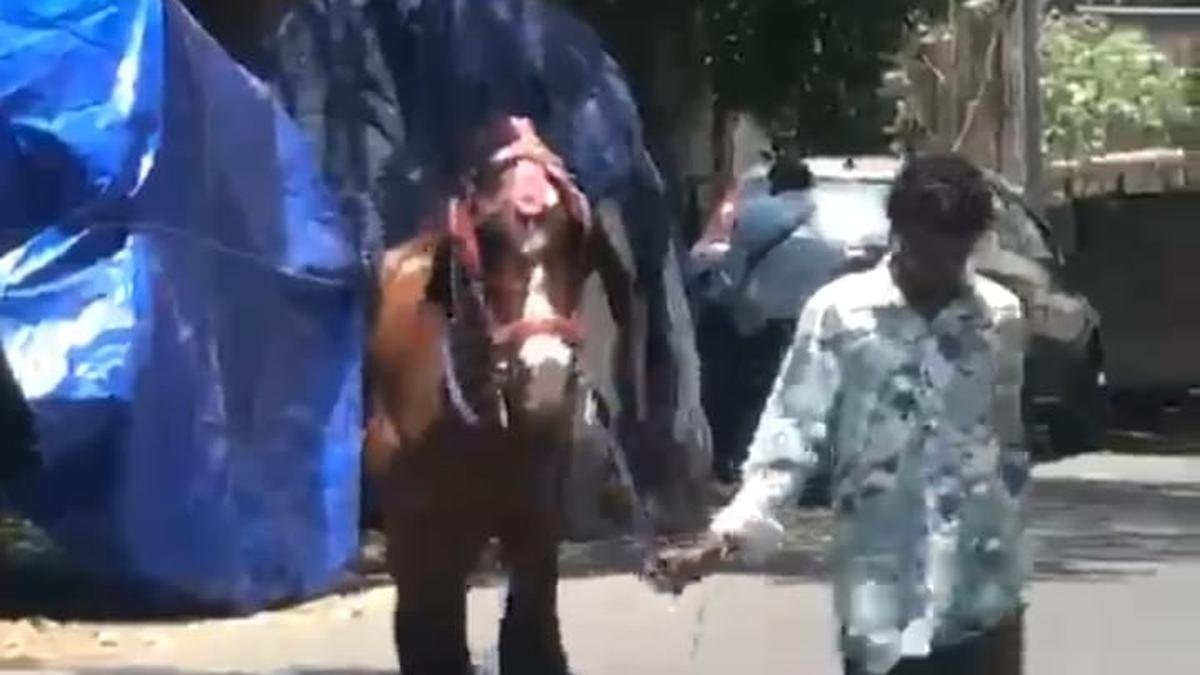

A screen grab of the horse that had exhibited multiple ulcerated cutaneous lesions and enlarged lymph nodes.
A horse used for joyrides in the city has died of glanders, a highly contagious and notifiable bacterial disease affecting equines.
The ICAR–National Research Centre on Equines (NRCE) — which confirmed the disease after testing a sample sent by the Besant Memorial Animal Dispensary (BMAD) — has written to the Tamil Nadu Animal Husbandry Department urging authorities to place the area under strict regulation and implement measures to prevent the disease from spreading to other horses.
Glanders is a contagious bacterial infection that spreads through direct contact or contaminated discharges such as pus and nasal and ocular secretions. It primarily affects horses, ponies, mules and donkeys, often causing severe respiratory illness, skin lesions and death.
Symptoms include fever, coughing, nasal discharge, enlarged lymph nodes, lung infections and ulcerated skin lesions, eventually progressing to respiratory distress and debilitation.
Josika Navukkarasu, Chief Veterinarian at BMAD, said the owner of the horse made a distress call after he noticed that it had weakened considerably.
“When I examined the horse, I found multiple ulcerated cutaneous lesions, enlarged lymph nodes and severe emaciation. We suspected glanders, especially since outbreaks have been reported in and around Karnataka, leading to restrictions on inter-State movement of horses,” she said.
Following this, the BMAD sent samples of the affected horse to the NRCE.
According to the communication from NRCE, the sample tested positive through ELISA, CFT, and qPCR tests. The NRCE advised the State to immediately isolate and monitor all equines housed with the infected horse, and recommended regular surveillance and testing in adjoining areas under the Prevention and Control of Infectious and Contagious Diseases in Animals Act, 2009.
P. Chockalingam, Chief Executive Officer of the Tamil Nadu Animal Welfare Board, said there were around 140 horses used for joyrides in the city and that samples from all of them must be collected and tested. He said the Board had written to the Animal Husbandry Department in this regard.
Containment protocols
S.P. Amrith, Director of Animal Husbandry and Veterinary Services, Tamil Nadu, said standard containment protocols were being followed since glanders is a zoonotic disease and has also been notified by the ICAR.
“Our teams are already on the ground. The Animal Disease Intelligence Unit and the Veterinary Epidemiology Centre are involved,” he said.
Mr. Amrith added that a similar case had been detected in Coimbatore over a month ago, following which the infected horse was culled as part of the standard response protocol.
Rapid response teams would be formed and movement of horses across border areas strictly regulated, he said.
Published – May 15, 2026 11:21 pm IST