

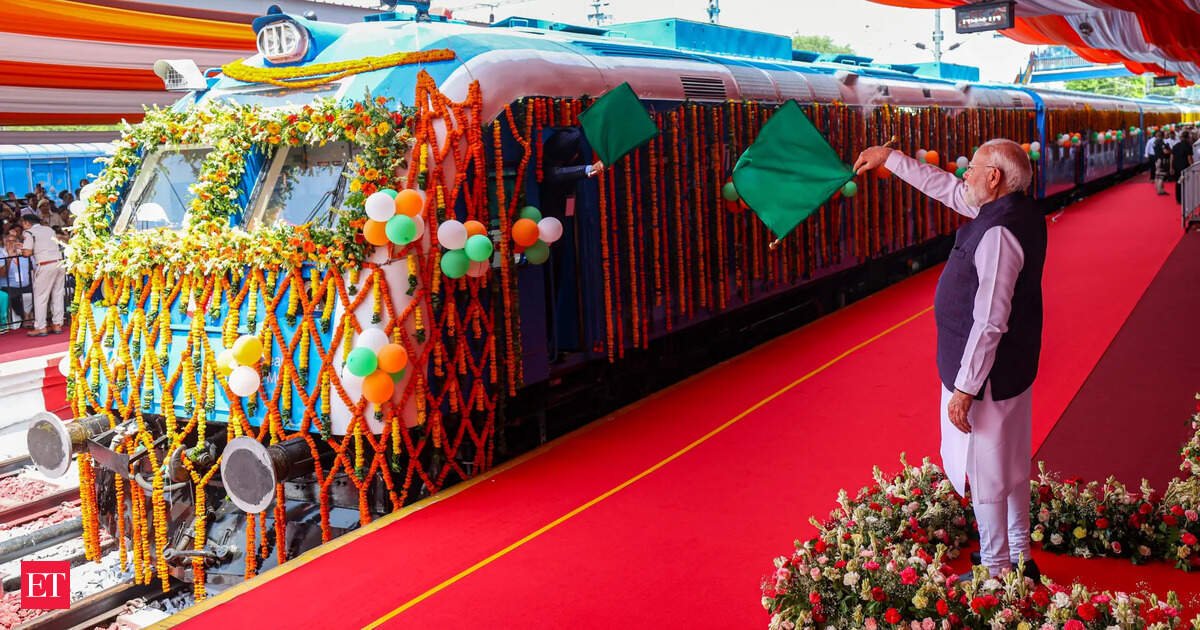
With this, India has joined a select group of countries with operational hydrogen-powered trains and marks an important step towards the adoption of clean and sustainable mobility in the railway sector.
In a statement on Friday, the company said it has supplied about 40 per cent of the total stainless steel requirement for India’s first hydrogen-powered train.
“The premium austenitic stainless steel grade X5CrNi1810, exclusively supplied by Jindal Stainless’ Jajpur and Hisar plants, has been used in the fabrication of the hydrogen train,” the country’s largest stainless steel player said.
Jindal Stainless Managing Director Abhyuday Jindal said the future of mobility will be defined by advanced materials that make these technologies more efficient, durable and sustainable.

The company said stainless steel has emerged as the preferred material for modern railway coaches owing to its unique combination of corrosion resistance, crash-worthiness, high strength-to-weight ratio, fire and impact resistance, durability, and recyclability.
Its lightweight properties also contribute to improved energy efficiency, making it particularly well-suited for emerging mobility solutions, such as hydrogen-powered trains, JSL said.The hydrogen-powered train connects the 89-km distance between Jind and Sonipat, which will be covered in two hours, with the train halting at 12 intermediate stations.
Jindal Stainless has been a supplier to Indian Railways for more than three decades, supplying stainless steel for several landmark projects, including the first LHB (Linke-Hofmann-Busch) coaches, the Vande Bharat Sleeper, and India’s first Vande Metro train, among other metro and inter-city train sets.